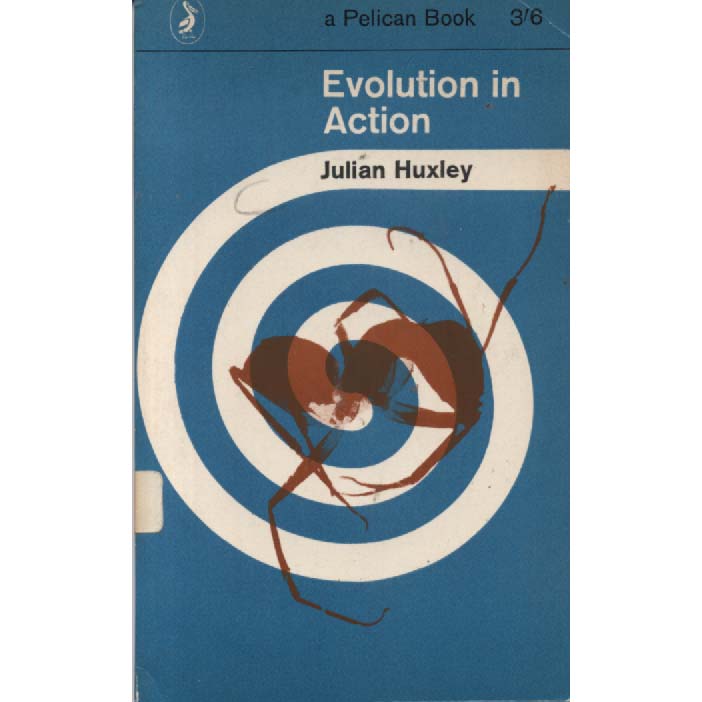
AI-assisted note, based on the text and a physical inspection of this copy.
“Evolution in Action” by Julian Huxley, published in 1963 by Pelican Books, is a fascinating yet flawed cultural object. The book attempts to delve into the intricacies of evolutionary biology, a subject that has sparked both fervent interest and heated debate. The cover design, typical for Pelican Books of the era, features bold typography and a simplistic, illustrative approach that aims to convey scientific ideas to the general public. The overall aesthetic is reminiscent of mid-20th century educational literature, appealing to a readership eager for enlightenment in an age marked by scientific discovery and optimism.
Huxley’s prose strikes a balance between accessibility and complexity, often making profound concepts digestible for those not specialised in the field. However, it is in this simplification that the book sometimes falters, leaving some essential details underexplored. The illustrations, while intended to clarify Huxley’s arguments, can occasionally feel dated and lack the nuanced detail that modern readers might expect. The paperback vibe of the book is indicative of the Pelican Books series, which sought to make knowledge available to a wider audience, a noble pursuit but one that can occasionally sacrifice depth for clarity.
Julian Huxley, the author of “Evolution in Action,” is a notable figure in the history of biology and a key proponent of the modern synthesis of evolutionary theory. Born into a prominent family in 1887, Huxley was not only a biologist but also a writer and a philosopher. He was involved in various scientific communities and served as the first Director-General of UNESCO. His works often straddle the lines between science and philosophy, reflecting his interest in the implications of evolutionary thought for human society. Despite his contributions, Huxley remains a somewhat ambiguous figure in contemporary discussions, overshadowed by his more famous brother Aldous Huxley, the author of “Brave New World.” This marginalisation may lead readers to view Julian as less relevant today, though his insights into evolutionary biology remain significant.
The year 1963 was a pivotal time in scientific and sociocultural contexts. The post-war era was marked by a burgeoning interest in science, spurred by advancements in technology and a growing public curiosity about the natural world. The Space Race was in full swing, and the implications of Darwinian thought were being reconsidered in light of new discoveries in genetics and ecology. Huxley’s work fits neatly within this zeitgeist, reflecting both the optimism of the age and the complexities of accepting evolution as a foundational principle of life. However, the book also bears the marks of its time, with certain outdated views on race and human behaviour that can provoke discomfort for modern readers. This tension between historical context and contemporary values is a recurring theme in examining works from this period.
While “Evolution in Action” is an engaging read, it suffers from the limitations inherent in attempting to encapsulate a vast and evolving scientific field within a single volume. Huxley’s exploratory style invites readers to ponder the implications of evolution beyond mere biological mechanics, yet it occasionally lacks the rigour that specialists might desire. The book serves as an introduction rather than a definitive guide, making it a somewhat superficial venture into a rich and nuanced subject. For those curious about evolutionary theory, it can stimulate thought but may leave some wanting more substantial engagement with the material.
In conclusion, “Evolution in Action” presents a unique snapshot of a specific moment in scientific literature, characterised by a blend of optimism and simplicity. Huxley’s attempt to popularise evolution remains commendable, even if the execution does not fully meet the expectations of a contemporary audience. The cultural artifacts from Pelican Books, including this one, provide valuable insights into the shifting landscapes of knowledge dissemination during the mid-20th century. For readers interested in the interplay of science and culture, “Evolution in Action” is worth exploring, particularly as a product of its time, even if it does not hold up against the rigorous standards of scientific discourse today. Crappy Old Books continues to offer a platform for reflecting on such works, reminding us of the complexities involved in engaging with our intellectual heritage.