AI-assisted note, based on the text and a physical inspection of this copy.
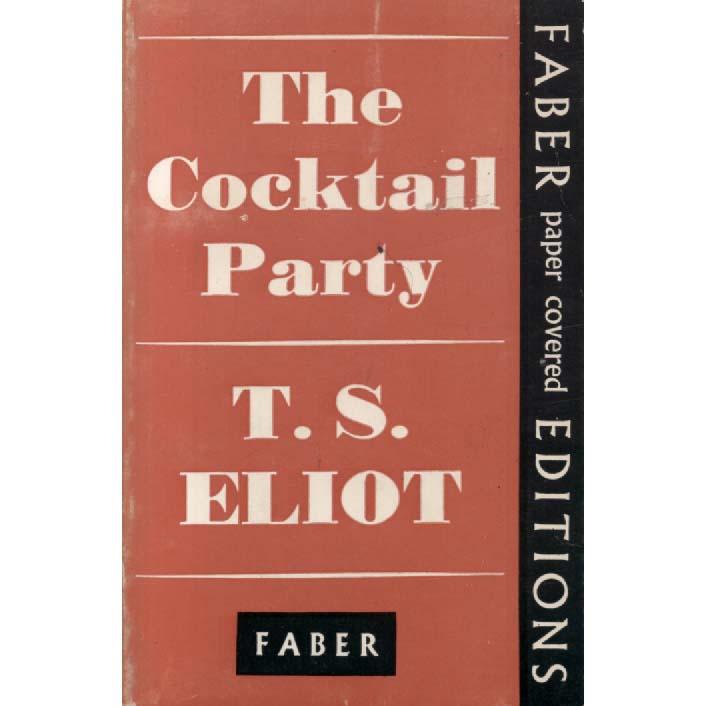
The Cocktail Party, penned by the illustrious T.S. Eliot and published in 1950 by Faber, is an intriguing specimen of mid-20th-century literature that embodies the complexities of social interactions and the existential dilemmas of its era. The cover design, typical of Faber's aesthetic during this period, features a minimalist yet elegant approach, often employing muted colours and clean lines that reflect the modernist sensibilities of the time. This particular edition, as with many of Eliot’s works, exudes a certain charm, the kind that could easily find a home on the bookshelves of both literary enthusiasts and casual readers alike. The paperback vibe, with its slightly worn texture, invites readers to explore the nuances of dialogue and character that Eliot so masterfully constructs throughout the play.
T.S. Eliot, born in 1888, is celebrated as a pivotal figure in modernist literature. His contributions extend beyond poetry into the realm of drama, and The Cocktail Party stands as a testament to his versatility. While Eliot is perhaps best known for his poems such as "The Waste Land" and "The Love Song of J. Alfred Prufrock," his foray into playwriting is not to be overlooked. The Cocktail Party, like much of his work, grapples with themes of identity, communication, and the human condition, providing insight into the social fabric of post-war Britain. Eliot’s stature in literary culture is undeniable, yet it is worth noting that his dramatic works often receive less attention than his poetry, which may be a reflection of the challenges faced by playwrights in the mid-20th century, particularly in the context of a rapidly evolving cultural landscape.
Published in a decade marked by significant social and political change, The Cocktail Party emerges from a world still reeling from the aftermath of World War II. The 1950s were a time of both optimism and disillusionment, as Britain sought to redefine its identity in a changing global context. The play’s setting—a cocktail party—serves as an apt microcosm for this era, encapsulating the tension between superficial social niceties and the deeper existential concerns of modern life. Eliot’s exploration of these themes resonates with a society grappling with the consequences of war, as well as the shifting dynamics of class and relationships in a post-war context. The interplay of wit, irony, and poignancy within the dialogue captures the essence of a generation seeking connection amidst uncertainty.
The Cocktail Party invites readers to engage with a variety of characters, each representing different facets of society. Eliot’s use of conversational exchanges not only reflects the complexities of human relationships but also serves as a critique of the social mores of the time. The play oscillates between humour and pathos, revealing the fragility of human connections in a world where individuals often mask their true selves behind societal expectations. This duality is particularly significant in the context of the 1950s, where traditional values were being challenged, and the search for authenticity became paramount. Eliot’s incisive dialogue and character development reveal a keen understanding of the subtleties of human interaction, making it a rich text for analysis and interpretation.
In terms of its place within the canon of theatre, The Cocktail Party is often overshadowed by Eliot's more iconic poetic works. However, it holds its own as a significant contribution to post-war drama, showcasing Eliot’s ability to blend philosophical introspection with theatrical flair. The play has been both celebrated and critiqued, and its reception reflects the evolving tastes of audiences and critics alike. While some may argue that Eliot's style can be dense or inaccessible, others appreciate the depth and intricacy of his writing, which invites repeated readings and thoughtful reflection.
The author’s engagement with the theatrical form might suggest a desire to explore new dimensions of expression beyond poetry, yet there remains a certain obscurity surrounding his dramatic output compared to his more widely recognised poetic achievements. Speculation abounds regarding the impact of Eliot’s literary legacy on contemporary playwrights, yet it is clear that his contributions to the theatrical landscape remain significant, albeit less frequently revisited in academic discourse. The Cocktail Party serves as a poignant reminder of this aspect of Eliot's oeuvre, revealing the depths of his insight into the human experience.
In conclusion, The Cocktail Party is a compelling exploration of social interaction and the complexities of human relationships, set against the backdrop of post-war Britain. Eliot’s skillful manipulation of dialogue and characterisation invites readers to reflect on their own experiences of connection and isolation. As a cultural object, it stands as a testament to the nuanced interplay between literature and the societal concerns of its time. Crappy Old Books provides an opportunity to revisit this gem, inviting a new generation of readers to engage with Eliot’s exploration of the human condition through the lens of a seemingly simple social gathering.