AI-assisted note, based on the text and a physical inspection of this copy.
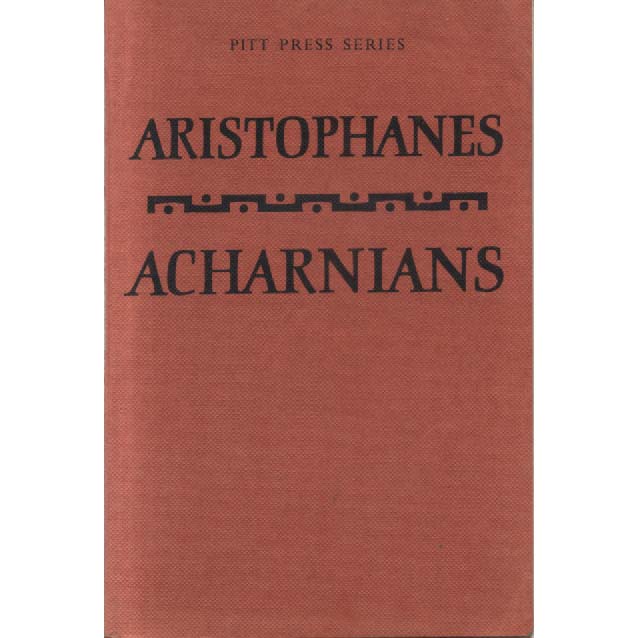
The 1967 edition of Acharnians by Aristophanes, published by The Syndicates of the Cambridge University Press, is a curious artefact that sits at the intersection of ancient theatre and mid-20th-century academic publishing. The cover design, which features a simple yet striking illustration, reflects the era's aesthetic of clean lines and a somewhat austere approach to visual representation. The choice of typography is both utilitarian and scholarly, suggesting that this publication is intended for those who seek to engage deeply with the text rather than merely skim its surface. The paperback vibe invites casual handling, which might be both a blessing and a curse, as the delicate binding often succumbs to the wear and tear of enthusiastic readers.
Aristophanes, the playwright behind Acharnians, is a towering figure in the canon of ancient Greek literature. Born around 446 BCE, he is celebrated as one of the earliest masters of comedy, known for his sharp wit and incisive political commentary. His works often satirise contemporary Athenian society, providing a window into the cultural and social mores of his time. However, Aristophanes himself remains somewhat enigmatic; while his plays have survived the ravages of time, detailed biographical accounts are scarce. This lack of concrete information about his life may lead some to speculate about the personal experiences that shaped his writing, but it is clear that his legacy endures through the vibrant, often irreverent lens he offers on ancient life.
The year 1967 was a time of significant cultural and political upheaval, particularly in the Western world. The counterculture movement was gaining momentum, challenging traditional norms and advocating for social change. In this context, the publication of Acharnians can be viewed as a bridge between the ancient and the modern, inviting readers to reflect on the timelessness of human concerns—war, peace, and the absurdity of socio-political life. The play itself, which revolves around the protagonist Dikaiopolis seeking peace during the Peloponnesian War, resonates with contemporary audiences who might find parallels with their own struggles for resolution amidst conflict.
As for the play itself, Acharnians is a remarkable blend of humour and profound critique, showcasing Aristophanes' unique ability to blend the absurd with the poignant. The narrative unfolds through a series of comedic escapades that challenge the norms of Athenian society, particularly the glorification of war. Aristophanes' characters are unapologetically flawed, yet their struggles resonate with humanity, making the work relatable across centuries. The 1967 edition does a commendable job of preserving the original text while offering insights through footnotes and commentary, although some readers may find the academic framing a bit heavy-handed for a play that thrives on lightness and spontaneity.
In terms of print culture, this edition sits within a notable tradition of scholarly publishing that seeks to elevate classical texts for modern readers. The Syndicates of the Cambridge University Press, known for their rigorous academic standards, has made a significant contribution to the accessibility of Aristophanes' work in the English-speaking world. Their commitment to preserving the integrity of the original language while providing a platform for scholarly discourse is commendable, yet it also raises questions about the balance between accessibility and academic rigor. One might argue that the very nature of comedy, especially in Aristophanes' hands, is to be lively and engaging, which can sometimes be dulled by too much scholarly apparatus.
Moreover, the typeface used in this edition is a rather nondescript serif, which, while quite legible, does little to evoke the rich theatrical tradition from which the text emerges. A more dynamic choice might have enhanced the reader's experience, inviting them into the comedic world of Ancient Greece with a sense of urgency and excitement. The lack of illustrations or any visual embellishments also detracts from the overall aesthetic experience. In a world where graphic design plays an increasingly crucial role in engaging readers, this edition feels somewhat utilitarian, prioritising content over form.
Ultimately, Acharnians serves as both a cultural artifact and a literary work that invites reflection on the cyclical nature of human conflict and the perennial quest for peace. The 1967 edition encapsulates a moment in time when the academic community sought to reconcile ancient wisdom with modern sensibilities. While it may not be the most visually stimulating version available, it offers a robust engagement with Aristophanes' work that is invaluable for those looking to delve into the nuances of classical comedy.
In conclusion, Acharnians remains a significant piece of literature that continues to resonate, and this particular edition from Crappy Old Books offers a window into both the ancient world and the scholarly approaches of the late 20th century. Whether you're a student of drama, a lover of history, or simply curious about the complexities of human nature, this play—and its accompanying commentary—provides ample food for thought.