AI-assisted note, based on the text and a physical inspection of this copy.
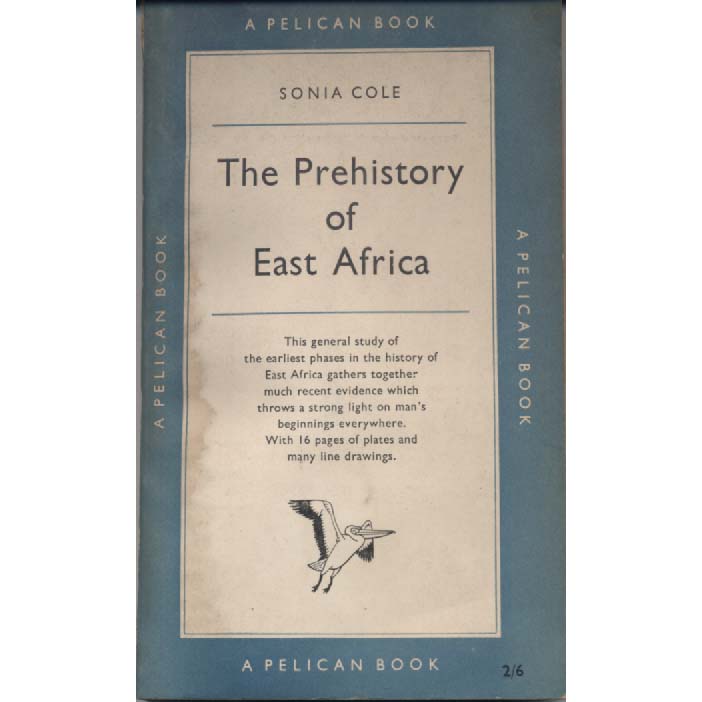
"The Prehistory of East Africa," authored by Sonia Cole and published in 1954 by Pelican Books, presents itself as an intriguing cultural artifact from a mid-20th century intellectual landscape. The book serves as a bridge between popular science and academic discourse, aimed at a readership eager to understand the ancient legacies of East Africa. Its cover design, typical of the Pelican series, features a simple yet striking illustration that hints at the contents within—an amalgamation of history and anthropology, draped in the muted colours characteristic of the era. The paperback format is emblematic of the 1950s publishing trend, where affordability and accessibility were paramount, allowing a wider audience to engage with scholarly topics that might otherwise remain confined to academic circles.
As one delves into the pages of this work, the reader is confronted with a narrative that attempts to weave together archaeological findings, anthropological insights, and historical context. Cole's writing is both informative and approachable, reflecting a time when educational literature sought to enlighten the masses. The prose is imbued with a sense of optimism about the discoveries being made in East Africa, a region that was starting to receive increased attention in the post-war era. This optimism is palpable, as Cole navigates through the complexities of human evolution and migration, presenting theories that were cutting-edge for her time. The book is richly illustrated, with maps and photographs that complement the text, further enhancing its appeal to both the layperson and the scholar.
Sonia Cole appears to be a somewhat obscure figure within the literary and academic landscape. There is limited documentation about her life and career, which suggests that she may not have achieved widespread recognition beyond the niche audience of her specific field. This obscurity raises questions about her influence and the reception of her work within the broader context of 20th-century anthropology and archaeology. It is important to note that while "The Prehistory of East Africa" may not have catapulted her into the limelight, it remains a testament to the contributions of women in the sciences during a period when female voices were often marginalised. Cole's work can be viewed as a stepping stone in the ongoing dialogue about human history, even if her name does not resonate loudly in the annals of literary fame.
The year 1954 is significant in terms of cultural context, as it fell within a decade marked by a burgeoning interest in Africa—both as a continent rich in history and as a focus of geopolitical interest in the wake of decolonisation movements. The post-war world was eager to reinterpret its understanding of history, especially regarding regions that had been previously overlooked or misrepresented in Western narratives. In this light, Cole’s book serves not only as an academic work but also as a cultural commentary, reflecting the zeitgeist of the 1950s. It embodies a shift towards a more inclusive understanding of history that encompassed diverse narratives, an aspiration that aligns with the progressive ideals of the time. The book can thus be seen as part of a broader movement to democratise knowledge, making the ancient past of East Africa accessible to a wider audience.
In terms of print culture, "The Prehistory of East Africa" exists within the Pelican Books series, which was known for producing affordable yet intellectually enriching literature. The series played a crucial role in popularising scholarly works, making them available to a general audience. This particular book, with its blend of scholarly rigor and readability, exemplifies the ethos of Pelican Books, which sought to educate and engage the public. The physicality of the paperback—its size, design, and texture—also reflects a time when readers valued the tactile experience of books, embracing their portability and the ability to annotate and interact with the text. In a world increasingly dominated by digital media, there is a nostalgic charm to holding such a book, one that evokes the spirit of inquiry that defined an era.
In conclusion, "The Prehistory of East Africa" by Sonia Cole stands as a noteworthy cultural object, not just for its content but for what it represents within the context of its time. While Cole may not be a household name, her contributions to the understanding of East African history during a pivotal moment in publishing history cannot be overlooked. The book serves as a reminder of the importance of making knowledge accessible and of the role that women have played in the sciences, even when their contributions have been overshadowed. Crappy Old Books appreciates such works, not just for their literary value but for the cultural narratives they encapsulate, inviting readers to delve into a past that continues to shape our understanding of the present.