AI-assisted note, based on the text and a physical inspection of this copy.
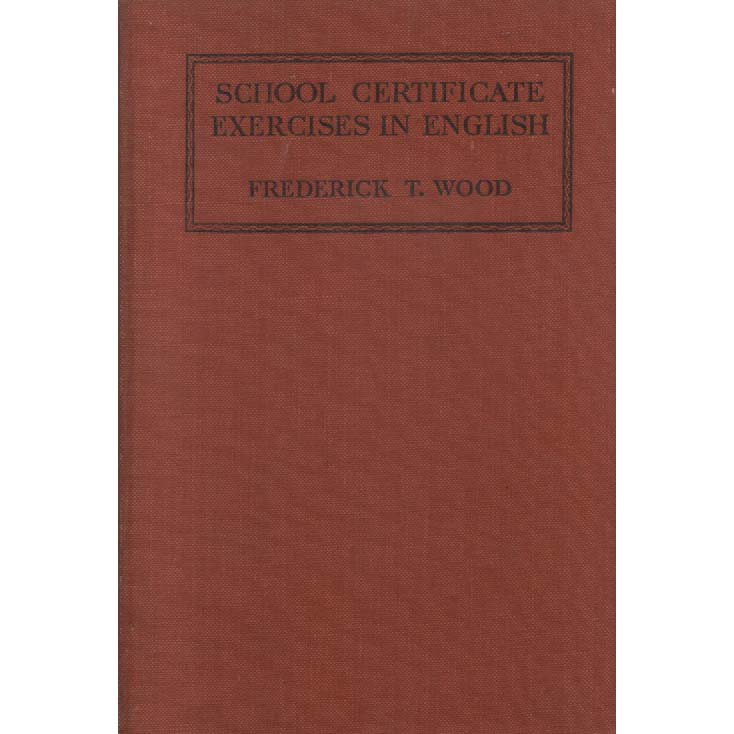
The book titled School Certificate Exercises in English by Frederick T. Wood, first published in 1955 by MacMillan, stands as a peculiar relic of educational literature from mid-20th century Britain. Its cover design, a stark yet functional illustration typical of the era, features muted colours and a no-nonsense font that embodies the utilitarian spirit of educational texts from that time. The paperback format feels deceptively lightweight, yet the content inside reveals a weighty commitment to the rigours of English language study. The overall aesthetic suggests a time when textbooks were designed for maximum utility rather than visual appeal, a trend that still resonates in many educational materials today.
Frederick T. Wood appears to occupy a somewhat obscure spot in the literary landscape. While there may not be extensive biographical information available about him, he is often associated with educational publishing, especially regarding English language instruction. His works suggest a dedication to helping students navigate the complexities of English grammar and composition, a vital skill set during an era when formal education was increasingly emphasised in post-war Britain. Wood's contributions, though perhaps not groundbreaking, reflect a broader commitment to educational standards that defined the teaching of English during his time.
Published in 1955, School Certificate Exercises in English emerges from a post-war Britain grappling with the consequences of the Second World War and the necessity for a well-educated populace. The mid-1950s were marked by a commitment to rebuilding and reshaping society, and education became a pivotal area of focus. This period saw the introduction of the School Certificate, a standardised exam aimed at assessing the knowledge and skills of secondary school students. Therefore, Wood’s exercises can be seen as a direct response to the educational reforms and societal expectations of the time, preparing students for a world that demanded both proficiency in English and critical thinking skills.
The content of the book itself is a curious blend of practical exercises and theoretical insights, designed to reinforce the foundations of English language competency. Each section methodically addresses different aspects of English, from grammar to comprehension, encouraging students to engage deeply with the material. The exercises, although possibly outdated in pedagogical approach, speak to an era where rote learning and rigorous practice were seen as essential to mastering the language. The tone of the writing is stern, reflecting the educational philosophies of the 1950s, which often prioritised discipline and structure over creativity and personal expression.
As one flips through the pages, the print culture of the time becomes evident. The book features a traditional layout with small text and minimal illustrations, characteristic of educational texts that aimed to maximise information delivery rather than aesthetic enjoyment. The absence of colour illustrations or modern design elements serves to reinforce the notion that this book was intended for serious study rather than casual reading. The paper itself has a distinctly worn texture, hinting at its age and the many hands it has passed through, each contributing to its patina of history.
Furthermore, the book is filled with numerous exercises that provide a glimpse into the educational standards of the time. These range from sentence construction and punctuation to comprehension questions based on selected texts. While many of these exercises may seem simplistic or even tedious by today’s standards, they serve as a reminder of the foundational skills that were deemed essential for students entering an increasingly complex world. The emphasis on clarity and correctness in language use mirrors the broader societal value placed on communication during this era.
As one contemplates the cultural significance of School Certificate Exercises in English, it becomes apparent that it is more than just an instructional manual. It is a snapshot of a specific moment in educational history, reflecting the values and priorities of a society that was keenly aware of the importance of language proficiency. The book encapsulates a time when the English language was not merely a tool for communication but a crucial component of personal and professional development.
The educational landscape has undoubtedly evolved since the publication of this book, with contemporary approaches favouring more interactive and student-centred learning models. Yet, the legacy of texts like Wood’s remains significant, serving as a testament to the enduring importance of language education. They provide insight into how educational philosophies have shifted over the decades, showing us what was once considered essential in the study of English.
In conclusion, School Certificate Exercises in English by Frederick T. Wood is more than just an outdated educational text; it is a cultural object that reflects the educational values and societal norms of the 1950s. It stands as a reminder of the rigorous standards of the time and the importance placed on mastering the English language. As we sift through the pages of this book, we grasp not only the evolution of language education but also the broader narrative of a society striving for improvement through the power of knowledge. For those interested in the history of educational materials, Crappy Old Books offers a unique opportunity to explore such relics from the past, preserving the insights they provide into our educational heritage.