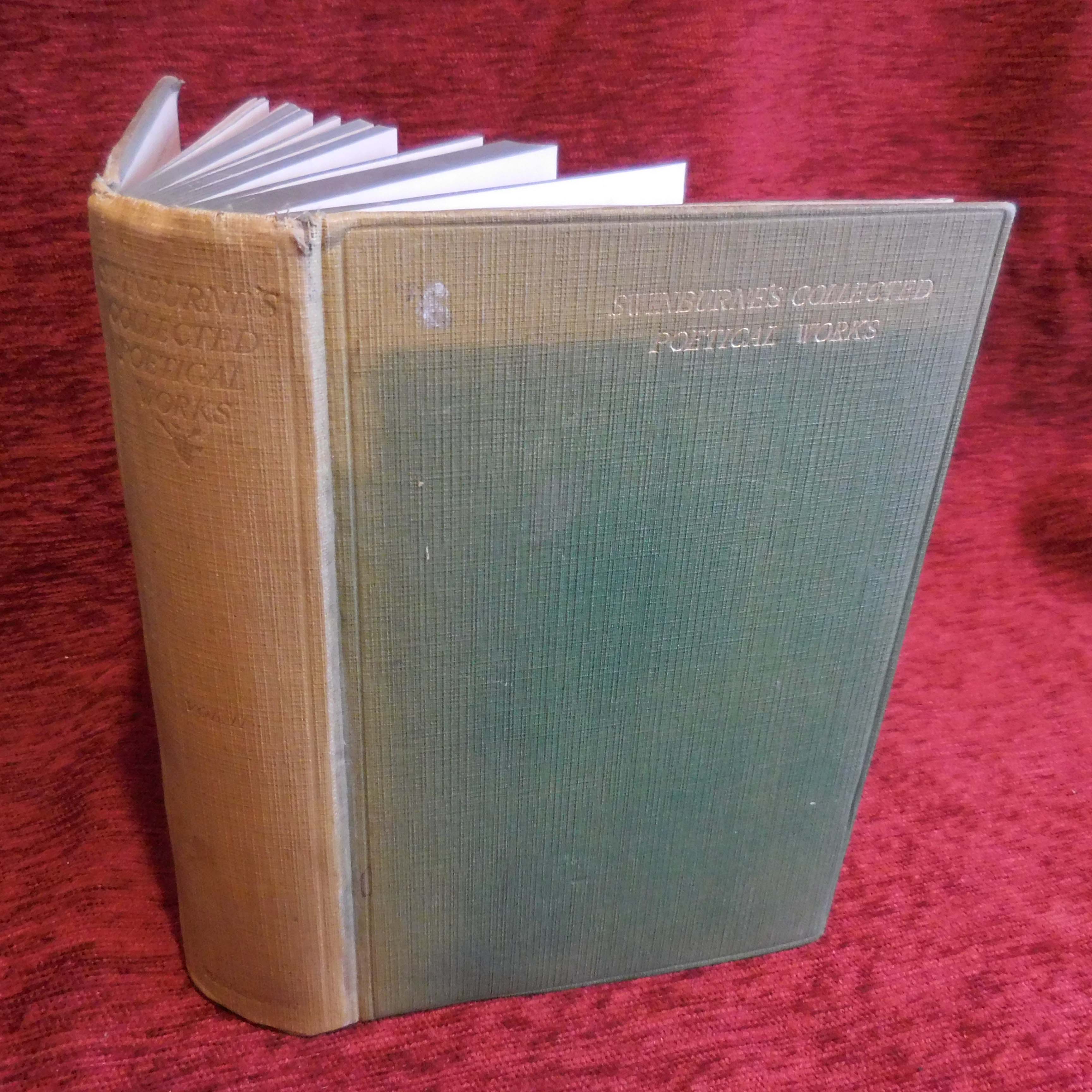
AI-assisted note, based on the text and a physical inspection of this copy.
Swinburne's Collected Poetical Works Vol II is a book that encapsulates the rich tapestry of late 19th-century poetry, preserved in the form of a 1924 reissue by the esteemed publisher William Heinemann. The tome is a striking representation of its era, featuring a cover design that is both ornate and somewhat austere, evoking the gravitas associated with Swinburne's literary reputation. The dark green cloth binding, embossed with gold lettering, suggests the kind of quality that was typical of the period’s literary publications, aimed at an audience that valued not just the content but the physicality of the book as a cultural artifact. The paper displays the characteristic yellowing that comes with age, adding a certain nostalgia for the reader, as if holding a piece of literary history in their hands.
In considering the author, Algernon Charles Swinburne is a well-known figure in the Victorian literary landscape, celebrated for his innovative use of meter and his often controversial themes. Born in 1837, Swinburne was a contemporary of other literary giants such as Dante Gabriel Rossetti and Oscar Wilde, yet he often stood apart due to his unique voice and stylistic audacity. He was a prolific writer, delving into poetry, plays, and criticism, and is remembered for his explorations of topics such as sexuality, death, and the divine. His reputation was not without its critics; he was both lauded and reviled, which perhaps adds to the intrigue surrounding his works. In the case of Collected Poetical Works Vol II, it serves as a testament to his enduring literary significance, although his standing has fluctuated over the decades. Today, while perhaps not as widely read as some of his contemporaries, Swinburne remains a pivotal figure for those interested in the evolution of English poetry.
The year 1924 was a time of considerable cultural shifts, marked by the aftermath of World War I and the burgeoning modernist movements. Literature was beginning to reflect the disillusionment and complexity of a post-war society, leading to the rise of various avant-garde movements. However, Swinburne's works, collected here, hark back to the Romantic and Pre-Raphaelite influences of the previous century, making this volume a curious juxtaposition against the backdrop of a rapidly changing literary landscape. The reissue by William Heinemann can be seen as an attempt to preserve and celebrate the past against the tide of modernity, presenting Swinburne's poetry as a cornerstone of English literary heritage, even as new voices began to emerge.
Upon opening the pages of Collected Poetical Works Vol II, readers are greeted with a multitude of lyrical styles and emotional depths. Swinburne’s fascination with nature, mythology, and the human experience is evident throughout the collection, showcasing his penchant for lush imagery and rhythmic experimentation. The poems range from the deeply personal to the grandiose, often intertwining themes of love and loss with a sense of existential inquiry. However, the density of some of his language can be daunting for contemporary readers, who might find themselves struggling to fully engage with the text. The book's layout, while respectful of its heritage, occasionally suffers from a lack of clarity, making it challenging to navigate through the extensive collection without losing the thread of the poet’s intention.
In terms of print culture, this edition stands as a representation of a specific moment in the history of book publishing, where the physicality of the book was still paramount. The quality of the print, the typeface used, and the overall craftsmanship of the binding contribute to an appreciation of the book as an object—an artefact of its time. Collectors and bibliophiles may find value not only in the contents but also in the tactile experience of handling a well-crafted volume from the early 20th century. It serves as a reminder of a time when books were often cherished possessions, reflecting the aspirations and tastes of their owners.
Ultimately, Swinburne's Collected Poetical Works Vol II encapsulates a particular historical and cultural moment, offering readers a doorway into the complexities of Swinburne's poetic universe. While some may find the language archaic or the themes less resonant with contemporary sensibilities, there is an undeniable beauty in the way Swinburne captures the human experience through his art. As a cultural object, it invites reflection not only on its contents but on the evolving nature of poetry and its role in society over the decades.
In conclusion, this volume represents a significant piece of literary history, preserved within the pages of Crappy Old Books. It invites both admiration and contemplation, serving as a testament to the enduring legacy of one of Victorian poetry's most intriguing figures.