AI-assisted note, based on the text and a physical inspection of this copy.
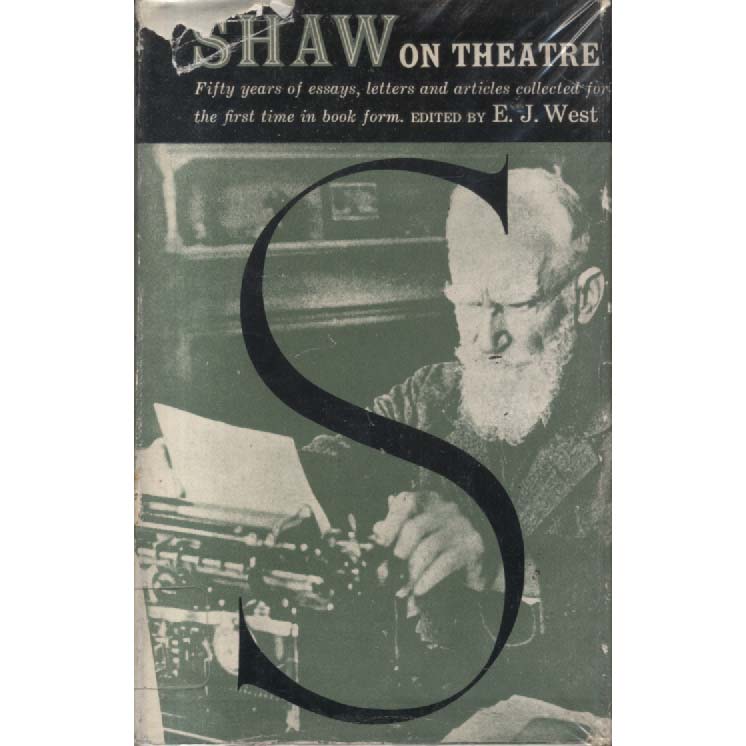
“Shaw On Theatre” by EJ West, published in 1958 by MacGibbon and Kee, is a curious relic from a time when theatre criticism was steeped in both reverence and rigorous analysis. This paperback edition, with its faded cover and slightly dog-eared pages, embodies the aesthetic of mid-20th century publishing. The cover design, featuring a somewhat uninspired graphic layout typical of the era, suggests an attempt to invoke the gravitas of George Bernard Shaw, whose work is critically examined within. The size and texture of the book contribute to that nostalgic paperback vibe, making it an artefact of its time, suitable for both theatre aficionados and casual readers intrigued by the interplay of drama and critique.
At first glance, the title suggests an exhaustive exploration of Shaw’s theatrical philosophy, but the book is more of a curated collection of thoughts and analyses rather than a comprehensive scholarly work. The text navigates through Shaw's significant contributions to theatre, touching upon his critiques of contemporary practices and the societal implications of his work. While the prose occasionally meanders into verbose territory—a hallmark of the period—the insights provided are nevertheless thought-provoking, evoking a sense of appreciation for the complexities of Shaw's theatrical vision. The book serves as both an introductory guide for newcomers and a reflective piece for those already versed in Shaw's oeuvre.
Author EJ West remains an elusive figure in literary history, with scant documentation available regarding his life or career. There are no widely known biographical facts to anchor his contributions, which leaves readers to wonder about his background and motivations. This lack of information contributes to a sense of obscurity that surrounds West, making it difficult to assess his influence within the broader context of theatre criticism or literary culture. His apparent anonymity may suggest that he was perhaps more a chronicler of Shaw's work rather than a prominent voice in theatre itself. The absence of records or notable accolades raises questions about how his perspectives were received in the literary community during his time.
Published in 1958, “Shaw On Theatre” emerges from a post-war cultural landscape that was both reflective and experimental. The 1950s in Britain were marked by a revival of interest in the arts, as society grappled with the remnants of war and the changing social fabric. This era witnessed the emergence of new theatrical forms and the questioning of traditional narratives, making Shaw's incisive critiques particularly relevant. West's exploration of Shaw's work aligns with the zeitgeist of the time, where theatre was seen as a crucible for social change and an examination of human behaviour. The book encapsulates the spirit of the age, capturing the tension between the established norms of theatre and the burgeoning desire for innovation.
The cultural object that is “Shaw On Theatre” serves as a time capsule, revealing both the reverence for Shaw's work and the struggles of a critic to articulate its significance in a rapidly changing world. The book is a reflection not only of Shaw's enduring legacy but also of the critical landscape of the 1950s. Readers may find themselves drawn into West's analysis, even if the text occasionally falters under the weight of its ambitions. The cultural context in which it was written enhances its value, allowing modern readers to appreciate the evolving discourse surrounding theatre and its societal roles.
In conclusion, “Shaw On Theatre” by EJ West stands as a fascinating, albeit flawed, contribution to the discourse on theatre criticism. While the author's obscurity may cast a shadow over the book's legacy, its insights into Shaw's work and the historical context in which it was published offer a valuable perspective. For those interested in the convergence of theatre and cultural criticism, this book, found among the shelves of Crappy Old Books, is an intriguing addition that invites contemplation and discussion.