AI-assisted note, based on the text and a physical inspection of this copy.
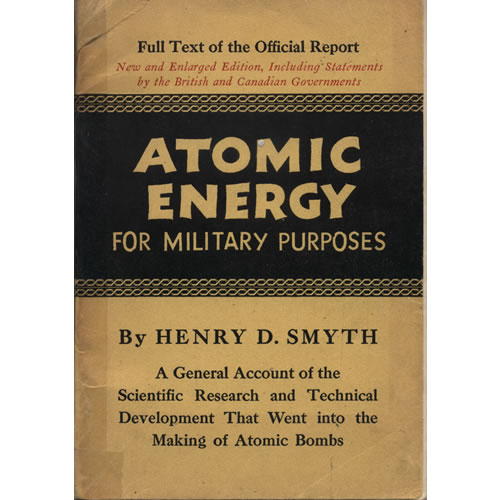
“Atomic Energy for Military Purposes” by Henry D. Smith stands as a significant cultural artifact from the post-World War II era, capturing the zeitgeist of a world grappling with the dawn of the nuclear age. The book, published in 1946 by Princeton University Press, is a stark reflection of the anxieties and ambitions of a society that had just witnessed the devastating effects of atomic bombs in Hiroshima and Nagasaki. Its cover design, typical of the period and reminiscent of government reports, features a sober palette that communicates seriousness and gravitas, perhaps aiming to lend an air of authority to its contents. The paperback edition possesses that unmistakable 'old book' vibe, with its slightly yellowed pages and faint smell of must, inviting readers to delve into a time when the theories of atomic energy were both marvelled at and feared.
Henry D. Smith appears to be a relatively obscure figure within the realm of publishing history, with limited biographical details available. His work on this book suggests a deep engagement with the scientific and military implications of nuclear energy, but beyond this publication, there is scant evidence of his literary output or academic contributions. This obscurity may stem from the complex nature of post-war intellectual discourse, where many voices have been overshadowed by more prominent figures in the fields of science and military studies. Therefore, it is difficult to ascertain his influence or standing within the wider literary culture of his time.
First published in 1946, this book emerged in a period marked by rapid technological advancement and profound societal change. The end of World War II brought not only a sense of relief but also an ominous awareness of the potential for destruction inherent in atomic energy. The United States had become the first nation to harness nuclear power for military use, and this was a time when the implications of such power were beginning to be explored in earnest. The Cold War was just on the horizon, and the discourse around nuclear energy had started to shift from a focus on scientific marvel to a more complex conversation about ethics, safety, and the potential for global annihilation. Smith’s work, therefore, provides insight into this transitional period, encapsulating a moment when the world was both fascinated and terrified by the atomic age.
The text itself is a mixture of technical exposition and military analysis, designed to inform policymakers and military officials about the potential applications of atomic energy. Smith discusses the scientific principles underlying nuclear fission, the processes involved in creating atomic bombs, and the strategic military implications of these developments. His writing is dense and at times esoteric, reflecting the scientific complexities of the subject matter, which could be daunting for the average reader. The book serves not only as a technical manual but also as a historical document, offering a snapshot of the militaristic mindset of the time.
Much of the writing style is indicative of mid-20th century technical literature, where clarity is often sacrificed for the sake of precision. The language is formal and laden with jargon, which may alienate casual readers but serves as a testament to the era’s academic rigour. It’s interesting to note how the text straddles two worlds: one of scientific discovery and the other of military strategy, highlighting the tension between innovation and its potential for destruction. The book might not be particularly engaging for those looking for narrative flair, but it is a crucial piece for understanding the historical context of nuclear energy and its military applications.
As with many books of its time, “Atomic Energy for Military Purposes” reflects a moment when the world was beginning to grapple with the moral implications of scientific advancement. It raises questions about responsibility, the dual-use nature of technology, and the ethical considerations that must accompany such powerful discoveries. These themes resonate even today as society continues to navigate the complexities of scientific progress and its potential consequences. The book serves as a reminder of the fine line between innovation and catastrophe, a line that remains as relevant now as it was in the mid-20th century.
In conclusion, “Atomic Energy for Military Purposes” by Henry D. Smith is a vital cultural object that encapsulates the anxieties and realities of a world on the brink of the nuclear age. Its publication in 1946 positions it at a pivotal moment in history, and while the author himself remains somewhat obscure, the book offers critical insights into the military and scientific discussions of the time. For those interested in the complexities of nuclear energy and its implications, this text provides a foundational understanding, albeit through a lens that may seem dense to modern readers. As we continue to engage with the cultural narratives surrounding nuclear technology, Smith’s work serves as a crucial reference point, reminding us of the historical context from which these discussions emerged. Crappy Old Books invites readers to explore such significant yet often overlooked texts, providing a window into the past that remains relevant in today’s discourse.