AI-assisted note, based on the text and a physical inspection of this copy.
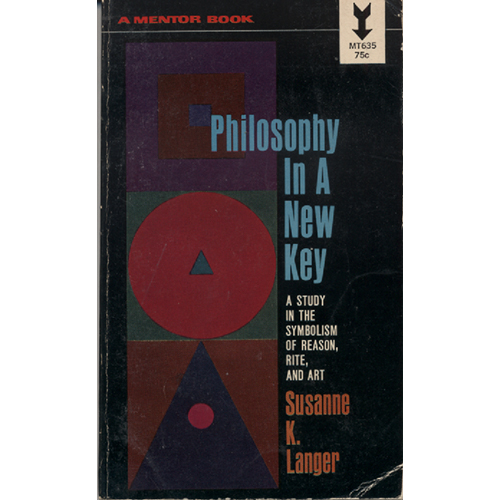
"Philosophy In A New Key" by Susanne K. Langer, published in 1951 by Mentor, occupies a peculiar niche within the landscape of mid-20th century philosophy and cultural criticism. Encased in a rather unassuming paperback format typical of its era, the cover design features bold, block lettering and a simple, if not slightly drab, colour palette that lacks the vibrancy one might expect from a philosophical treatise aiming to engage a broad audience. The overall aesthetic reflects the utilitarian approach to book design prevalent at the time, prioritising content over visual appeal, a characteristic that seems to echo the philosophical inquiries contained within its pages.
Langer’s work addresses the interrelationship between philosophy and the arts, suggesting that human cognition and culture can be understood through the lens of symbolism and expressive forms. Her exploration of these themes is both ambitious and thought-provoking, yet the presentation can come across as dense and challenging for the casual reader. This is perhaps indicative of a wider trend in post-war intellectual culture, where the complexities of modern thought were often encapsulated in dense prose that demanded rigorous engagement. The paperback vibe, while accessible, might deter some readers who are accustomed to more straightforward philosophical texts, making it a curious blend of erudition and elitism.
Susanne K. Langer is a figure whose prominence in the field of philosophy, particularly in the realm of aesthetics and symbolic thought, is often overshadowed by her contemporaries. Born in 1895, she was an American philosopher and a prominent member of the intellectual community during a time when women in philosophy were not as widely recognised. Langer's contributions, particularly in the context of art and symbolism, have had a lasting impact, yet she remains somewhat obscure in the wider pantheon of philosophical thought. Her ideas were often considered ahead of their time, and while she was a student of the influential philosopher George Santayana, her work did not always receive the attention it deserved in mainstream philosophical discourse. The lack of extensive documentation on her life and career further complicates our understanding of her position within publishing history, leaving many aspects of her influence open to speculation.
Published in 1951, "Philosophy In A New Key" emerged during a period of significant cultural and intellectual upheaval in the United States and beyond. The post-war era was marked by a flourishing of ideas as societies grappled with the implications of a world transformed by conflict and technological advancement. In the realm of philosophy, there was a growing interest in the intersection of art, culture, and human experience. Langer's work can be seen as a response to this zeitgeist, as she endeavoured to bridge the gap between abstract philosophical thought and the lived experience of art and culture. The book's release coincided with a burgeoning interest in existentialism, modernism, and the role of art in society, making it a timely contribution to the ongoing discourse surrounding human expression and understanding.
The content of the book itself is as ambitious as it is challenging. Langer's exploration of the symbolic nature of human thought and its implications for understanding art and culture is both profound and intricate. She posits that art is not merely a reflection of reality but a means of interpreting and understanding it, a notion that continues to resonate in contemporary discussions of aesthetics and meaning. However, readers may find themselves grappling with her complex arguments and dense prose, which can sometimes obscure the very insights she aims to convey. The intellectual rigour required to engage with Langer’s ideas may deter those looking for a more accessible entry point into philosophical discourse, resulting in a work that feels simultaneously vital and exclusionary.
In terms of print culture, "Philosophy In A New Key" fits snugly within the landscape of mid-century publishing, where the rise of the paperback format allowed for a wider dissemination of intellectual ideas. Mentor, as a publisher, contributed to this trend by producing affordable editions of significant works, thus making complex ideas more accessible to the general public. This democratization of knowledge was a hallmark of the time, although the book's content may not fully align with the expectations of casual readers seeking enlightenment through philosophical texts. In this sense, the book stands as a cultural artefact that reflects both the aspirations and limitations of its time, embodying the tension between elitist intellectualism and democratic accessibility.
Ultimately, "Philosophy In A New Key" is a thought-provoking yet challenging read. While it offers valuable insights into the relationship between philosophy, art, and human experience, the density of its ideas may limit its appeal to a broader audience. The book serves as a testament to Susanne K. Langer's unique contributions to philosophical thought, even as her obscurity in the literary canon raises questions about the recognition of women in intellectual history. As we engage with such works through outlets like Crappy Old Books, we are reminded of the complex interplay between cultural production, historical context, and the evolving nature of philosophical inquiry.