AI-assisted note, based on the text and a physical inspection of this copy.
In a world where the complexities of faith and spirituality intertwine with the fabric of society, Religions of the World, published in 1901 by A.C. Black, attempts to distill the essence of various belief systems into a digestible format. This book exemplifies the early 20th-century fascination with global cultures and religions, presenting a snapshot of the world's spiritual landscape from a Western perspective. However, the approach taken by Grant often falls flat, revealing more about the era's biases than the religions themselves.
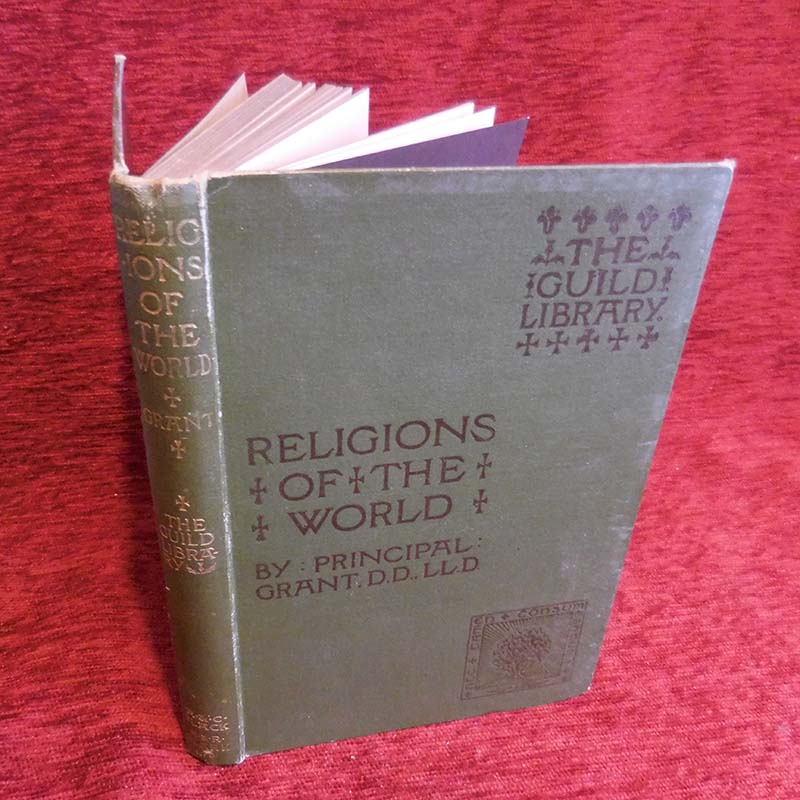
The cover design is a telling artefact of its time. Adorned with intricate patterns and an ornate font typical of the Edwardian period, the book's aesthetic recalls a time when such embellishments were fashionable in printed works. The faded spine and slightly yellowed pages suggest that Religions of the World has weathered the years, yet the paperback vibe carries an air of neglect, as if it has been relegated to the dusty shelves of forgotten libraries. This physical deterioration reflects not just the passage of time but perhaps a waning interest in the book's content—a common fate for works that attempt to encompass the vastness of human belief with a superficial brush.
G.M. Grant remains a somewhat obscure figure in literary history, with scant biographical information available. His position within the publishing landscape of his time is not well-documented, leaving us to speculate about his motivations and influences. From the context of the book itself, it appears that Grant was keenly aware of the era’s burgeoning interest in anthropology and world cultures, yet he may have lacked the depth of understanding required to do justice to such a rich subject. The absence of comprehensive records makes it difficult to assess his impact or the extent of his literary contributions, suggesting that he may have been more of a compiler than an innovator in the realm of religious studies.
The year 1901 marked a significant moment in the tapestry of cultural shifts occurring at the turn of the 20th century. The Victorian era had given way to new societal norms, with the British Empire at its zenith, fostering a climate of curiosity about the world's diverse faiths. The publication coincided with an increasing appetite for knowledge about non-Western religions, spurred by colonial expansion and a growing interest in anthropology. However, this book reflects the limitations of its time—a tendency to categorise and simplify complex belief systems into digestible narratives, often neglecting the nuances and lived experiences of practitioners. As a result, Religions of the World serves more as a reflection of Western perceptions than an accurate portrayal of the religions it seeks to describe.
Content-wise, the book offers a patchwork of summaries on various religions, including Christianity, Islam, Hinduism, Buddhism, and others. Each section is marred by generalisations and oversimplifications, rendering the rich tapestry of these belief systems into a bland, homogenised version that lacks depth. The tone is often patronising, evoking an air of superiority that permeated much of Edwardian thought. Readers seeking insight into the complexities of faith will find little sustenance in Grant's cursory overviews; rather, they may walk away with more questions than answers about the spiritual practices and beliefs he attempts to summarise.
Moreover, the language employed by Grant is emblematic of its period—formal, sometimes archaic, and occasionally patronising. This style can be both a barrier and a curiosity for modern readers. While it offers a glimpse into the literary conventions of the early 20th century, it also serves as a reminder of how far our understanding of cultural sensitivity has evolved. The book may function as a historical artefact, illustrating the limitations of past scholarship, yet it simultaneously raises important questions about the responsibility of authors to engage with their subjects in a respectful and informed manner.
In conclusion, Religions of the World by G.M. Grant stands as a cultural artefact of its time, encapsulating the Edwardian obsession with categorising and simplifying complex human experiences. While it is a product of its era, it ultimately falls short of providing genuine insight into the religions it attempts to represent. For those intrigued by the evolution of religious studies or the cultural narratives of the early 20th century, this book offers a curious glimpse into the past. However, readers seeking a nuanced understanding of world religions may find themselves disappointed by its oversimplifications. This review serves as a testament to the unique role that Crappy Old Books plays in examining the cultural significance of such works, encouraging us to reflect on the progress we’ve made in understanding the diverse beliefs that shape our world.