AI-assisted note, based on the text and a physical inspection of this copy.
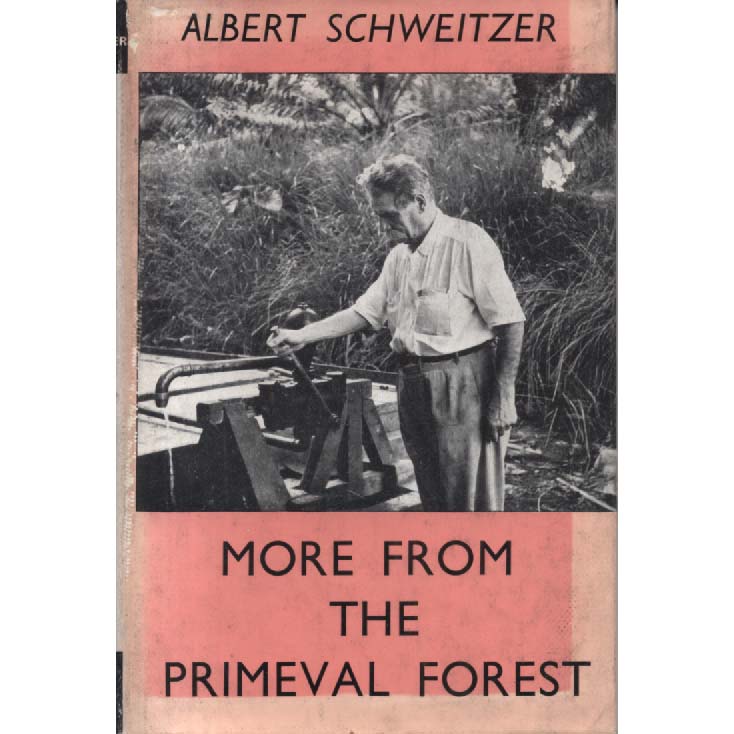
“More From The Primeval Forest” by Albert Schweitzer is a curious work that invites readers into the intricate interplay between humanity and nature. Published in 1956 by A&C Black, this book encapsulates a mid-20th-century fascination with the natural world, framed through the lens of Schweitzer's experiences in Africa. The cover design, typical of its time, features a somewhat evocative illustration that attempts to resonate with both the mystique of the untamed forest and the solemnity of Schweitzer’s philosophical inquiries. Its paperback format gives it a casual yet earnest vibe, reminiscent of the era’s push towards accessible literature that aimed to educate and inspire a broader audience. However, one might argue that the book’s aesthetic does not quite match its thematic weight, as the imagery feels almost generic, lacking the depth that the subject matter deserves.
Albert Schweitzer, a renowned theologian, philosopher, and physician, is perhaps best known for his humanitarian work and the concept of "Reverence for Life." He was awarded the Nobel Peace Prize in 1952 for his efforts to promote peace and understanding amidst the chaos of the post-war world. Born in 1875 in Alsace, Schweitzer's multifaceted career spanned various fields, including music and medicine, which shaped his worldview and informed his writings. His excursions into Africa, where he established a hospital in Gabon, are often highlighted as pivotal moments that influenced his philosophical outlook. Although widely recognised, his literary contributions, particularly this one, seem to occupy a more obscure niche within the broader literary landscape, often overshadowed by his more prominent theological works.
Published in the mid-1950s, “More From The Primeval Forest” reflects a cultural moment steeped in post-war optimism and an emerging environmental consciousness. The decade saw an increased interest in nature and ecology, spurred by a growing awareness of industrialisation’s impact on the environment. Schweitzer’s narrative fits neatly into this zeitgeist, as it delves into the relationship between humans and their natural surroundings, echoing the burgeoning environmental movements that would gain momentum in subsequent decades. Despite this, one might find that the book does not fully engage with the complexities of these themes, lingering instead on romantic notions of nature that feel somewhat dated in the context of modern ecological discussions.
The text itself is a blend of personal reflection and philosophical musings, interspersed with observations about the flora and fauna of the regions he traversed. Schweitzer's prose, while earnest, can sometimes veer into the overly sentimental, presenting nature as an untouched paradise rather than the complex ecosystem it truly is. This idealisation, while charming, risks alienating readers who seek a more nuanced understanding of the environmental issues at play. The book, at times, reads as a pastoral ode rather than a critical examination of the challenges faced by the primeval forest and its inhabitants.
Moreover, the language used throughout the book is indicative of its time, with a tendency towards grandiloquence that can feel unwieldy for contemporary readers. The use of metaphor and simile, while beautifully crafted, may come off as excessive, detracting from the clarity of his observations. This stylistic choice, coupled with the book's somewhat meandering structure, can make for a challenging read, as Schweitzer oscillates between personal anecdotes and broader philosophical reflections without a clear narrative arc. As a cultural object, the book serves as a fascinating intersection between literature and philosophy, yet it often lacks the rigour that would place it alongside the works of his contemporaries.
In terms of its impact and reception, “More From The Primeval Forest” appears to occupy a marginalised space within the literary canon. While it may not have achieved the same level of acclaim as Schweitzer’s other works, it nonetheless contributes to our understanding of his thought processes and the era’s evolving attitudes towards nature. It serves as a reminder of a time when literature sought to bridge the gap between the human experience and the natural world, albeit through a lens that may not resonate as strongly with today’s readers.
In conclusion, “More From The Primeval Forest” is a thought-provoking yet flawed exploration of humanity’s ties to nature, filtered through the unique perspective of Albert Schweitzer. The book’s 1956 publication situates it within a cultural milieu that valued both philosophical reflection and an emerging ecological awareness, though its execution may leave modern readers wanting more depth and clarity. As a piece of literary history, the work stands as a testament to the complexities of its author and the era, while also highlighting the challenges inherent in discussing nature in an increasingly industrialised world. For those interested in the intersections of philosophy, literature, and environmentalism, this book remains a curious if imperfect addition to the library of Crappy Old Books.