AI-assisted note, based on the text and a physical inspection of this copy.
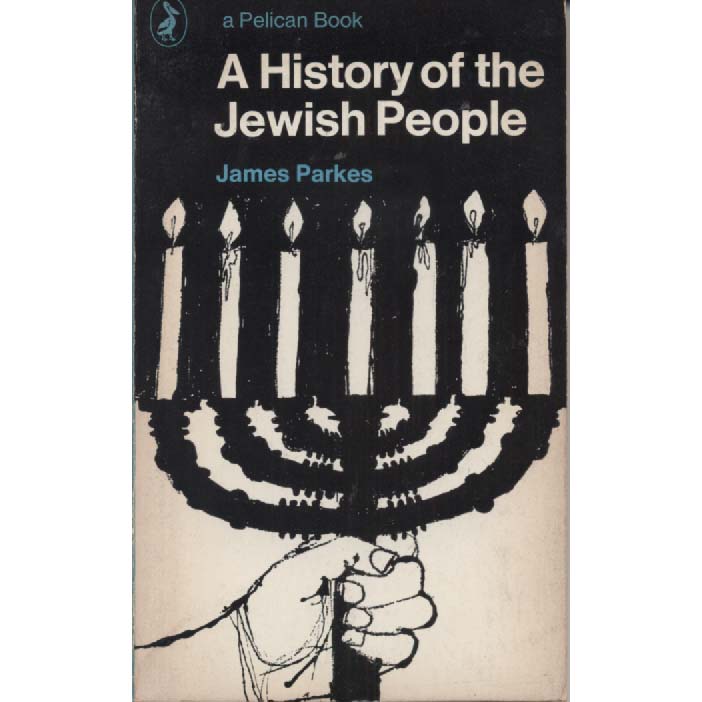
Published in 1967 by Pelican, A History Of The Jewish People by James Parkes serves as a rather ambitious attempt to chronicle the Jewish experience from ancient times to the modern era. The book is encased in a rather unassuming paperback cover typical of its time, featuring a simple design that eschews the more elaborate illustrations or photographs often found in contemporary historical texts. Instead, it opts for a straightforward presentation that reflects the utilitarian ethos of 1960s publishing. The cover’s muted palette and minimalistic typography suggest a work aimed at educative rather than artistic merit, appealing to the scholarly reader rather than the casual browser.
Parkes’ writing style balances accessibility with a scholarly approach, making it suitable for both academic audiences and general readers with an interest in Jewish history. However, one could argue that the book's tone, at times, falls into the realm of dry exposition, which may deter those seeking a more engaging narrative. The text is interspersed with the kind of footnotes that were common in the era, providing references that may serve as breadcrumbs for further exploration into the subject matter, albeit sometimes at the risk of overwhelming the reader with academic detail.
James Parkes himself holds a notable place in the landscape of 20th-century religious scholarship. Born in 1896, he was an English Anglican priest and theologian who dedicated much of his life to interfaith dialogue and Jewish-Christian relations. His work often sought to address the historical complexities and tensions between these two faiths. However, despite his contributions to religious scholarship, Parkes remains relatively obscure in the broader literary canon compared to more prominent figures of the time. His lesser-known status perhaps stems from his specialized focus, which, while significant, may not have garnered the widespread acclaim of contemporaries who engaged with more mainstream topics in literature and history.
The year 1967 was particularly tumultuous in global politics, marked notably by the Six-Day War in the Middle East, which had profound implications for Jewish identity and statehood. This context likely influenced Parkes’ writing, as discussions surrounding Jewish history and identity were increasingly relevant. The late 1960s also saw a resurgence of interest in cultural and religious identity among various groups, including Jewish communities worldwide. As such, Parkes’ work can be viewed as both a reflection of and a response to the contemporary cultural milieu, offering insights that may resonate with readers grappling with questions of identity and heritage during a time of significant social upheaval.
In terms of print culture, the 1960s represented a shift towards more accessible educational materials, particularly through the proliferation of paperback editions designed for the mass market. Pelican, known for its commitment to producing quality, affordable literature, found its niche during this period by publishing works that aimed to educate the public without compromising on scholarly integrity. A History Of The Jewish People fits neatly within this framework, suggesting that the publisher was keen to make complex historical narratives available to a wider audience.
As one flips through the pages of this book, one cannot help but feel the weight of history, both in the content and the physicality of the book itself. The paper used is of average quality, typical for the era, and the binding shows signs of wear that can be expected from a volume that has likely found its way into the libraries of many homes and educational institutions. This wear bears testament to the book’s role as a bridge between academic discourse and public understanding, indicating that it has been read and perhaps debated over the years.
In conclusion, A History Of The Jewish People by James Parkes, though not without its limitations, offers a valuable exploration of Jewish history through the lens of mid-20th-century scholarship. It stands as a cultural object emblematic of its time, reflecting both the aesthetic choices of the era in publishing and the pressing sociopolitical contexts that shaped the discourse surrounding Jewish identity. While Parkes may not enjoy the same level of recognition as other historical authors, his contribution remains significant for those interested in understanding the complexities of the Jewish narrative. For readers seeking to delve into the past with a scholarly yet accessible guide, this title may still provide insights worth pursuing, as highlighted by the ethos of Crappy Old Books.