AI-assisted note, based on the text and a physical inspection of this copy.
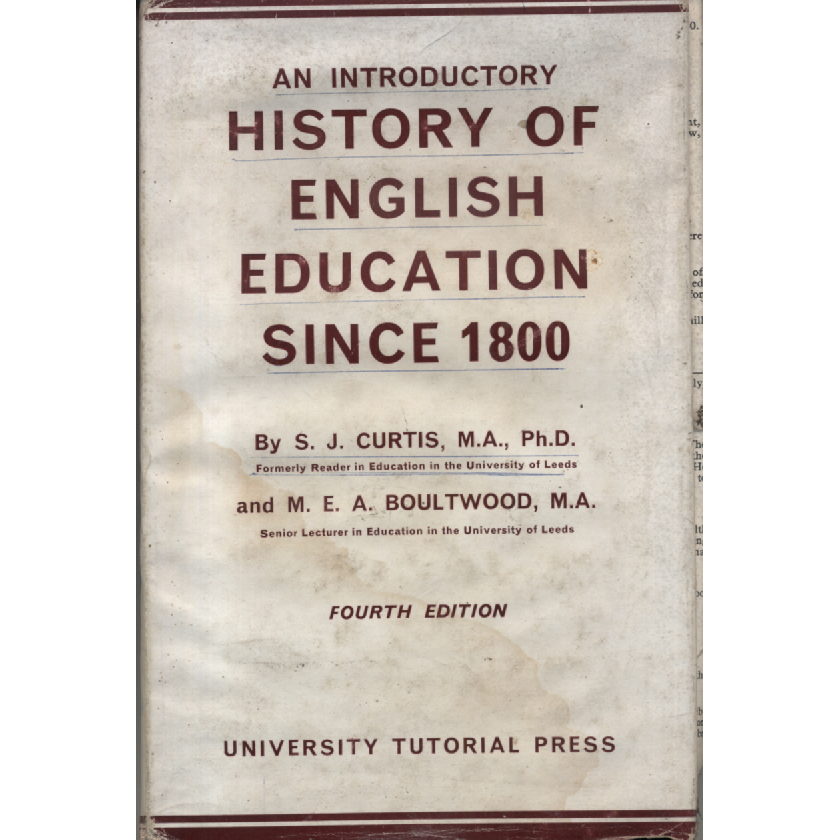
Published in 1966, "An Introductory History of English Education Since 1800" by SJ Curtis and MEA Boultwood presents itself as an ambitious endeavour to chronicle the evolution of English education over more than a century. This hardback, emanating from the University Tutorial Press, showcases a rather utilitarian cover design typical of educational texts from the mid-20th century. The cover features a drab colour palette, an unremarkable title font, and a rather bland layout that does little to entice potential readers. It exudes a scholarly vibe rather than a commercial one, appealing more to students and educators than to the general public. The overall aesthetic aligns with the academic focus of the era but lacks the vibrancy that could have made it more engaging.
The book operates within a niche, aiming to provide a comprehensive overview of educational developments in England since the dawn of the 19th century. It seeks to address significant milestones, legislative changes, and evolving pedagogical philosophies. The tone is decidedly academic, filled with the kind of dense prose that can deter casual readers. Yet, for those who persevere, it offers a wealth of information, though it often reads as a tedious compilation of facts rather than an engaging narrative. The structure is straightforward, often leaning heavily on chronological progression, which can result in a sense of monotony.
SJ Curtis and MEA Boultwood appear to be somewhat obscure figures within the realm of educational literature. There is limited biographical information available about them, which raises questions about their broader impact or recognition in the field of educational history. It is plausible that both authors were educators or historians with a vested interest in English education, yet the absence of substantial records makes it challenging to gauge their influence or contributions beyond this particular work. Their anonymity adds an air of mystery to the book, leaving readers curious about the authors behind such a significant topic.
The year 1966 was a period marked by significant social change in the UK, with the educational landscape undergoing considerable transformation. This was the era of the comprehensive school movement, where the push for more inclusive education began to reshape the traditional schooling system. The authors' choice to document the history of English education at this juncture is particularly noteworthy, as it reflects an ongoing dialogue about educational reform that would resonate in subsequent decades. The text captures the shifting attitudes towards education, mirroring the broader societal changes happening during that time, although it does so through a rather clinical lens.
In terms of print culture, the book fits into a wider trend of educational texts that sought to provide foundational knowledge for students and educators alike. The paperback format, typical of the era, suggests a preference for accessibility and affordability, enabling a wider audience to engage with the material. However, the production quality is less than stellar, with pages that feel somewhat flimsy and a binding that may not withstand the test of time. This mirrors a common critique of educational publications from this period, where the focus on content often overshadowed considerations of durability and aesthetic appeal.
The impact of "An Introductory History of English Education Since 1800" on contemporary educational discourse remains ambiguous. While it undoubtedly serves as a resource for understanding historical trends, its academic language and structure may limit its accessibility to a broader audience. One wonders whether it has been widely cited or has influenced subsequent educational literature; however, without a more extensive bibliographic record or author recognition, it is difficult to ascertain its lasting significance.
In conclusion, while "An Introductory History of English Education Since 1800" provides a valuable historical perspective, its academic tone and unremarkable presentation may deter casual readers. The authors, Curtis and Boultwood, remain enigmatic figures, and the book's place in the educational canon appears to be limited, although it does offer a snapshot of an important period in English educational history. For those interested in delving into the complexities of English education, Crappy Old Books presents this work as an intriguing, albeit challenging, read.