AI-assisted note, based on the text and a physical inspection of this copy.
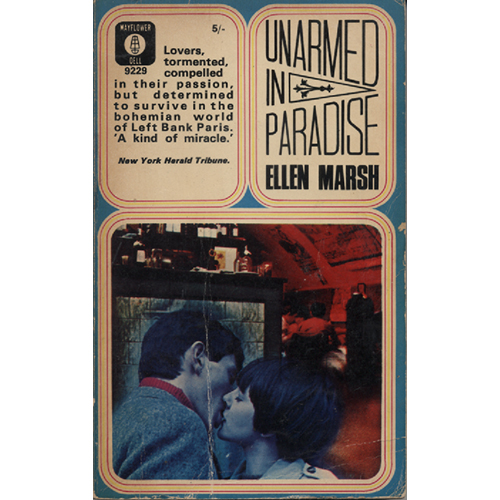
"Unarmed in Paradise," penned by Ellen Marsh and published in 1965 by Mayflower, presents itself as a curious artefact from a transformative era in both literature and culture. The book, with its somewhat pedestrian cover design featuring a pastel palette and an illustration that seems to evoke an idyllic yet vague setting, captures a snapshot of mid-20th century publishing aesthetics. The paperback vibe is very much in line with the period’s literary output, aimed at a mass market eager for escapism and romance, yet it often comes across as a mere product of its time, lacking the innovation that would later define the genre. The paper quality is typical for the period, thin and somewhat fragile, suggesting that it was not meant to stand the test of time, much like the sentiments it may convey within its pages.
Ellen Marsh remains a somewhat obscure figure in the literary world, with scant biographical details available. She does not appear to have received significant recognition in broader literary circles, and her works seem limited in scope, suggesting she may have been a writer of niche appeal within her time. Her presence in the literary culture of the 1960s is not well documented, leaving readers to speculate about her influences and motivations. While it’s possible she contributed to the landscape of light romantic fiction, the lack of extensive records makes it challenging to position her within a broader literary movement or to ascertain her impact.
The publication year of 1965 situates "Unarmed in Paradise" within a vibrant cultural context marked by significant social upheaval and change. The mid-60s were characterised by the rise of counterculture, shifting societal norms, and a growing appetite for new forms of expression. Literature of this era often reflected the complexities of modern life, with themes of personal freedom, love, and existential exploration coming to the forefront. However, Marsh's work seems to retreat from these more pressing issues, instead offering a more conservative narrative that aligns with the escapist tendencies of the time. This juxtaposition highlights an intriguing paradox: while the world was evolving rapidly, some literary works clung to traditional narratives and familiar tropes, perhaps in an attempt to provide comfort in uncertain times.
The thematic elements within "Unarmed in Paradise" are emblematic of the romantic fiction genre prevalent during the 1960s. Readers may encounter familiar motifs of love, longing, and idyllic settings, all wrapped in a narrative that feels predictable and formulaic. The title itself suggests an exploration of vulnerability in a seemingly perfect world, yet the execution leaves much to be desired. The dialogue and character development often lack depth, which could detract from the overall experience and may render the book a forgettable entry in the canon of romantic literature. It’s as if the author, while attempting to create a lush, enchanting paradise, inadvertently crafted a landscape that feels flat and uninspired.
Moreover, it is worth noting how the book reflects the publishing practices of the time. The Mayflower publishing house, known for its production of affordable paperbacks targeting a wide audience, played a crucial role in democratizing literature in the post-war era. This accessibility was a double-edged sword; while it allowed for a broader readership, it also contributed to the proliferation of works that often prioritised quantity over quality. "Unarmed in Paradise" may be seen as a product of this environment, embodying the era's trends while simultaneously exemplifying the pitfalls of mass-market fiction.
In terms of physicality, the book’s design choices—ranging from its cover art to the typeface used—are reflective of 1960s aesthetics, which often leaned towards pastel colours and simplistic illustrations. This visual language, while appealing at first glance, may not hold significant depth upon closer examination. The artwork suggests a romantic escapade, yet it hardly hints at the emotional complexity or narrative depth that could have elevated the work. Instead, it seems to serve as a mere lure, drawing readers in without delivering the richness that one might hope for.
As a cultural object, "Unarmed in Paradise" stands as a testament to a certain kind of literary production that flourished in the 1960s. Its presence on the shelves, alongside more impactful works of the time, illustrates the varied landscape of literature that existed during this pivotal decade. One cannot help but wonder how many readers picked up this book in search of a romantic escape, only to find themselves navigating through a simplistic tale that ultimately lacked the substance they craved.
In conclusion, while "Unarmed in Paradise" may hold a certain charm as a relic of its time, it ultimately falls short of offering a meaningful literary experience. The blend of a predictable narrative, shallow characterisation, and a lack of significant authorial presence leaves much to be desired. For those interested in the evolution of romantic fiction or the cultural milieu of the 1960s, it may serve as a curious study, but its value as a compelling read may be limited. Crappy Old Books presents this title not as a gem to be cherished but rather as a reminder of the literary landscape that once was, encapsulating the hopes and limitations of its era.