AI-assisted note, based on the text and a physical inspection of this copy.
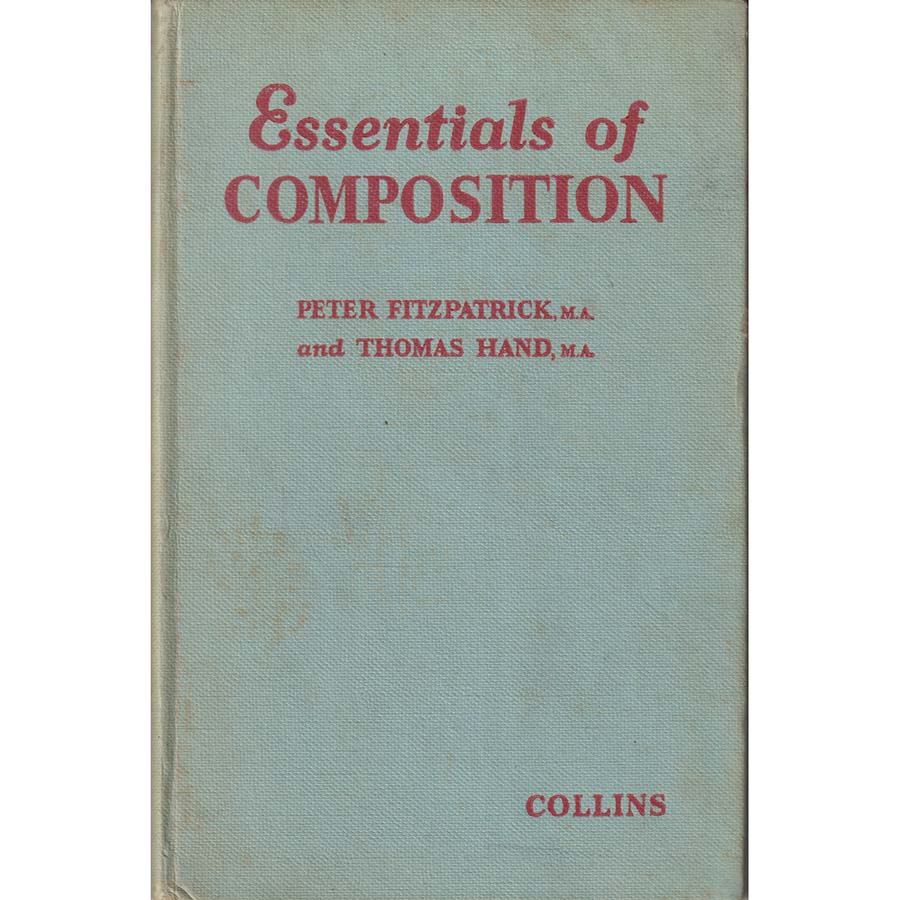
“Essentials of Composition” by Peter Fitzpatrick and Thomas Hand, published in 1958 by Collins, is a curious artefact of educational literature that straddles the line between a practical guide and a relic of its time. The book presents itself as a straightforward manual designed to instruct readers on the fundamental principles of writing. Its cover, a rather unremarkable affair, features a simple design typical of the era, with bold lettering that hints at its academic intentions. The paperback format, now somewhat yellowed and faded, exudes a sense of nostalgia, reminiscent of a pre-digital age where students relied heavily on physical texts for their learning needs. The overall aesthetic is functional, lacking the flair that one might associate with more contemporary educational books, yet it encapsulates a certain charm of mid-20th-century publishing.
Both authors, Peter Fitzpatrick and Thomas Hand, appear to exist in a somewhat nebulous space within literary culture. While they are credited as the creators of this instructional text, their wider contributions to literature or education seem to be minimally documented. It is tempting to speculate that they were educators or scholars with a vested interest in composition, as the content suggests a deep understanding of pedagogical methods. However, the absence of substantial biographical information leaves much to be desired about their backgrounds and influences. This obscurity might reflect a broader trend of the time, where numerous educational authors contributed to the genre without gaining lasting recognition.
Published in 1958, “Essentials of Composition” emerges from a cultural milieu that placed significant value on written communication. Post-World War II Britain was a period marked by a burgeoning emphasis on education, driven by the need for skilled professionals in a recovering economy. The book likely aimed to equip students with the necessary skills to thrive in a rapidly evolving society, where effective writing was becoming increasingly essential. The 1950s also heralded a time of increased access to education for the middle classes, and texts like this one likely played a role in shaping the writing standards of the era. The book’s focus on composition reflects a societal push towards clarity and efficacy in communication, aligning with the educational reforms of the time.
The content of “Essentials of Composition” itself is structured around key concepts of writing, including grammar, syntax, and the construction of arguments. The authors employ a no-nonsense approach, presenting writing as a skill that can be taught and learned rather than an innate talent. This perspective aligns well with the educational philosophies of the 1950s, which often emphasised systematic methodologies for teaching. However, the text’s practical applications may feel dated to contemporary readers, who might find the rigid format and prescriptive style limiting. The examples given within the text could be seen as overly simplistic or even quaint when viewed through a modern lens, reflecting the norms of composition that were prevalent at the time of publication.
As a cultural object, the book serves as a reminder of the pedagogical practices of its era, while also highlighting the evolution of writing instruction over the decades. The lack of innovative design or engaging content may deter some readers, yet it provides insights into the educational values of the 1950s. The straightforward prose and instructional tone suggest a focus on clarity, a virtue that remains relevant today, albeit approached with more creative methods in contemporary contexts.
In conclusion, “Essentials of Composition” occupies a peculiar yet fascinating niche within educational literature. Its unadorned presentation and straightforward content reflect a bygone era of instruction that prioritised clear communication and methodical learning. While the authors may not be household names, their contributions to composition education resonate with the historical context of the 1950s. This book, available through Crappy Old Books, offers an intriguing glimpse into the past, making it a worthy, if somewhat underappreciated, addition to any collection focused on the evolution of writing and education.