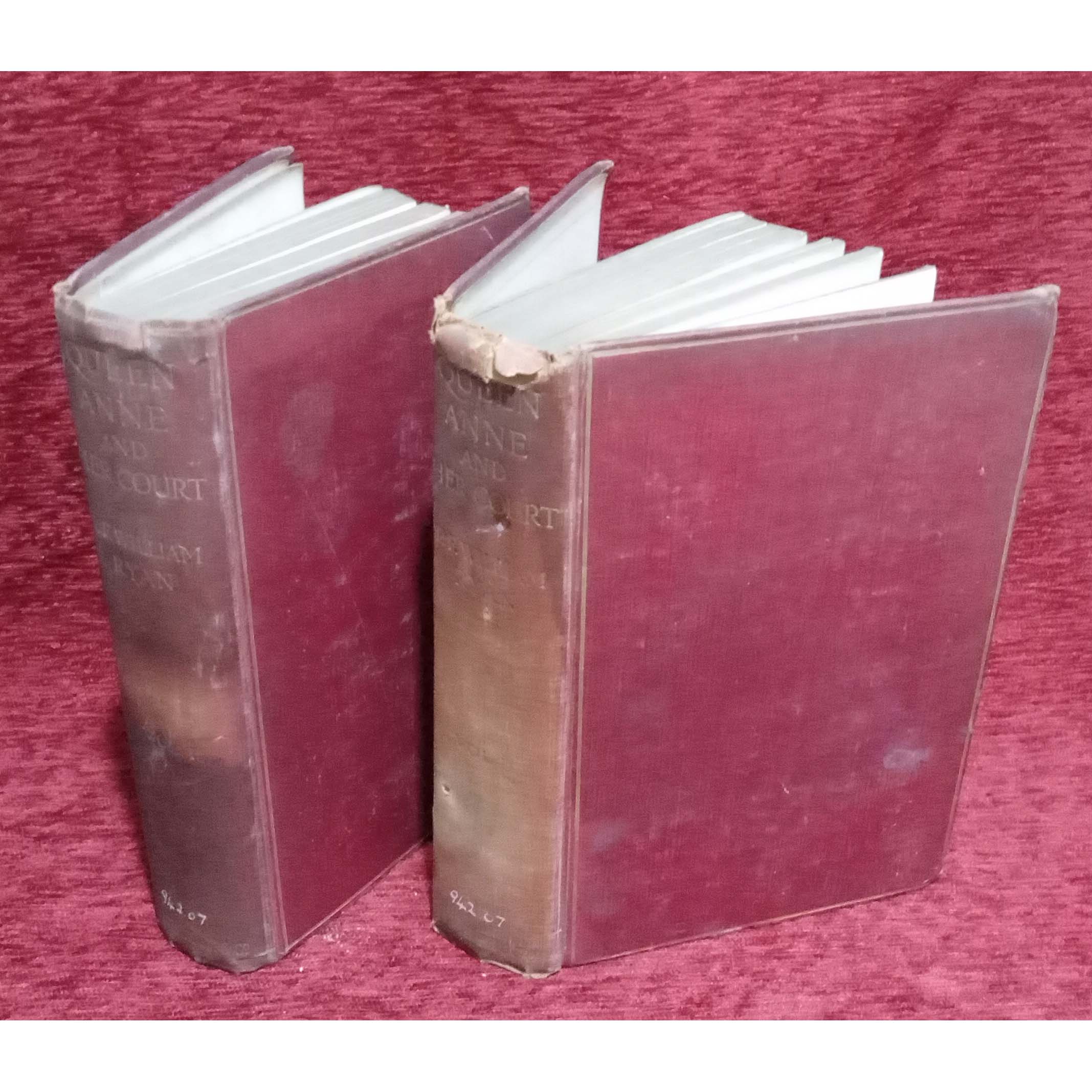
AI-assisted note, based on the text and a physical inspection of this copy.
“Queen Anne and Her Court,” authored by PF William Ryan and published in 1908 by Hutchinson, is a two-volume set that attempts to illuminate the reign of Queen Anne, the last monarch of the House of Stuart. This work presents itself as a historical account, richly woven with the tapestry of court life during the early 18th century. The cover design, typical of the era, features a somewhat elaborate decorative binding that reflects the Victorian fascination with history and its figures. This aesthetic choice is indicative of the time's publishing trends, where visual appeal often went hand-in-hand with the content's scholarly aspirations. The volumes, now aged and with their spines gently worn, evoke a certain nostalgia for the print culture of the early 20th century, when the proliferation of historical texts was on the rise and the public's appetite for learning about past monarchies was insatiable.
PF William Ryan is not a household name in the literary world, and the biographical details surrounding him are scarce. It appears that his contributions to the historical genre have not been widely documented or celebrated. This obscurity raises questions about his place within the larger narrative of literary culture, particularly regarding his influence or recognition among contemporary historians and authors. Without a substantial record, Ryan emerges as a somewhat enigmatic figure, whose motivations and literary ambitions remain largely speculative.
Published in 1908, “Queen Anne and Her Court” arrives at a time when Britain was experiencing significant social and political shifts. The early 20th century was marked by the aftermath of the Victorian era, a period that had seen the expansion of the British Empire and the consolidation of its global influence. The fascination with historical figures like Queen Anne during this period can be seen as a reflection of a society grappling with its identity in the face of modernity. The book’s release coincided with a growing interest in the historical narratives that shaped national consciousness, as authors sought to connect contemporary readers with their storied pasts. This cultural backdrop likely influenced Ryan's decision to explore the court of Queen Anne, as it provided a rich canvas for examining the complexities of power, gender, and social dynamics.
The content itself is a blend of biographical sketches, court intrigues, and political commentary, offering readers a glimpse into the lives of those who surrounded Queen Anne. Ryan's prose, although at times verbose and laden with the stylistic flourishes popular in the literary fashion of the day, seeks to transport the reader to the heart of the Queen's court. However, the execution leaves much to be desired; the narrative can occasionally feel disjointed, as if Ryan struggled to maintain a cohesive thread throughout the sprawling tale of court life. Readers may find themselves wading through a sea of names and events without a clear sense of direction.
The physicality of the volumes also deserves mention. The paper quality, reminiscent of the early 20th century, exhibits a certain fragility, with pages that have yellowed and started to become brittle over time. The illustrations, if present, are often limited in number and quality, lacking the vibrancy one might expect from more contemporary historical works. This is not unusual for books of this era, as the emphasis was often placed more on text than on visual storytelling. Nevertheless, for collectors and enthusiasts of historical literature, these volumes represent a tangible connection to a bygone era, where the printed word was revered and the act of reading was seen as a noble pursuit.
The relationship between the text and its historical subject matter provides a fascinating lens through which to examine the themes of power and influence. Queen Anne, who ruled from 1702 to 1714, was a monarch who navigated the complexities of the War of the Spanish Succession, religious strife, and the ever-evolving landscape of British politics. Ryan's portrayal of her court reflects the societal norms of his day, often emphasising the roles of women and their interactions within a male-dominated sphere. This perspective, while rooted in the historical record, can sometimes feel anachronistic, as Ryan's interpretations are inevitably coloured by the values and norms of the early 20th century.
In terms of literary merit, “Queen Anne and Her Court” occupies a curious space. It does not command the same level of respect as more prominent historical biographies, nor does it engage with the academic rigor that characterises scholarly historical texts. Instead, it sits comfortably within the realm of popular history, appealing to those with a casual interest in the subject rather than those seeking a comprehensive or critical analysis. As such, it serves as a reminder of the diverse landscape of publishing in the early 20th century, where works like Ryan's could flourish alongside more distinguished counterparts.
In conclusion, “Queen Anne and Her Court” by PF William Ryan is a curious artifact of its time, embodying both the aspirations and limitations of early 20th-century historical writing. While it provides a window into the life and times of Queen Anne, it does so with a narrative that occasionally falters under the weight of its ambitions. For those interested in the intersection of history and culture, this two-volume set offers a glimpse into a past that continues to shape contemporary understandings of monarchy and power. As we peruse such works in the context of Crappy Old Books, we are reminded of the rich tapestry of narratives that have sought to capture the complexities of history, each with its own peculiarities and merits.