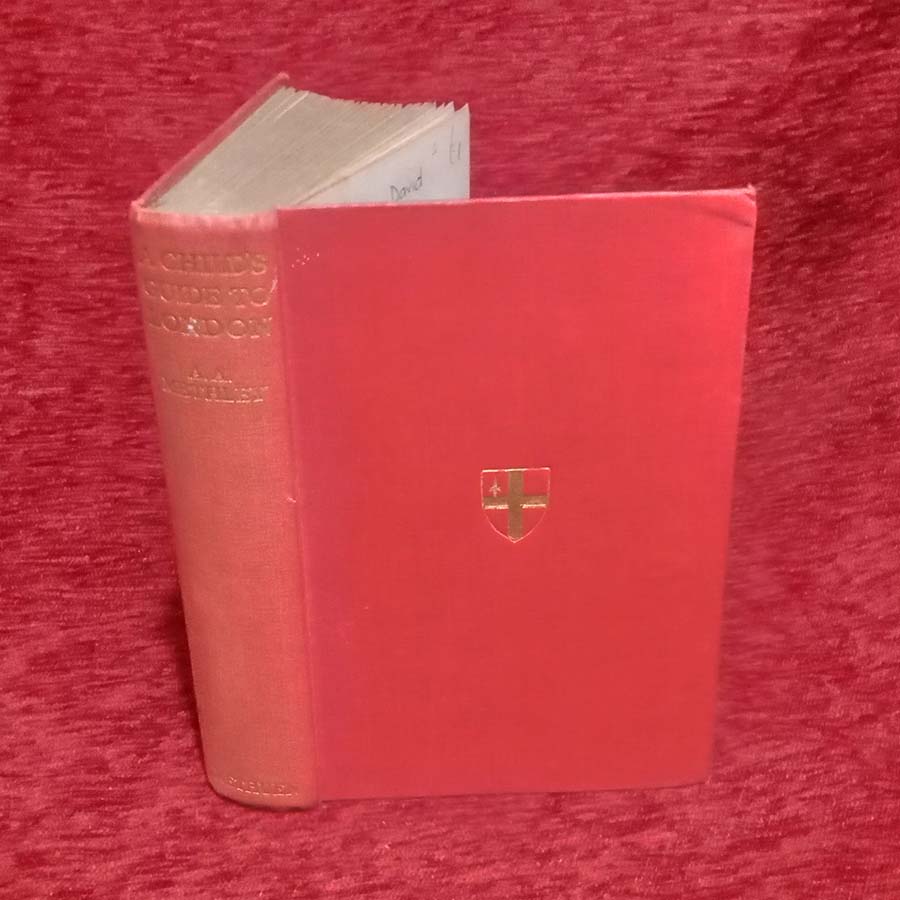
AI-assisted note, based on the text and a physical inspection of this copy.
In the realm of children's literature, few works oscillate between whimsy and educational intent with as much charm as A Child’s Guide to London by AA Methley. Published in 1926 by Methuen and Co, this guide aspires to illuminate the many wonders of London for its younger readers. The book's cover, adorned with a vibrant illustration of the iconic skyline, evokes a sense of nostalgia that beckons curious minds. Its paperback construction, typical of the interwar period, features a textured finish and a slightly yellowed page quality that adds to its vintage allure. The illustrations within, a mixture of colourful drawings and black-and-white photographs, serve both to inform and to entertain, striking a balance between the visual and textual that is essential for engaging a child’s imagination.
AA Methley remains a somewhat obscure figure in the literary landscape, with limited biographical details available. What is evident, however, is that Methley occupied a niche within children’s literature during the early 20th century. His works seem to reflect a broader trend in publishing, where authors aimed to create educational yet delightful texts for youngsters, a movement that gained momentum in the post-war years. Although Methley does not appear to be a household name, his contributions like this guide are vital in understanding how children’s literature evolved during a time when societal norms and expectations were shifting. The lack of extensive documentation about Methley opens the door to speculation about his impact and the extent of his oeuvre, suggesting that he may be more of a footnote in the history of children's publishing than a pivotal figure.
First published in 1926, A Child’s Guide to London emerges from a culturally rich but tumultuous period in British history. The aftermath of the First World War saw a surge in interest towards rebuilding society, reflected in the optimism and curiosity of the era. London was evolving rapidly, with new architectural feats and cultural landmarks emerging in the landscape. This guide captures that spirit of exploration, inviting children to not only learn about their city but also to take pride in its history and diversity. The book’s content reflects the burgeoning interest in urban exploration for children, a concept that was gaining traction as societal norms began to shift towards a more child-centric view of education and leisure.
The narrative style is accessible, with simple yet vivid descriptions that make various London landmarks come alive. Methley introduces children to the Tower of London, Buckingham Palace, and the British Museum, weaving in fun facts that are both entertaining and informative. The way he presents the information is reminiscent of a friendly tour guide, aimed at igniting a sense of wonder about the city’s history and culture. The text is interspersed with engaging illustrations that not only break the monotony of the written word but also serve to stimulate a child’s imagination. This dual approach of combining text and visuals is a hallmark of effective children's literature, and Methley seems to have successfully embraced this technique.
In terms of print culture, the book serves as a snapshot of 1920s British publishing trends. Methuen and Co, known for its commitment to producing quality literature, particularly for children, played a significant role in this era. The choice of a paperback format in the 1920s was indicative of changing preferences in the reading public, where affordability and accessibility began to take precedence. This format made the book more approachable for families, allowing children to engage with literature in a manner that was both enjoyable and educational. The choice of illustrations, which range from detailed sketches to whimsical drawings, reflects the broader artistic trends of the period, where Art Deco influences began to permeate even children’s literature.
Despite its charming premise, A Child’s Guide to London is not without its limitations. The text occasionally leans towards a simplistic interpretation of some historical events and cultural nuances, which, while suitable for a young audience, may leave older readers wanting more depth. Additionally, certain aspects of London’s diverse culture are glossed over, which could be attributed to the time in which it was written. The 1920s were marked by a particular sociopolitical climate that may have influenced Methley’s narrative choices, steering clear of complex themes in favour of a more straightforward approach to storytelling.
Furthermore, while the book aims to educate, some of the information may feel outdated to modern readers. The landmarks and cultural references, while iconic, are presented from a perspective that does not account for the rapid changes that London has undergone since the book’s publication. In a contemporary context, readers might find themselves questioning the relevance of certain passages, as the city continues to evolve, embracing new cultures and experiences.
In summation, A Child’s Guide to London by AA Methley stands as a quaint relic from a bygone era, encapsulating the innocence and curiosity of childhood in 1920s London. While Methley may not be a prominent figure in literary history, his work contributes to the understanding of children’s literature and its evolution during a significant cultural period. This guide serves not just as a book but as a cultural artifact, reflecting both the hopes and limitations of its time. For those interested in exploring the idiosyncrasies of children’s literature, this title is a worthy inclusion in any collection, reminding us of the importance of nurturing a sense of wonder in young readers. As with many titles showcased by Crappy Old Books, it is a reminder of how the past continues to influence our understanding of literature and culture today.