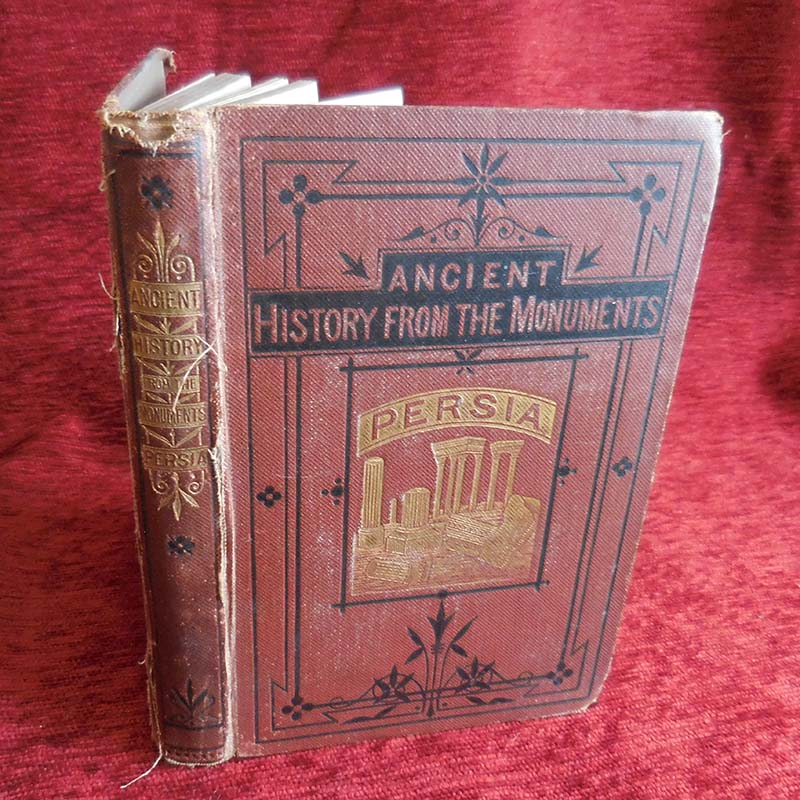
AI-assisted note, based on the text and a physical inspection of this copy.
“Ancient History From The Monuments - Persia” by WSW Vaux is a fascinating relic of its time, encapsulating the intersection of historical scholarship and early 20th-century Christian thought. The book presents itself in a rather austere paperback format typical of the 1930s, with a cover design that might easily be overlooked in today’s market of vibrant and attention-grabbing publications. The muted colours and simple typography evoke an era when books were valued for their content rather than their aesthetic appeal. This publication reflects a time when knowledge was disseminated with the intent to educate and perhaps evangelise, as indicated by its publisher, the Society for Promoting Christian Knowledge.
The author, WSW Vaux, remains a somewhat obscure figure within the literary and academic landscape. There is limited documentation regarding his life and works, which poses a challenge for anyone seeking to understand his influences or contributions to the field of archaeology or history. Vaux’s writings predominantly focus on historical interpretations drawn from archaeological findings, particularly relating to ancient civilisations. His scholarly approach, while perhaps not widely celebrated today, offers an insight into how early 20th-century thinkers perceived and interpreted the remnants of ancient cultures. This positioning makes him an interesting, if not pivotal, character in the annals of historical scholarship, even if his work does not carry the same weight as more prominent historians of the era.
Published in the 1930s, “Ancient History From The Monuments - Persia” emerges from a decade coloured by significant global events, including the rise of fascism in Europe and the Great Depression. This backdrop undoubtedly influenced not only the tone and content of the book but also the mindset of its readers. In an age where the quest for understanding past civilisations was perhaps seen as a means of deriving lessons for the future, Vaux’s work might have been perceived as a stabilising force, offering a sense of continuity and connection to the ancient world. The 1930s were also marked by a burgeoning interest in archaeology and historical studies as tools for both education and moral guidance, aligning well with the goals of its publisher.
The book provides a detailed examination of Persian history as interpreted through its monuments, which is a particularly unique angle. Vaux’s emphasis on physical remains rather than solely textual accounts speaks to a growing appreciation for archaeology as a legitimate and critical avenue of historical inquiry. This approach reflects a departure from more traditional historiography that often prioritised literary sources over material culture. The text likely resonates with the intellectual currents of its time, where the artefacts of ancient civilisations were becoming increasingly recognised as vital to understanding human history.
The Society for Promoting Christian Knowledge, the publisher, established in the 1690s, aimed to disseminate Christian literature and education. Their choice to publish Vaux’s work indicates a desire to bridge faith and knowledge, an effort to present ancient history through a lens that aligns with Christian values and teachings. This reflects the broader trend of the time, where religious institutions sought to position themselves as bastions of knowledge amidst the rapidly changing social landscape. The book can be seen as part of their larger mission to engage with the past in a manner that supports a Christian worldview, encouraging readers to learn from ancient civilisations while maintaining their faith.
The textual content of “Ancient History From The Monuments - Persia” is dense, reflecting the scholarly conventions of the time. Vaux’s writing style is methodical, aiming to provide a comprehensive overview of Persian history based on archaeological findings. This makes the book a rich resource for those interested in the specifics of Persian artefacts and their historical context. However, the style may also be a barrier for contemporary readers, who might prefer a more engaging narrative. The scholarly tone, while authoritative, occasionally lacks the dynamism that could make the ancient world feel more accessible and relevant to modern audiences.
Visually, the book’s layout is standard for the time, with black and white illustrations and maps that accompany the text. These visual aids serve to enhance understanding but also reflect the limitations of the period in terms of printing technology. The absence of colour imagery may seem dull by today’s standards, yet it embodies the practical approach of early historical texts that prioritised information over flair. The images themselves, likely sourced from Vaux’s own observations or archaeological reports, provide a tangible link to the past, allowing readers an opportunity to visualise the remnants of a once-great empire.
In terms of cultural impact, this work may not have achieved the prominence of other historical texts, yet it occupies a niche that is reflective of its time. The 1930s were a pivotal era for the study of ancient civilisations, and Vaux’s contributions, while perhaps overshadowed by more renowned figures, represent a crucial step in the evolution of historical scholarship that acknowledged the importance of physical evidence. As a cultural object, the book is a testament to the scholarly pursuits of its era, embodying a blend of faith, education, and a burgeoning interest in archaeology.
In conclusion, “Ancient History From The Monuments - Persia” by WSW Vaux serves as a window into a specific period of historical scholarship, encapsulating the intellectual currents of the 1930s. The book’s austere design, combined with its scholarly content, reflects both its time and its publisher’s mission. Though Vaux himself remains an elusive figure in the literary canon, his work is a noteworthy example of the early 20th-century approach to ancient history. For those interested in the intersection of archaeology and Christian thought, this book stands as an important cultural artefact, a worthy addition to the collection of any enthusiast of Crappy Old Books.