AI-assisted note, based on the text and a physical inspection of this copy.
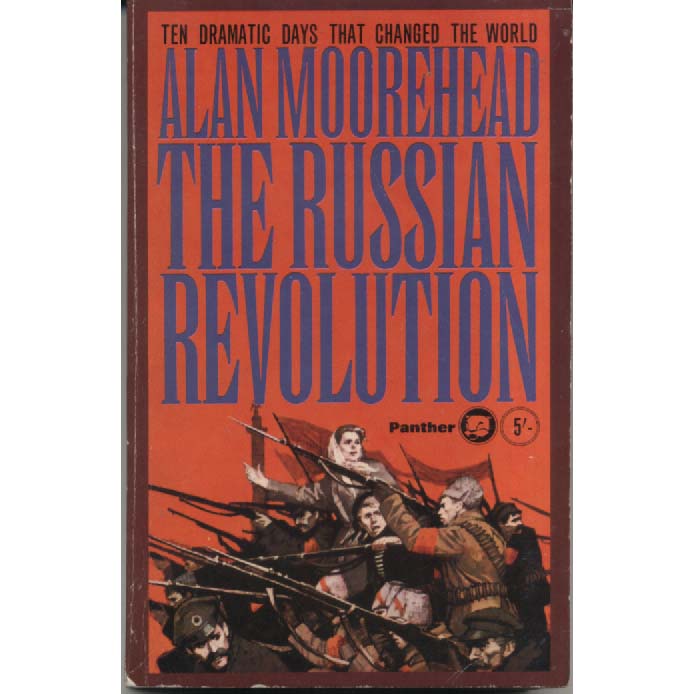
"The Russian Revolution" by Alan Moorehead, published in 1965 by Panther, attempts to encapsulate one of the most tumultuous periods in modern history. The cover design, typical of the era, features bold typography with a stark, monochromatic palette that suggests both urgency and severity, reflecting the dramatic shifts in power and ideology that marked the revolution itself. The paperback format, slightly dog-eared and worn, evokes a sense of accessibility that was characteristic of the 1960s publishing culture, inviting readers to engage with complex historical narratives in a more casual way. The physicality of the book—with its slightly yellowed pages and the faint aroma of aged paper—adds a layer of authenticity, connecting readers to the past as they delve into the turbulent events of early 20th-century Russia.
Alan Moorehead, an Australian journalist and author, is perhaps best known for his historical works, but little is widely documented about his life beyond the essential milestones. He was born in 1910 and became a prominent figure in war correspondence, which no doubt informed his narrative style. His broader contributions to historical literature, while notable, do not overshadow the obscurity of his complete oeuvre; many readers may find him a lesser-known figure compared to his contemporaries. Moorehead's perspective on the Russian Revolution is shaped by his experiences and the journalistic ethos of the time, which may explain his ability to convey the chaos and complexity of the events he describes.
Published during a time of significant social upheaval in the Western world, 1965 was marked by movements advocating for civil rights, anti-war protests, and a general questioning of authority. This cultural backdrop likely influenced the reception of Moorehead's work, as readers were keenly interested in understanding historical precedents for contemporary struggles. The book's publication by Panther, a publisher known for its focus on mass-market paperbacks, aligns with the era's shift towards more populist access to literature. Such publications aimed to educate a broader audience, making complex subjects like the Russian Revolution more digestible for the average reader.
The content of "The Russian Revolution" is structured to provide a narrative that balances storytelling with factual recounting, a hallmark of Moorehead's style. He navigates the intricacies of the Bolshevik uprising, the fall of the Tsar, and the ensuing civil war with a deft hand, attempting to humanise figures often relegated to mere historical footnotes. However, the book occasionally veers into oversimplification, a pitfall of attempting to distill such a multifaceted event into a manageable narrative. Readers seeking in-depth analysis may find themselves wanting, as Moorehead skims over some of the deeper ideological debates in favour of a more straightforward account. This approach may resonate with casual readers but can frustrate those looking for a more rigorous scholarly treatment.
The language throughout the book is engaging, peppered with vivid imagery that draws the reader into the scenes of revolution. Moorehead's ability to craft compelling narratives helps maintain interest, yet at times it feels as though the emotional weight of the events is lost in favour of a more journalistic tone. This reflects a broader trend in mid-20th-century historical writing, where narrative flair was often prioritised over analytical depth.
Moreover, the book’s structure, with its episodic chapters, may appeal to readers looking to understand the revolution in segments rather than as a continuous flow of events. Each chapter serves as a vignette, illustrating key moments and figures in the revolution, from Lenin's rise to power to the harrowing conditions faced by ordinary citizens. This episodic nature, while useful for breaking down complex ideas, sometimes detracts from the overarching narrative cohesion that is essential for comprehending the revolution's long-term implications.
Another notable aspect of "The Russian Revolution" is its engagement with primary sources, albeit in a limited capacity. Moorehead references a variety of historical documents and personal accounts, providing a glimpse into the thoughts and feelings of those who lived through the upheaval. However, this reliance on secondary interpretation rather than direct engagement with the primary sources can leave readers questioning the authenticity of the perspectives presented. While it may serve to enhance the narrative, it also raises concerns about the depth of historical accuracy.
In terms of its cultural impact, "The Russian Revolution" fits into a larger milieu of historical texts that sought to interpret and analyse the implications of the revolution for both Russia and the world at large. The 1960s were a time of ideological confrontation, particularly during the Cold War, and works like Moorehead's contributed to the ongoing dialogue about communism, socialism, and their effects on global politics. However, the book does not delve deeply into the ideological ramifications of the revolution, which may render it somewhat superficial in the eyes of modern historians and readers seeking comprehensive analysis.
Overall, "The Russian Revolution" by Alan Moorehead is a reflection of its time—an accessible, if occasionally simplistic, recounting of a pivotal moment in history. It straddles the line between journalism and historical narrative, offering insights without fully realising the depth of its subject matter. For readers interested in a quick overview of the events surrounding the Russian Revolution, it serves as an adequate entry point. However, those seeking a thorough examination of the revolution's complexities may find themselves wanting. As part of the Crappy Old Books collection, it stands as a testament to the era's publishing trends and cultural attitudes toward history.