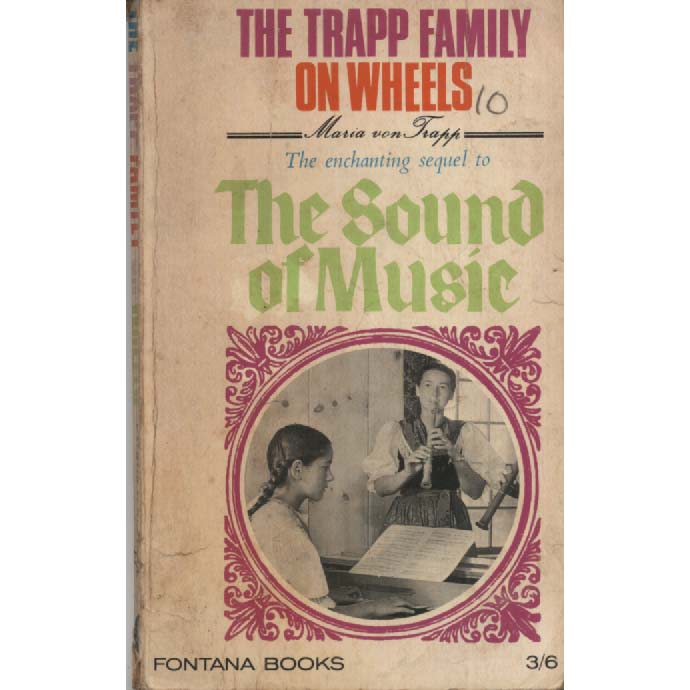
AI-assisted note, based on the text and a physical inspection of this copy.
“The Trapp Family On Wheels” by Maria von Trapp is a curious entry in the annals of mid-20th century literature, encapsulating the spirit of adventure and familial bonds against the backdrop of the American landscape. As a sequel to the more widely known “The Sound of Music,” this book takes readers on a journey with the Trapp family as they embark on a cross-country trip in a motor home. The cover design, typical of the 1960s, features a nostalgic illustration that captures the essence of the family’s joyous escapades, adorned with cheerful colours that evoke a sense of warmth and nostalgia. This paperback edition, published by Fontana, embodies the era's aesthetic, with its slightly worn edges and aged paper, making it a tangible relic of its time.
Maria von Trapp, the author, is best known for her role as the matriarch of the Trapp Family Singers, whose story inspired the beloved musical and film. Her life story is marked by resilience and creativity; after fleeing Austria during World War II, the family settled in the United States, where they found success in performance and storytelling. However, much of her literary output seems to have been overshadowed by the enormous cultural impact of “The Sound of Music.” “The Trapp Family On Wheels” appears to be less documented and is often overlooked, leading to speculation about its place in her broader oeuvre and the extent of her literary contributions. While some may argue that her fame rests on the coattails of a singular narrative, it is important to recognise her endeavour to encapsulate the spirit of her family's journey in this book.
Published in 1966, “The Trapp Family On Wheels” coincides with a period in American culture that was marked by a growing fascination with travel, particularly in the wake of post-war prosperity. The mid-1960s saw an uptick in family-oriented narratives, with the burgeoning popularity of road trips as both a leisure activity and a rite of passage for many families. The book taps into this zeitgeist, illustrating the joys and challenges of family travel, which resonated with readers eager for stories that reflected their own experiences. Furthermore, the era's burgeoning counterculture movement introduced a sense of freedom and exploration that is palpable in the narrative, as the Trapp family seeks adventure and connection with the wider world.
The narrative unfolds through a series of vignettes that highlight the family’s interactions with various people and places along their journey. Von Trapp’s writing style is accessible and straightforward, catering to a family audience. However, it occasionally lacks the depth and nuance that one might expect from a more seasoned author. The prose feels somewhat simplistic, which may reflect the author’s intention to appeal to a younger readership or families looking for light-hearted entertainment. The stories are peppered with charming anecdotes, but they can also feel repetitive, as the overarching theme of adventure sometimes overshadows character development and emotional resonance.
In terms of print culture, the book is a fascinating artefact of its time, embodying the characteristics of 1960s publishing trends that favoured mass-market paperbacks. The tactile experience of holding the book, with its slightly yellowed pages and soft cover, evokes a sense of nostalgia that aligns with the themes of family and memory present in the text. The book’s publication by Fontana, a publisher known for producing popular fiction, suggests that it was intended for a wide audience, aiming to capture the attention of families eager for wholesome tales.
Despite its many charms, “The Trapp Family On Wheels” does not escape criticism. The book is often seen as lacking the dramatic tension and emotional depth found in its predecessor. It can feel like a series of charming but disconnected moments rather than a cohesive narrative arc. Readers might find themselves longing for more substantial character development and thematic exploration. Additionally, those unfamiliar with the Trapp family’s backstory may find themselves at a loss, as the book assumes some prior knowledge of their history and previous adventures.
In conclusion, “The Trapp Family On Wheels” is a nostalgic journey that reflects the spirit of its time, capturing the essence of family travel and adventure. While Maria von Trapp’s literary efforts may not have garnered the same acclaim as her musical contributions, this work stands as a testament to her desire to share her family’s experiences. For those interested in the cultural and historical context of the 1960s, this book offers a glimpse into a simpler time when the open road symbolised freedom and exploration. It is a charming yet flawed addition to the canon of family literature, making it a noteworthy read for those who appreciate the quirks of Crappy Old Books.