AI-assisted note, based on the text and a physical inspection of this copy.
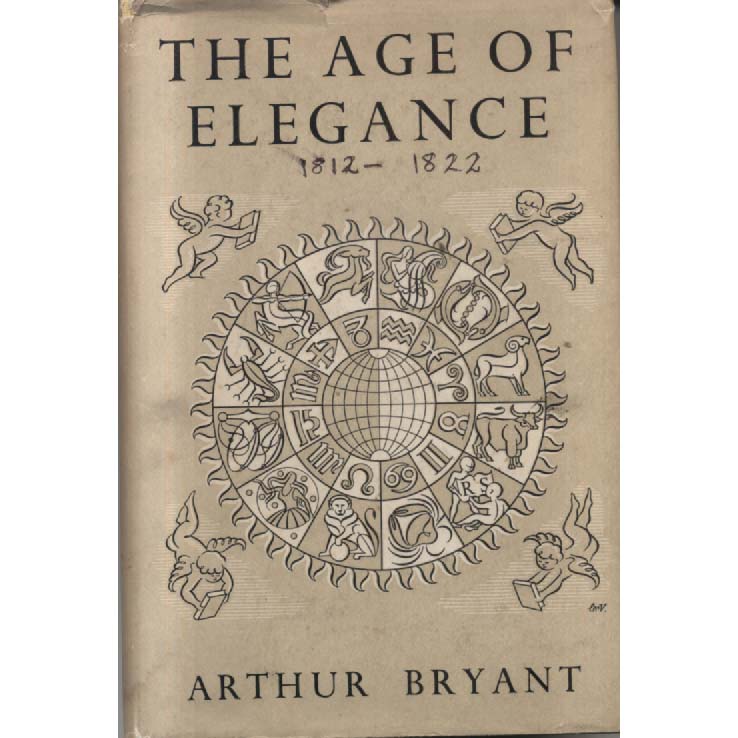
Arthur Bryant's "The Age of Elegance," published in 1954 by the Reprint Society, presents itself as a cultural artefact steeped in the aspirations and aesthetics of mid-20th century Britain. The book, with its somewhat austere cover design, evokes a sense of gravitas, befitting a work that aims to explore an era defined by refinement and sophistication. The muted palette of its cover, adorned with simple motifs, suggests a genteel approach to its subject matter, appealing to an audience that values both history and style. The paperback format, while practical, exudes a certain vintage charm, taking us back to an era when such publications were staples on the shelves of the literate classes.
In "The Age of Elegance," Bryant attempts to encapsulate the spirit of the 18th and 19th centuries, celebrating the cultural achievements of a time regarded for its artistic and social refinement. The prose is often embellished, reflecting the elegance of the age he describes, yet can at times feel grandiose, perhaps even overly nostalgic. Readers may find themselves lost in a haze of Victorian sentimentality, which can be a double-edged sword—immersive yet potentially alienating for those unacquainted with the intricacies of the period's cultural milieu. Bryant's narrative often meanders through various historical anecdotes and figures, creating a tapestry that is as rich as it is, at times, confusing.
Arthur Bryant himself occupies an interesting place in literary history, though he remains relatively obscure in contemporary discussions. Best known for his historical works, Bryant was a prolific author and broadcaster during the mid-20th century, contributing significantly to the popular understanding of British history. His writings often reflected a patriotic outlook, and he was known for his ability to weave narratives that were both educational and engaging. While he may not have garnered the same level of acclaim as some of his peers, his contributions to historical literature, particularly during a time when the public had a renewed interest in national identity post-World War II, are noteworthy. Speculatively, his work may have resonated with readers seeking solace in a sense of continuity and elegance amidst the rapidly changing socio-political landscape of the time.
Published in 1954, "The Age of Elegance" emerges from a period marked by a distinct shift in British culture following the war. The early 1950s were a time of recovery and reflection, as the nation grappled with its place in a new world order. There was a palpable yearning for the civility and grandeur of previous eras, a sentiment that Bryant's work seems to echo. The book taps into this cultural zeitgeist, offering readers a nostalgic escape to a time perceived as more refined and dignified. This yearning for elegance may have been particularly appealing to a populace keen to re-establish a sense of identity and pride during a decade of rebuilding and reinvention.
Thematically, "The Age of Elegance" intertwines notions of aesthetics with a broader historical narrative, inviting readers to consider how beauty and culture reflect societal values. Bryant’s exploration of the period is marked by an appreciation for the arts—literature, architecture, and fashion—and how they coalesce to form a cultural identity. Yet, while the text succeeds in illustrating the splendour of the era, it sometimes falters in providing a critical lens through which to view its subjects, instead opting for a more celebratory tone that may not fully acknowledge the complexities of the time.
As a cultural object, the book captures the essence of its era not only through its content but also through its presentation and the demographic it seeks to engage. It speaks to a readership that is both nostalgic and aspirational, likely appealing to those who value the intricate dance of history and elegance. The Reprint Society, known for its publication of works that capture the historical zeitgeist, presents this volume as a testament to the enduring allure of a bygone age.
In conclusion, "The Age of Elegance" by Arthur Bryant is a fascinating glimpse into a time when elegance was not just an aesthetic but a cultural aspiration. The book’s nostalgic tone and rich narrative invite readers to reflect on the past while also encouraging them to critique the disparities between then and now. Though Bryant may not be a household name today, his work serves as a valuable cultural document, reminding us of the elegance that once defined an era. Crappy Old Books is proud to highlight such unique literary artefacts that offer a window into the past, encouraging us to ponder the complexities of history and its enduring legacy.