AI-assisted note, based on the text and a physical inspection of this copy.
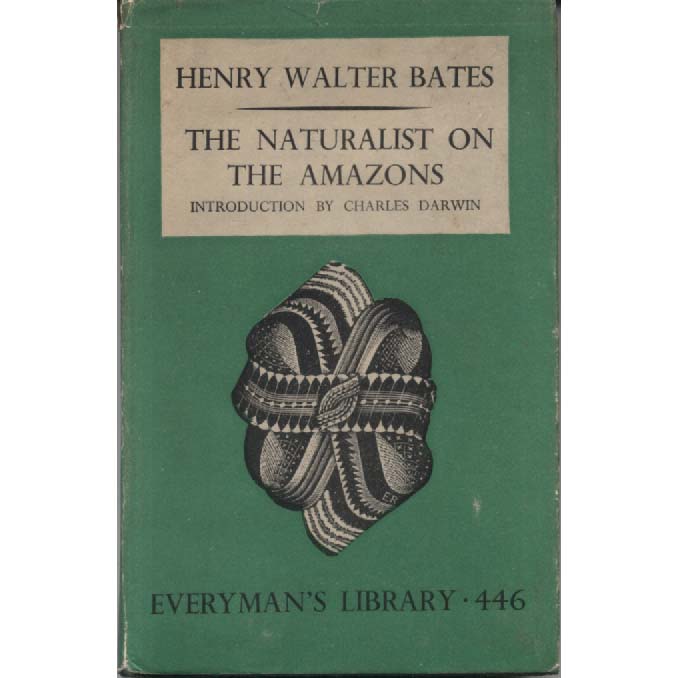
In the realm of early naturalist literature, "The Naturalist on the Amazons" by Henry Walter Bates stands as a fascinating yet somewhat obscure work that encapsulates the spirit of exploration and scientific curiosity of its time. This edition, published in 1930 by Everyman’s Library, features a rather unassuming cover design that reflects the simplicity and utilitarian aesthetic of its era. The soft, muted tones and classic typography evoke a sense of nostalgia, appealing to readers who appreciate the charm of vintage books. The paperback vibe invites one to delve into the text without the pretentiousness often associated with modern hardcovers, making it an accessible read for anyone interested in natural history.
Henry Walter Bates, though not a household name today, was a prominent figure in the 19th century, celebrated for his extensive work in entomology and his explorations in the Amazon rainforest. His contributions to the study of natural selection, particularly through his research on mimicry in butterflies, have left a mark on the field. Bates was a contemporary of Charles Darwin, and his work provided critical evidence supporting Darwin's theories. However, despite his significant contributions, little is widely known about his personal life or broader literary impact, which renders him somewhat obscure in the popular literary canon. The absence of extensive documentation about his life beyond his scientific achievements contributes to a sense of mystery surrounding his character.
Published in 1930, this book emerges from a time when interest in the natural sciences was burgeoning. The early 20th century was marked by a growing fascination with exploration and discovery, spurred by technological advancements and a desire to understand the world more thoroughly. The Amazon, as one of the last frontiers, captured the imaginations of many. This period saw a shift in how nature was perceived, transitioning from a romanticised view to a more scientific approach. Bates's narrative reflects this transition, melding personal adventure with meticulous observation, and contributes to the rich tapestry of travel literature that feeds both the scientific community and the general public's yearning for knowledge about distant lands.
The content of "The Naturalist on the Amazons" is a mixture of personal memoir and scientific observation, where Bates recounts his experiences while navigating the lush and often perilous environment of the Amazon rainforest. His prose is imbued with a sense of wonder and reverence for nature, demonstrating an early understanding of ecological balance long before it became a popular concern. The text is peppered with detailed descriptions of the flora and fauna he encountered, revealing Bates's keen observational skills and deep appreciation for the intricacies of life in the jungle. Each chapter invites the reader to walk alongside him as he explores the vibrant ecosystems, providing insights into both the challenges of his journey and the beauty of the natural world. However, the book occasionally feels dated, with language and perspectives that can be jarring to contemporary sensibilities.
The Everyman’s Library edition of 1930 is notable not just for its content but also for its production quality. Everyman’s Library was known for creating enduring volumes that aimed to make classic literature accessible to a wider audience. This edition, while it lacks the glossiness of modern publications, offers a tactile experience that many readers of older texts cherish. The paper quality, the binding, and even the slight smell of aged paper transport one back to a time when books were cherished objects rather than disposable commodities. The physicality of the book itself is a testament to the enduring nature of printed works, which have the ability to outlast the digital fluctuations of contemporary media.
While "The Naturalist on the Amazons" is a product of its time, it also raises questions about the legacy of exploration literature and the ethics surrounding it. Bates’s account, like many narratives of exploration, can be viewed through a modern lens that critiques the impact of colonialism on indigenous peoples and their environments. Today, there is a growing awareness of the complexities involved in documenting and sharing stories of exploration, particularly when they intersect with the lives and cultures of those who inhabit the regions being explored. Bates’s work opens the door to such discussions, inviting readers to reflect on the implications of scientific discovery and the often romanticised notion of the ‘noble explorer’.
In summary, "The Naturalist on the Amazons" is a captivating piece of literature that bridges the gap between science and adventure. Henry Walter Bates’s observations contribute significantly to our understanding of natural history and the Amazon itself. While the author may not enjoy widespread recognition today, his work remains an important part of the dialogue surrounding naturalism and exploration. The 1930 Everyman’s Library edition serves not only as a vessel for Bates’s words but also as an emblem of a time when literature and science began to intertwine more deeply. For those who appreciate the charm of Crappy Old Books and the cultural contexts they represent, this volume is certainly worth a read, offering both historical insight and an appreciation for the wonders of the natural world.