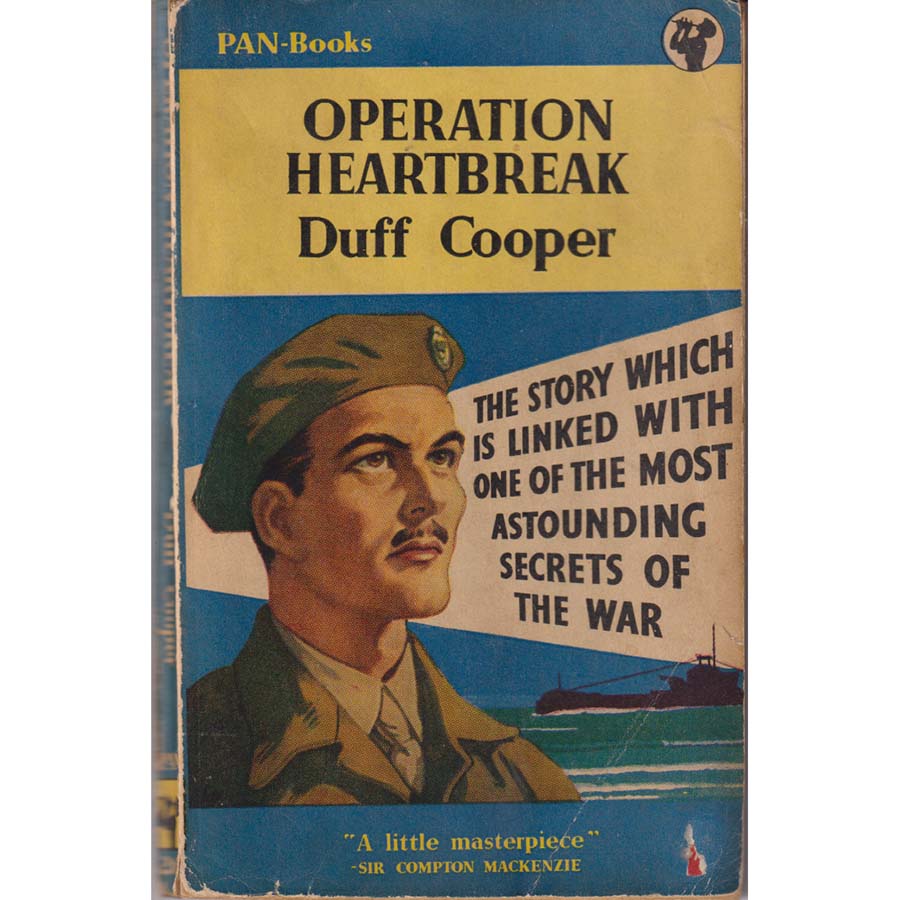
AI-assisted note, based on the text and a physical inspection of this copy.
“Operation Heartbreak” by Duff Cooper, first published in 1953 by Pan Books, is a curious artefact of mid-20th-century literature that has found its way into the pantheon of Crappy Old Books. The cover design of this paperback edition features a somewhat dramatic illustration that evokes a sense of intrigue, yet it lacks the finesse often sought in modern book covers. The muted colour palette, predominantly featuring shades of orange and navy, aligns with the design sensibilities of the post-war era, but might seem underwhelming to contemporary readers accustomed to more vibrant and polished aesthetics. The paperback itself exudes a certain fragility, characteristic of the time, when mass-market paperbacks were gaining traction, offering readers affordable access to literature, albeit at the cost of longevity.
Duff Cooper, the author of this novel, is a figure whose life is more notable than his literary output. He was a British politician and diplomat who served as a member of the Conservative Party and held various governmental roles during his career. Although Cooper's literary contributions might not hold the same weight as other contemporaries of his era, he remains a significant figure in the context of British political history. Yet, his foray into fiction seems to have been more of an aside than a defining characteristic of his life. The obscurity surrounding his literary career is palpable, as there are few records of his works having a lasting impact on the literary landscape. This lack of documentation raises questions about the reception of “Operation Heartbreak” and whether it was merely a diversion from his more prominent political life.
Published in 1953, “Operation Heartbreak” arrived at a time when the world was grappling with the aftermath of World War II. The early 1950s in Britain were marked by a cultural shift as society began to emerge from the shadows of conflict, seeking to rebuild and redefine itself. This period saw a burgeoning interest in new narratives that encapsulated the complexities of human emotions and relationships, which might explain the thematic explorations within Cooper's work. However, it is essential to acknowledge that the novel does not appear to resonate strongly with the zeitgeist of its time; rather, it feels like a relic, overshadowed by the more profound literary movements and the evolution of popular culture that followed. As a product of its era, “Operation Heartbreak” reflects the transitional phase in British literature, where traditional values clashed with emerging modernist perspectives.
The narrative itself, while it may aim to weave a tale of human emotion and conflict, often stumbles under the weight of its own ambition. Readers of “Operation Heartbreak” might find themselves navigating a convoluted plot that fails to deliver the expected emotional depth. The characters often come across as archetypal rather than fully realised individuals, limiting the reader's ability to connect on a more profound level. The dialogue can feel stilted, a hallmark of its time, which detracts from the overall reading experience. This is not to say that the book is devoid of merit; rather, it serves more as a reflection of its author’s background in politics than in literary artistry.
The print culture of the 1950s was undergoing a significant transformation, with paperbacks becoming a staple of everyday reading. Pan Books was at the forefront of this revolution, making literature accessible to a broader audience. However, “Operation Heartbreak” does not stand out in the crowded marketplace of the time. Unlike other more memorable titles from this era, Cooper's work has not maintained its place in the collective literary consciousness. The book embodies a certain charm typical of less revered novels, yet it ultimately seems to fade into the background when compared to the more impactful narratives of the same period.
In examining “Operation Heartbreak,” one cannot ignore the cultural significance of the book as a product of its time. It captures a moment in literary history where the lines between politics and literature blur, a reflection of an author who was more at home in the halls of power than in the realms of fiction. Despite its shortcomings, the novel offers a glimpse into the complexities of human relationships as filtered through the lens of a political figure. This duality might provide a unique perspective for readers interested in the intersection of these worlds, though it may not fulfil the expectations of those seeking a gripping literary experience.
Ultimately, “Operation Heartbreak” stands as a testament to a bygone era of publishing and narrative form. While it may not achieve the heights of literary acclaim, it serves as a reminder of the diverse voices that emerged in the aftermath of the war. The book may not resonate with contemporary audiences, but it remains an interesting cultural object, ripe for exploration by those intrigued by the quirks of literary history. Crappy Old Books has preserved this piece of literary history, ensuring that even the less celebrated works find their place in the annals of time.