AI-assisted note, based on the text and a physical inspection of this copy.
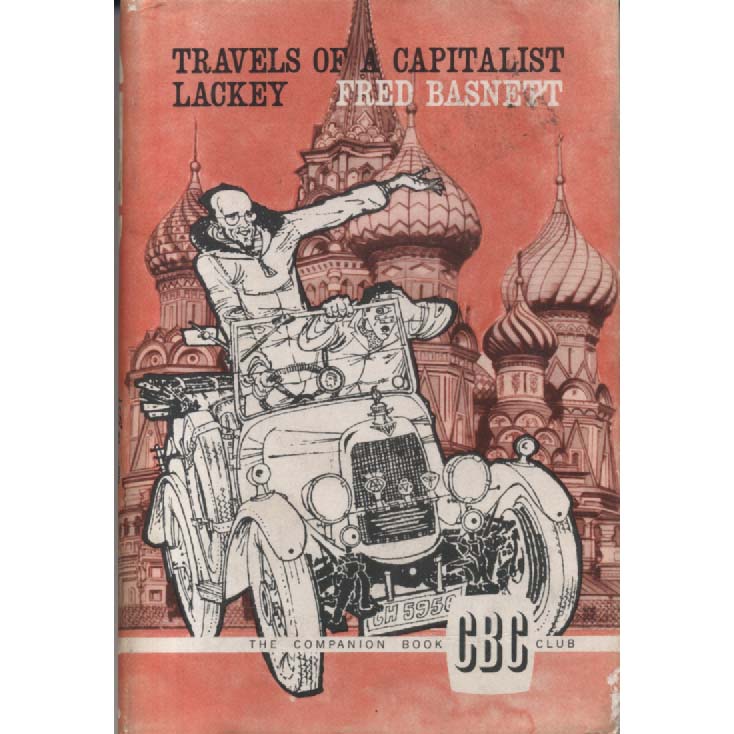
“Travels Of A Capitalist Lackey” by Fred Basnett, first published in 1965 by Companion Book Club, serves as a curious artefact of its time, encapsulating the spirit of a period marked by economic turbulence, social upheaval, and a burgeoning counterculture. The book’s cover design features a somewhat austere layout, typical of mid-20th century publishing, with bold typography that hints at both seriousness and irony. The muted colour palette reinforces a sense of the era’s ambivalence towards capitalism, while the paperback format invites casual reading, perhaps on a train or in a café, which was in line with the culture of the '60s when literature began to be more accessible to the masses.
As one dips into Basnett's narrative, the tone is unmistakably reflective of a time when the post-war economic boom was beginning to show its cracks. The author’s exploration of capitalism through a personal lens provides insights into the societal dynamics of the 1960s. The prose often oscillates between satire and earnestness, revealing the contradictions and complexities of a system that was, at once, both lauded and reviled. The book is peppered with anecdotes and observations that resonate with the reader, drawing them into a world where the pursuit of wealth is both a dream and a burden. Its conversational style and engaging storytelling make it an intriguing read, yet it is simultaneously filled with the disillusionment characteristic of the period, suggesting that the promise of capitalism might not be as golden as it once appeared.
Fred Basnett appears to be a rather obscure figure in the literary landscape, with limited biographical information available. There seems to be scant documentation regarding his life or career, which leaves a certain air of mystery around him. Speculation about his background might lead one to consider that he was possibly a writer who engaged deeply with the socio-political currents of his time. However, without concrete information, it is challenging to position him within the literary culture definitively. His works, including “Travels Of A Capitalist Lackey,” could suggest he was an observer of society, keen to critique the prevailing norms and values of his day.
Published in 1965, the book resonates with a decade that was not only marked by economic growth but also by significant social changes. The countercultural movements were gaining momentum, challenging traditional notions of authority and capitalism. This period saw the rise of a new consciousness around issues such as civil rights, anti-war protests, and a questioning of the established social order. Basnett’s work, in many ways, captures the zeitgeist, offering a lens through which readers can examine the contradictions of the capitalist system during a time of profound transformation. The book sits comfortably within the backdrop of a society grappling with its identity, making it a worthwhile reflection for those interested in the cultural undercurrents of the '60s.
The experience of reading “Travels Of A Capitalist Lackey” is akin to witnessing a personal journey through the economic landscapes of the time, interwoven with the broader tapestry of societal change. Basnett's observations are tinged with a sense of irony that often resonates with contemporary readers, making it a relevant piece of literature even decades after its initial release. The book stands as a testament to the era’s complex relationship with capitalism, urging readers to reflect on their own positions within this system.
In sum, while “Travels Of A Capitalist Lackey” may not have garnered the widely celebrated acclaim that some contemporaneous works achieved, it nonetheless holds a unique place as a cultural document of its time. Its exploration of capitalism, both as a system and a personal journey, invites reflection on the nature of wealth and the societal structures that support it. For those intrigued by the intersections of literature and socio-economic critique, this book offers a valuable glimpse into the psyche of the 1960s.
As a product of Crappy Old Books, “Travels Of A Capitalist Lackey” remains an intriguing read, showcasing the literary tendencies of a bygone era while prompting discussions that are still relevant today.