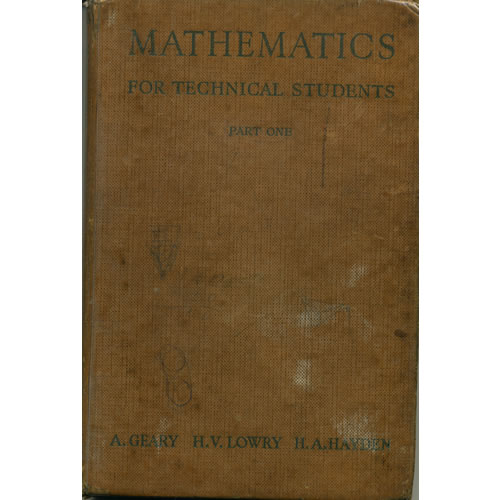
AI-assisted note, based on the text and a physical inspection of this copy.
“Mathematics for Technical Students Part Three” is a quintessential example of mid-20th century educational literature, embodying the utilitarian design and content typical of its era. The cover design features a rather austere and functional aesthetic, with a muted colour palette that does little to entice the casual reader. The paperback format, characteristic of educational texts from this period, suggests a certain level of accessibility, although the paper quality leans towards the flimsy side, indicative of budget constraints in the publishing world of the time. The stark typography, devoid of embellishments, reflects the no-nonsense approach to mathematics, aiming to convey information rather than engage in artistic expression.
In examining the authors, A Geary, HV Lowry, and HA Hayden, it appears that they occupy a somewhat obscure place in the annals of educational publishing. There is scant information available regarding their individual contributions to mathematics or academia, suggesting that they were perhaps not prominent figures in literary or scholarly circles. This anonymity, however, does not diminish the text's utility as a resource for technical students in the field of mathematics. The collaborative effort among these authors indicates a pooling of expertise, aimed at addressing the specific needs of students pursuing technical subjects.
Published in 1960, this text emerges from a period marked by significant advancements in technology and a growing demand for skilled workers in technical fields. The post-war era saw a surge in educational reforms and a focus on practical skills, making mathematics increasingly relevant to students in engineering, manufacturing, and other vocational disciplines. This context likely influenced the book’s content, which is designed to equip students with mathematical principles that are directly applicable to their fields. The 1960s were a time of optimism and progress, as societies began to embrace the possibilities of modern technology, and this book serves as a testament to that spirit.
The content of “Mathematics for Technical Students Part Three” is structured to reinforce foundational mathematical concepts, progressively building on knowledge that is crucial for technical applications. The text is dense with formulas, diagrams, and practice problems, aligning with the educational philosophy of the time that prioritised rote learning and mastery of skills. While this may appeal to the dedicated student wishing to delve deeply into the subject matter, the book’s lack of engaging narratives or relatable examples may render it uninviting to those less passionate about mathematics. The pedagogical approach reflects the era’s educational norms, which often viewed mathematics as a series of challenges to be overcome rather than a dynamic field of inquiry.
One notable aspect of the book is its commitment to clarity and precision in mathematical language, which is essential for students who are likely grappling with complex concepts. However, this commitment to clarity can sometimes result in a dry reading experience that lacks the vibrancy found in more contemporary educational materials. The text’s layout, while functional, does not provide the visual stimulation or interactive elements that are now prevalent in modern textbooks. This serves as a reminder of how far educational publishing has come, with advancements in design and pedagogical strategies aiming to engage a broader audience.
Despite its dated presentation and somewhat uninspired design, “Mathematics for Technical Students Part Three” remains a valuable resource for those seeking to solidify their understanding of technical mathematics. The book’s straightforward approach is well-suited for dedicated learners who appreciate a no-frills educational experience. It is a cultural artifact of its time, encapsulating the values and priorities of an era focused on practical skills and vocational training.
In conclusion, “Mathematics for Technical Students Part Three” serves as a window into the educational practices of the 1960s, reflecting both the aspirations of its authors and the cultural context of its publication. While the authors themselves may not be widely known, their collective effort contributed to a body of educational literature aimed at fostering technical expertise. For those interested in the evolution of educational texts and the cultural significance of mathematics in vocational training, this book offers a nostalgic glimpse into a bygone era of pedagogical philosophy. Crappy Old Books celebrates such works, recognising their historical and cultural value, even when their appeal may not resonate with the contemporary reader.