AI-assisted note, based on the text and a physical inspection of this copy.
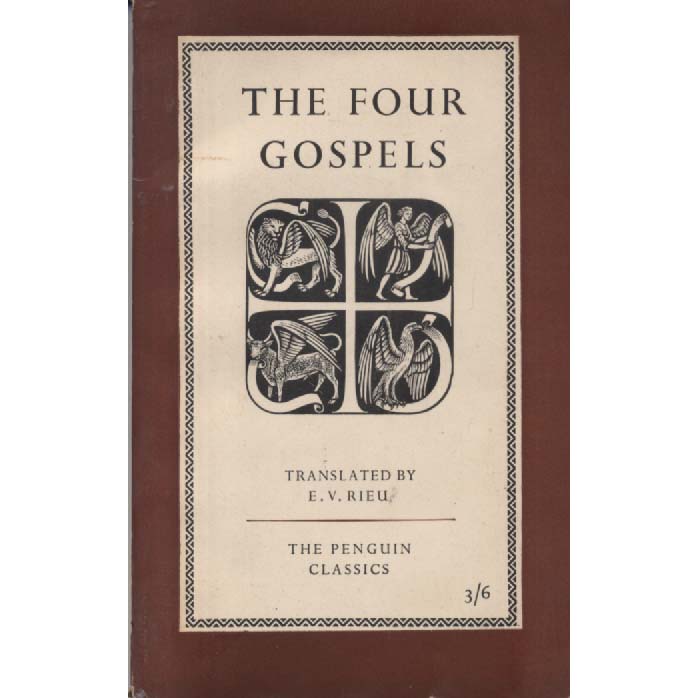
The 1956 edition of The Four Gospels by E.V. Rieu is a notable entry in the Penguin Classics series, which has long been a hallmark of accessible yet scholarly literature. This edition presents a modern English translation of the Gospels—Matthew, Mark, Luke, and John—making them approachable for contemporary readers. The cover design is typical of the Penguin Classics aesthetic, featuring a simple but striking black and white motif which draws from both traditional and modern elements. Its paperback format is lightweight, a characteristic feature of the Penguin series, inviting readers to engage with the text in a casual setting, whether on a train or in a coffee shop. However, the quality of the print and binding reflects the era’s market trends: while it is serviceable, it lacks the durability that might be expected in a book of such cultural significance.
Rieu, an author who remains somewhat obscure in the broad landscape of literary history, is best known for his translations, particularly of classical texts. While not a household name, he has made contributions to the field of literature that resonate with those interested in translations and adaptations of ancient texts. His work in translating the Gospels into modern English reflects a commitment to making religious texts accessible to a wider audience, yet his life outside of this work is not widely documented. It appears that Rieu focused primarily on his translation efforts, which has left little in the way of biographical records aside from his published works. This has resulted in a relatively low profile in the annals of literary culture, overshadowed perhaps by more prominent figures in the field.
Published in 1956, this version of The Four Gospels emerged in a post-war context where society was grappling with significant philosophical and theological questions. The mid-20th century was a time of shifting paradigms in both religious belief and literary expression. Many readers were seeking to reconcile traditional faith with modern existential questions, and Rieu’s translation offered a fresh perspective on ancient texts. The era was also marked by a growing interest in making literature more accessible to the general public, a movement that Penguin Classics epitomised. In this light, Rieu's translation serves not only as a religious text but also as a cultural artifact reflecting the evolving relationship between faith and modernity.
In terms of the translation itself, Rieu's approach is characterised by a desire to maintain the spiritual essence of the original texts while using language that resonates with contemporary readers. This balance is crucial, as it allows the Gospels to speak to a modern audience without losing the weight of their historical significance. However, some purists might argue that this modernisation dilutes the original intent and beauty of the scripture. Furthermore, the choice of words and phrases, while often effective, can occasionally feel too simplistic, lacking the depth and nuance that might be desired in such profound texts. This aspect of the translation might evoke mixed feelings among readers—those seeking a straightforward narrative might appreciate the clarity, while others may yearn for a more reverent and complex rendering.
The cultural impact of this edition can be seen in its role within the larger scope of religious literature. By placing the Gospels in a format that is approachable and easy to read, Rieu contributed to the democratization of religious texts. This aligns with the broader trends of the 1950s, where there was a push towards inclusivity in literature. The Penguin Classics series has long been celebrated for its ability to bring significant works to the masses, and Rieu's Gospels fit neatly within this mission. Despite the potential criticisms regarding the translation's depth, the mere existence of this edition allows for a wider discourse around the Gospels and their relevance today.
In conclusion, E.V. Rieu's The Four Gospels serves as both a translation and a cultural artifact, situated firmly within the context of the mid-20th century's literary and religious landscape. While the author remains somewhat of a mystery, his contributions, particularly through this Penguin Classics edition, have paved the way for greater accessibility to religious texts. Readers may find themselves engaging with the Gospels in a new light, appreciating the effort to bridge ancient wisdom with modern understanding. This book, like many in the Crappy Old Books collection, invites readers to reflect not only on its content but also on the cultural currents that shaped its creation.