AI-assisted note, based on the text and a physical inspection of this copy.
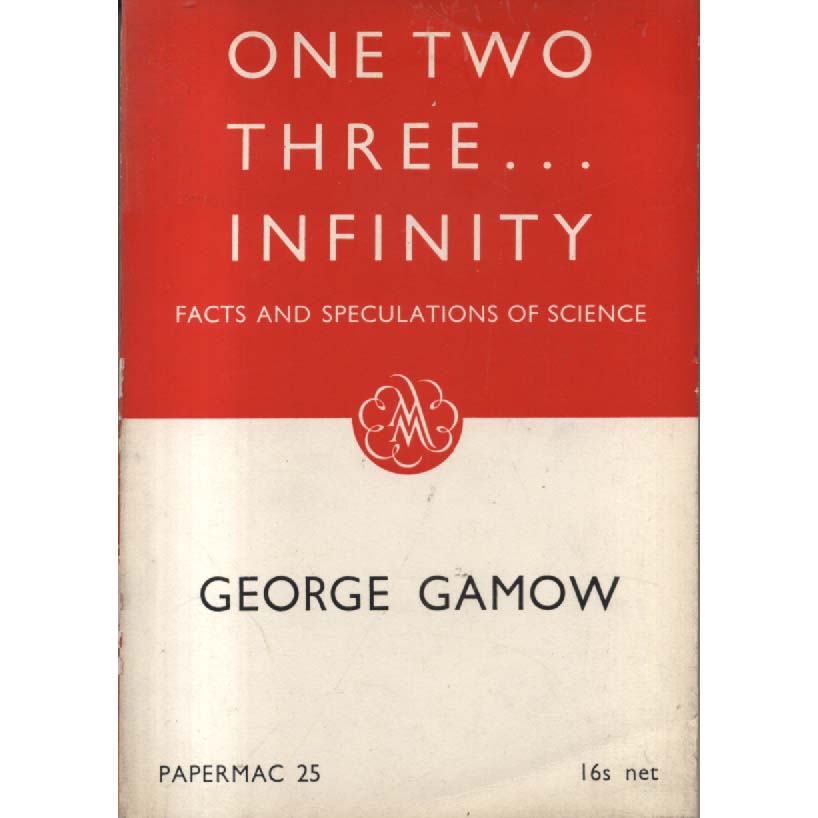
George Gamow's One Two Three Infinity - Facts and Speculation of Science, published in 1962 by Macmillan Press, is a fascinating mix of science communication and speculative thought that endeavours to explain complex scientific concepts to a lay audience. The book is a paperback edition, typical of its time, featuring a cover design that reflects the mid-20th century aesthetic—clean lines, vibrant colours, and an illustration that teases the reader with hints of the vast universe. The cover art, with its abstract representation of atomic structures and cosmic phenomena, captures the spirit of the era’s fascination with science, making it visually appealing and somewhat nostalgic for those who appreciate the aesthetic of books from this period.
Gamow's writing style is engaging and often whimsical, employing an accessible tone that invites readers from all backgrounds to delve into subjects ranging from the fundamentals of physics to the intricacies of cosmology. The book is structured in a way that encourages curiosity, with each chapter building on the last while exploring various themes such as the nature of infinity, the concept of time, and the complexities of the universe. Despite the depth of the material, Gamow's knack for using analogies and thought experiments makes the content digestible, allowing readers to ponder profound scientific questions without feeling overwhelmed.
George Gamow himself is a notable figure in the realm of physics, known primarily for his contributions to the field of cosmology and his work on nuclear physics. Born in Ukraine in 1904, Gamow emigrated to the United States in the 1930s, where he became a prominent scientist and educator. He is perhaps most famously linked to the Big Bang theory and is credited with popularising complex scientific ideas through his writing. His approach to science communication has influenced many subsequent authors and scientists who seek to bridge the gap between expert knowledge and public understanding. While he is not as widely celebrated as some contemporaries, his contributions to both scientific innovation and literature have earned him a respected place in the history of science.
The year 1962 was a significant period in scientific history, marked by rapid advancements and a burgeoning public interest in space exploration, particularly following the launch of Sputnik in 1957. This era saw a cultural shift where science was no longer confined to academia; it became a part of popular culture, inspiring a generation of thinkers, writers, and everyday citizens. Gamow's book emerged at a time when the boundaries of human understanding were being stretched, and the public was eager for knowledge about the cosmos and the underlying principles of the natural world. The optimism of the Space Age was palpable, and Gamow's work contributed to this excitement, encouraging readers to reflect on the mysteries of the universe from a more philosophical perspective.
In terms of print culture, One Two Three Infinity is representative of mid-20th century science literature, which often sought to demystify science for the average reader. The paperback format makes the book accessible and portable, a feature that was increasingly popular during this time as mass-market paperbacks gained traction. The tactile nature of the book, with its slightly weathered pages and the faint scent of aged paper, evokes a sense of nostalgia, reminding readers of a time when the act of reading was a dedicated pursuit, free from the distractions of modern technology.
The book's significance lies not only in its content but also in its cultural context. It embodies a moment when science was becoming a shared passion among the public, and Gamow’s ability to articulate complex ideas in simple terms helped bridge the gap between scientists and the general population. His use of humour and engaging narratives allowed readers to explore scientific concepts while feeling a sense of wonder and curiosity, characteristics that are often lost in contemporary scientific literature.
While Gamow's work has not been without its criticisms—some argue that his speculative approach occasionally oversimplifies complex theories—the enduring charm of One Two Three Infinity lies in its ability to stimulate thought and inspire curiosity. It captures the essence of a time when science was seen as an adventure, a frontier that beckoned exploration and understanding. The book has maintained its relevance in discussions about science communication, serving as a valuable reference for those interested in how to convey scientific ideas effectively.
In conclusion, George Gamow's One Two Three Infinity - Facts and Speculation of Science is a delightful journey through the realms of science, underscored by the cultural zeitgeist of the early 1960s. Its inviting prose and imaginative illustrations make it a unique artifact of its time, one that continues to engage readers and inspire curiosity about the universe. As we reflect on this work within the landscape of Crappy Old Books, it serves as a reminder of the importance of accessible science communication and the enduring power of literature to spark our imagination.