AI-assisted note, based on the text and a physical inspection of this copy.
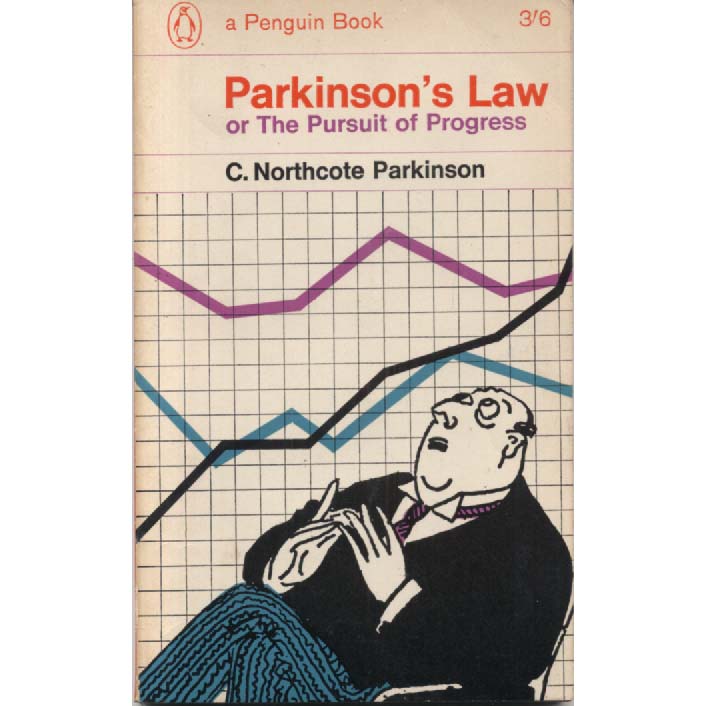
“Parkinson’s Law: or The Pursuit of Progress,” published in 1965 by Penguin Books, is an intriguing cultural object that encapsulates the zeitgeist of its era while presenting a satirical take on bureaucracy and organisational theory. The book’s cover design, typical of Penguin’s mid-century aesthetic, features a minimalist approach with bold typography that commands attention. The simplicity of the cover belies the complexity of the ideas contained within, inviting readers to engage with the text while offering a glimpse into the graphic design trends of the time. The paperback format, slightly worn at the edges, adds to the charm and authenticity, evoking a sense of nostalgia for a time when books were cherished objects rather than mere digital commodities.
C. Northcote Parkinson, the author, appears somewhat enigmatic within the literary landscape. While he is known for his contributions to the study of management and organisational dynamics, specifics about his life and career remain scarce. He is often remembered for his humorous and insightful observations, yet his broader influence on literary culture seems muted. Parkinson’s work, particularly the formulation of the famous adage “work expands to fill the time available for its completion,” has permeated discussions of productivity and time management, placing him in a unique niche. However, aside from this recognition, comprehensive biographical details about his life and other works are light, which may contribute to his somewhat obscure status in the pantheon of management literature.
Published during a period marked by rapid industrialisation and the burgeoning of corporate culture, “Parkinson’s Law” arrived at a time when organisations were expanding, and the complexities of management were becoming a pressing concern. The 1960s were rife with shifts in work culture, as traditional structures were challenged by emerging ideas about efficiency and productivity. Parkinson’s critique of bureaucratic inefficiencies resonated deeply with professionals and academics alike, as it provided a lens through which to understand the challenges of a rapidly changing workplace. The book’s wit and incisiveness allowed it to stand out in a genre that often leaned heavily on dry theories and complex jargon.
The content of “Parkinson’s Law” is characterised by its blend of humour and keen observation, which serves to both entertain and inform. Parkinson employs a series of anecdotes and hypothetical scenarios to illustrate his points, revealing the absurdities of bureaucratic systems. His knack for storytelling transforms what could easily have been a tedious examination of organisational theory into an engaging narrative that captivates the reader’s attention. This approach not only makes the book accessible but also ensures its relevance across generations, as the themes of inefficiency and the absurdities of corporate life continue to resonate today.
In examining the book further, one cannot ignore the impact of its publication context. The 1960s were not only a time of economic change but also a period of cultural upheaval, with the rise of counterculture movements challenging traditional norms. In this light, Parkinson’s satirical analysis of bureaucracy can be seen as part of a broader critique of societal structures, reflecting a growing discontent with established authority. The book’s insights into human behaviour and organisational dysfunction echo the sentiments of a generation eager to question the status quo.
The influence of “Parkinson’s Law” extends beyond its immediate reception; it has been cited and referenced across various fields, from management studies to popular culture. The phrase “Parkinson’s Law” itself has transcended the pages of the book to become a common expression in discussions about productivity and work habits. Its enduring legacy speaks to the power of Parkinson’s observations, as they continue to provide a framework for understanding the dynamics of work and efficiency in an increasingly complex world.
Comparing the book to other works of the time, it stands out for its approachability and humour. In a decade that produced a plethora of serious management texts, Parkinson’s light-hearted yet incisive style offered a refreshing alternative. This accessibility ensured that “Parkinson’s Law” reached a broader audience, appealing not only to academics and professionals but also to the everyday reader seeking insight into the absurdities of their work life.
In conclusion, “Parkinson’s Law: or The Pursuit of Progress” is more than just a book about management theory; it is a cultural artifact that encapsulates a specific moment in history. Through its clever observations and witty prose, it invites readers to reflect on the nature of work and the structures that govern it. The book’s relevance persists, as the challenges of bureaucracy and inefficiency remain pertinent in contemporary discussions about workplace dynamics. As a notable entry in the realm of Crappy Old Books, it reinforces the idea that literature can be both entertaining and enlightening, providing timeless insights into the human condition and the structures we create.