AI-assisted note, based on the text and a physical inspection of this copy.
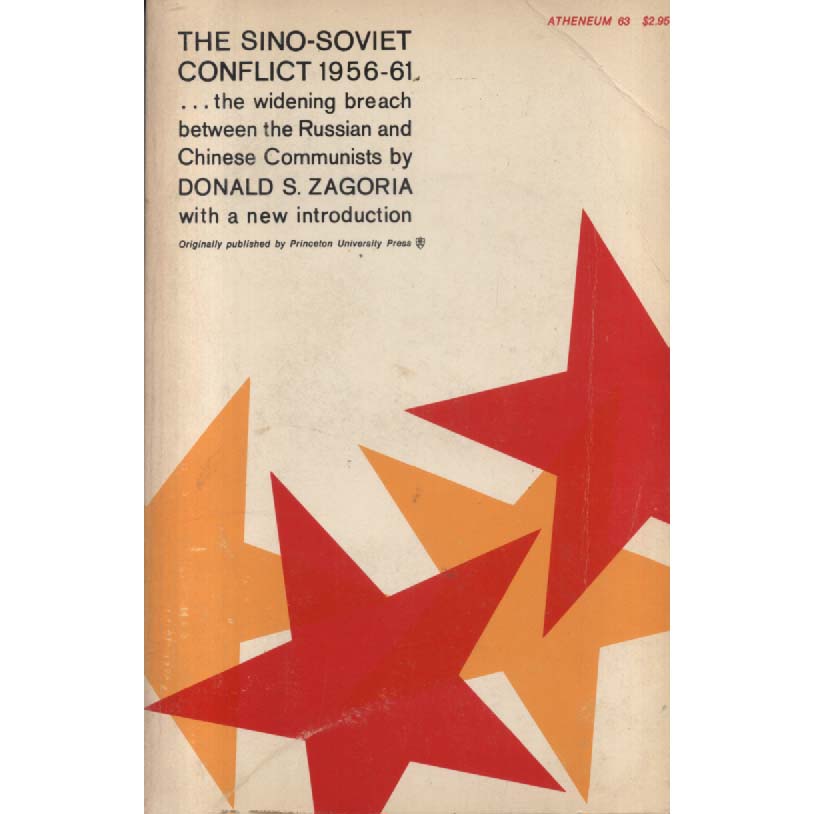
In "The Sino-Soviet Conflict 1956-61," Donald S. Zagoria attempts to dissect a complex and turbulent period in international relations, specifically focusing on the tensions between two communist giants, China and the Soviet Union. Published in 1964 by Princeton University Press, this book exemplifies a mid-20th-century approach to geopolitical analysis, combining a scholarly tone with the earnestness characteristic of Cold War-era literature. The cover design, a modest affair typical of academic publications of the time, features a stark layout with a simple colour palette. The aesthetics reflect the seriousness of the subject matter, eschewing flashy graphics in favour of a more subdued, intellectual presentation that invites the reader to engage with the content on a deeper level.
Zagoria’s work emerges from a period when the Cold War dominated global politics, and the ideological rift between communist powers was becoming increasingly pronounced. His analysis primarily covers the years immediately following the 20th Congress of the Communist Party of the Soviet Union, where tensions were exacerbated by differing interpretations of Marxism-Leninism and national interests. The book serves not only as a historical account but also as a timely commentary on the shifting alliances and rivalries that defined the geopolitical landscape of the era. The publication year, 1964, places it amidst a backdrop of heightened anxieties about nuclear warfare and the ideological battlefields of communism versus capitalism, making the content even more relevant for contemporary readers trying to understand the origins of modern-day international relations.
In terms of authorial background, Donald S. Zagoria appears to be a somewhat obscure figure within the context of literary history. While his works contribute to the field of political science and international relations, detailed biographical information is limited. He is recognised for his scholarly contributions, particularly in the analysis of Sino-Soviet relations, but he does not seem to have achieved the same level of notoriety as some contemporaries in the field. This lack of extensive documentation raises questions about his influence in broader academic circles. Nevertheless, his work remains a touchstone for understanding a critical period in global politics, even if his name does not resonate as strongly as those of more prominent figures.
The era in which "The Sino-Soviet Conflict" was published was marked by a series of significant global events, including the Vietnam War and the Cuban Missile Crisis. The ideological battle lines were stark, and literature from this time often reflected the urgency of the political climate. Zagoria's analysis offers insights into the foundational year of 1956, when the de-Stalinisation process began to reshape Soviet policy, and China was grappling with its own identity under Mao Zedong's leadership. The book’s academic rigor provides a detailed examination of the political maneuvers and ideological clashes, yet it also functions as a historical document that captures the anxieties and complexities of the Cold War era.
The book is structured to facilitate a comprehensive understanding of the conflict, often employing a meticulous, almost clinical approach to the subject. Readers may find that Zagoria balances theoretical frameworks with empirical data, lending credibility to his arguments. However, the prose can be dense at times, reflecting the scholarly nature of the text. It is certainly not light reading, and those unfamiliar with political jargon or historical context may struggle to grasp the nuances of the analysis. This complexity can be both a strength and a weakness, as it underscores the intricacies of international relations while potentially alienating casual readers.
In conclusion, "The Sino-Soviet Conflict 1956-61" stands as a significant cultural object within the realm of Cold War literature. Its publication by Princeton University Press in 1964 situates it within a critical historical moment, while Zagoria's detailed examination of the ideological rift offers valuable insights into the complexities of Sino-Soviet relations. Although the author remains somewhat elusive in terms of broader literary influence, his contribution to academic discourse is noteworthy. For those interested in the intricacies of diplomatic history, this book is a compelling read. However, it may require a commitment to engage fully with its detailed arguments and historical context. Such explorations of past conflicts remain relevant today, reminding us of the persistent nature of geopolitical tensions. Crappy Old Books encourages readers to delve into this text as a window into the past, even if it means navigating the occasional dense passage.