AI-assisted note, based on the text and a physical inspection of this copy.
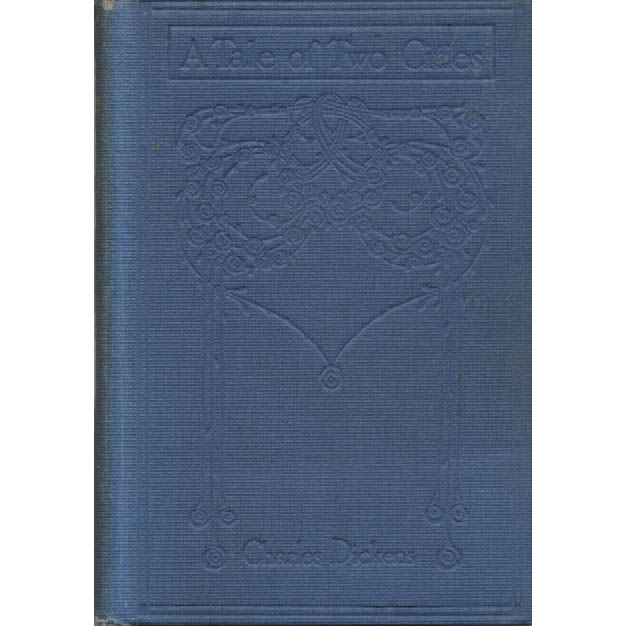
Charles Dickens' A Tale of Two Cities, published in 1911 by Nelson, remains a striking cultural artifact, encapsulating not just a narrative set against the tumultuous backdrop of the French Revolution but also a distinct moment in early 20th-century publishing. While the novel was originally published in 1859, this later edition reflects the evolving design sensibilities and print culture of its time. The cover of this edition, with its faded but rich colour palette, hints at the vintage allure that often accompanies books from this era, appealing to bibliophiles and collectors alike. The typesetting and paper quality suggest a transition toward the more modern printing techniques that would dominate the 20th century, yet they also carry the weight of history, echoing the Victorian era that birthed this beloved classic.
Charles Dickens is a titan of English literature, renowned for his keen social commentary and colourful characterisation. Born in 1812, he lived through the upheavals of the Industrial Revolution and its profound societal implications, which deeply influenced his writing. As a prolific author, he produced a multitude of novels, many of which have become cornerstones of English literature. Dickens' works often reflect his own experiences with poverty and social injustice, making him a significant figure in both literary and social reform circles. His position within the 19th-century literary canon is well-documented, yet the 1911 edition of A Tale of Two Cities highlights an intriguing aspect of his legacy: the enduring popularity of his works, even decades after their initial release. This particular edition may not introduce anything radically new but serves as a testament to the book's lasting impact on readers and its resilience in the face of changing literary tastes.
The year 1911 represents a fascinating period in both print culture and societal development. By this time, the world was on the cusp of significant changes, with the looming shadow of the Great War and the social tensions that would soon erupt across Europe. In literature, there was a burgeoning interest in modernism, yet Dickens' traditional narrative style stood in stark contrast to the experimental forms that would soon dominate the literary landscape. This edition seems to straddle the line between the old and the new, reflecting a nostalgia for a pre-modern era while simultaneously participating in the shifting dynamics of the early 20th century. It speaks to a readership that was likely grappling with its own societal changes, perhaps finding solace in the familiarity of Dickens' exploration of sacrifice, resurrection, and the struggle for justice.
In examining the cultural significance of A Tale of Two Cities, one can’t overlook its themes of duality and revolution. The juxtaposition of Paris and London serves as a metaphor for the contrasts within society itself, and this edition's design subtly evokes those themes. The cover art, though not particularly remarkable, hints at the chaotic beauty of revolution, perhaps intended to attract the curiosity of a reader drawn to historical dramas. The book's physical presence, with its slightly worn edges and textured cover, invites the reader to engage with the text, as if challenging them to reflect upon the historical weight it carries.
The narrative itself, while a product of Dickens' Victorian sensibilities, continues to resonate with contemporary audiences. Its exploration of themes such as sacrifice, familial bonds, and social justice transcends time, making it a staple not only in literary studies but also in discussions about social issues. The character of Sydney Carton, in particular, embodies the complex moral dilemmas that remain relevant today, inviting readers to consider the implications of personal redemption against the backdrop of societal upheaval.
Despite the rich history surrounding Dickens and his works, the 1911 edition of A Tale of Two Cities does not seem to have garnered extensive scholarly attention. It remains somewhat obscure in the context of literary history, possibly overshadowed by the myriad other editions and adaptations that have emerged over the years. This lack of documentation could suggest that this particular version was produced more for the mass market than for literary enthusiasts. However, it still holds value as a cultural object, offering insights into the publishing practices of the time and the enduring legacy of Dickens' work.
In conclusion, A Tale of Two Cities as presented in this 1911 edition by Nelson serves as both a window into the past and a reflection of persistent cultural themes. While Dickens' stature as a literary giant is well-established, this edition invites readers to appreciate the evolving nature of print culture and literary consumption. It stands as a testament to the resilience of classic literature, reminding us that, even in a rapidly changing world, the tales of human struggle and triumph remain timeless. For those interested in exploring the nuances of literary history and the material culture surrounding books, Crappy Old Books offers a delightful avenue for discovery, with this edition of A Tale of Two Cities being a notable entry in the ongoing conversation about the significance of literature across generations.