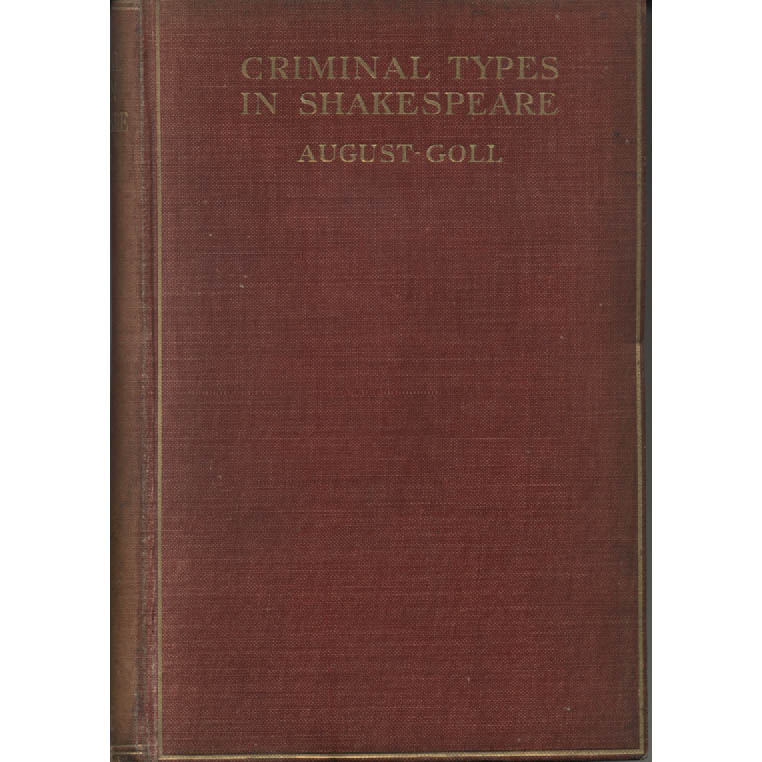
AI-assisted note, based on the text and a physical inspection of this copy.
August Goll's Criminal Types in Shakespeare, published in 1909 by Methuen, is a curious amalgamation of literary analysis and criminological theory, presented through the lens of one of the most revered playwrights in English literature. The book’s cover, a faded illustration of a brooding Shakespearean figure, evokes a sense of nostalgia, reflecting the era's fascination with both the theatrical and the psychological. The paperback vibe is unmistakable, with its slightly dog-eared pages and the faint scent of aged paper, which contributes to its charm as a cultural artifact from the early 20th century.
The text itself is a product of its time, written during the Edwardian period, a time marked by social change and a burgeoning interest in psychology and criminology. Goll’s work attempts to bridge the gap between the arts and sciences, illustrating how Shakespeare’s characters can be viewed through the prism of criminal psychology. The book is filled with meandering arguments, often straying into speculative territory, which may leave the modern reader questioning its scholarly rigor. Yet, it holds a certain appeal for those interested in the intersection of literature and social sciences, presenting Shakespeare not just as a playwright but as a precursor to psychological exploration in character development.
August Goll himself remains a somewhat obscure figure in the literary landscape. While he is not widely known, his work on Shakespeare reflects an academic trend of the early 20th century, where literary figures were often subjected to analysis through contemporary scientific methods. There is little information available about Goll's other works or his influence within the broader literary culture, suggesting that he may have been a niche scholar rather than a prominent literary voice. This obscurity adds an intriguing layer to the reading experience, as it leaves one curious about the life and motivations of the author behind this analytical endeavour.
The year 1909 was pivotal in the cultural context of the Western world, as it was a time when modernist movements were beginning to take shape. The arts were experiencing a shift, with traditional forms being challenged by new ideas and expressions. Goll’s analysis of Shakespeare can be seen as part of this broader cultural dialogue, where the classics were being re-examined under the new light of contemporary thought. This context enriches the reading of Criminal Types in Shakespeare, as it invites readers to consider not only Shakespeare’s work but also how it interacts with the evolving understanding of human behaviour and morality in the early 20th century.
The book is structured in a series of essays, each delving into different characters and themes within Shakespeare’s plays, examining them through a criminological lens. Goll’s arguments are often convoluted, as he attempts to apply psychological theories to figures like Macbeth and Iago. While the intention is commendable, the execution sometimes falters, leading to lengthy passages that may frustrate readers seeking clarity. The prose itself is indicative of the academic style of the period, filled with elaborate sentence structures and a somewhat pedantic tone that may appeal to scholars but could alienate casual readers.
One of the most striking aspects of the book is Goll's insistence on linking Shakespeare’s narratives to contemporary theories of crime and morality. This perspective, although innovative for its time, can feel dated to today’s reader, as modern understandings of psychology have evolved significantly. Nonetheless, it provides a fascinating glimpse into the early 20th century’s attempts to marry literary analysis with scientific inquiry, an endeavour that foreshadows many contemporary approaches in literary studies.
The physicality of the book further enhances its status as a cultural object. The binding, though worn, retains a certain sturdiness that reflects the craftsmanship of early 20th-century publishing. The typeface, a classic serif, lends an air of seriousness to the text, while the occasional illustrations—though sparse—add a visual element that complements Goll's arguments. This combination of textual and physical attributes makes Criminal Types in Shakespeare an intriguing piece for collectors and scholars alike, as it encapsulates a moment in time where literature and science began to converge in unexpected ways.
In conclusion, Criminal Types in Shakespeare by August Goll is a peculiar yet engaging exploration of Shakespearean characters through the lens of criminal psychology. While the author may not be a household name, his work provides an interesting perspective on the intersection of literature and the emerging field of psychology in the early 20th century. The book’s cultural significance is amplified by its publication year, reflecting the shifting tides of thought during a transformative era. For those interested in the quirks of literary analysis and the historical context of Shakespeare, this title is a worthwhile addition to the library, offering a glimpse into the ongoing conversation between the arts and sciences—a conversation that Crappy Old Books invites us to explore further.