AI-assisted note, based on the text and a physical inspection of this copy.
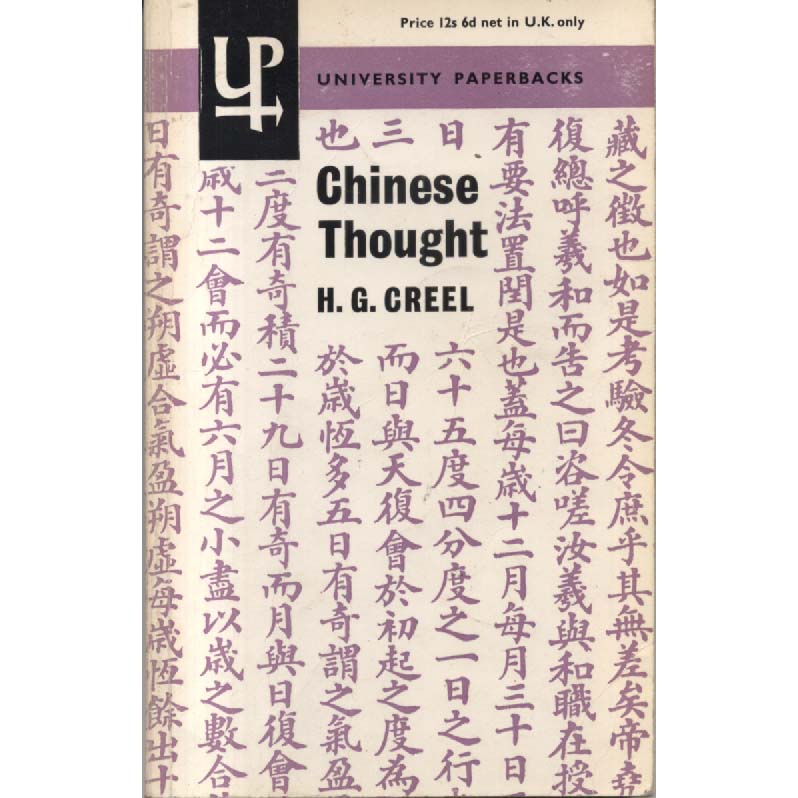
In the realm of intellectual literature, Chinese Thought by H.G. Creel stands as a curious artefact from 1962. Its paperback cover, adorned with a rather simple yet evocative design, reflects a time when publishing leaned heavily on minimalism rather than flashy graphics. The book is well-bound with an almost tactile quality that invites readers to delve into its pages, but its aesthetic is decidedly 'of its time'—a blend of earnestness and a certain academic reserve that characterises much of mid-20th century scholarship. The muted colours and straightforward typography suggest a seriousness of purpose, echoing the scholarly intentions of its author.
H.G. Creel, an American sinologist and scholar, is primarily known for his works on Chinese history and philosophy. Although his name may not evoke widespread recognition today, he carved a niche within the academic community during his lifetime. His expertise was grounded in years of study and experience, particularly in understanding Chinese cultural and philosophical traditions. Creel's contributions to the study of Chinese thought are notable, but his legacy appears somewhat overshadowed by contemporaries who have more prominently shaped the discourse on Eastern philosophies in the Western world. The absence of extensive documentation about his career suggests that while he was respected in scholarly circles, he may not have achieved the same level of fame as some of his peers.
Published during a time when the West was increasingly intrigued by Eastern philosophies, Chinese Thought came at a pivotal moment in cultural exchange. The 1960s marked a period of burgeoning interest in Asian philosophies and religions, partly fuelled by the counterculture movement that sought alternatives to Western materialism. Creel's work fits neatly into this zeitgeist, providing insights into the intricacies of Chinese philosophical traditions for a Western audience eager to understand and engage with ideas beyond their own cultural confines. The book serves not only as an academic endeavour but as a bridge, facilitating dialogue between vastly different ways of thinking. In this light, Creel's work can be viewed as both reflective of its era and a catalyst for ongoing discussions about East-West relations.
The content of Chinese Thought is deeply rooted in the philosophical traditions of Confucianism, Daoism, and other schools of thought that have shaped Chinese intellectual history. Creel presents these ideas with clarity and an intention to demystify complex concepts, making them accessible to a readership that may not have prior exposure to them. However, the book also exhibits the limitations of its time; some interpretations may feel dated or overly simplistic when viewed through the lens of contemporary scholarship, which has evolved significantly since the 1960s. The language is scholarly yet approachable, striking a balance that invites both the interested layperson and the more serious scholar to engage with the material.
The print culture of the 1960s, particularly in the context of academic publishing, played a significant role in shaping how texts like Chinese Thought were produced and distributed. The physical quality of the book is commendable, with a design that prioritises readability, yet it is emblematic of a period when many academic texts were often more about substance than style. This approach has its merits, ensuring that the focus remains on the ideas presented rather than the aesthetics of the publication. Nevertheless, the overall feel is akin to holding a relic from an earlier, perhaps more earnest era of scholarship.
In examining the book's reception, it is clear that while Chinese Thought has not achieved the kind of mainstream recognition that some other works on Eastern philosophy have, it remains a significant contribution to the field. The academic community has acknowledged Creel's insights, particularly regarding the nuances of Chinese philosophical thought. However, the book has not permeated popular culture in the same way that more accessible or sensationalised texts have. This reflects a broader trend in academic publishing, where certain works, even if they are of substantial intellectual value, struggle to find a foothold in a market driven by trends and broader public interest.
In conclusion, Chinese Thought by H.G. Creel serves as both a cultural artefact and an intellectual endeavour from a time when Western interest in Eastern philosophies was on the rise. Its straightforward design, coupled with the earnest scholarly approach of the author, encapsulates the spirit of the 1960s while providing valuable insights into the complexities of Chinese thought. Despite its somewhat niche status in contemporary discussions, it remains a commendable piece of literature that deserves recognition within the pantheon of academic works. For those with a penchant for exploring the intersections of culture and philosophy, this book is a notable entry point, albeit one that may not resonate with every reader in today’s dynamic literary landscape. Crappy Old Books appreciates such overlooked gems, reminding us of the enduring value of thoughtful exploration in literature.