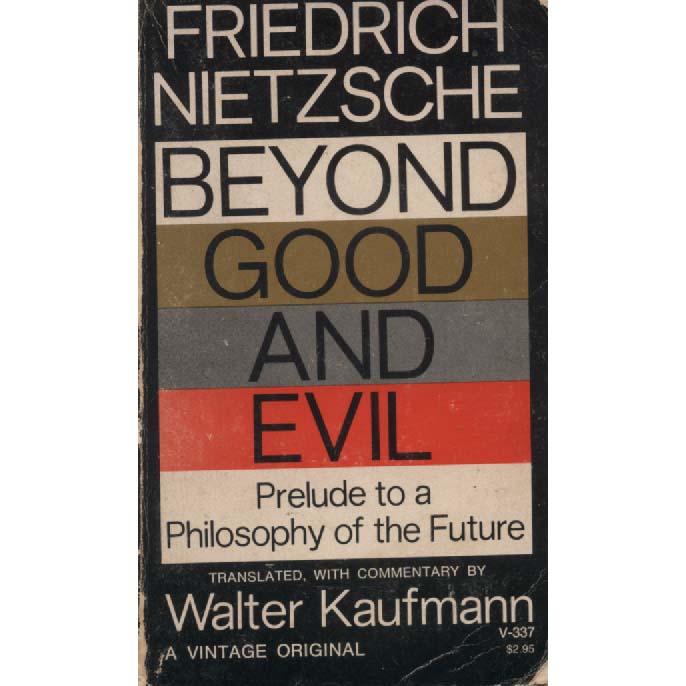
AI-assisted note, based on the text and a physical inspection of this copy.
Friedrich Nietzsche's "Beyond Good and Evil," first published in 1886, continues to resonate with readers today, even in this 1966 Vintage Books edition. The cover design reflects the mid-20th century’s penchant for minimalism, featuring a stark, monochrome palette with bold typography that captures the essence of Nietzsche's philosophical inquiries. The paperback vibe is undeniably classic, and the textured finish of the cover gives it a tactile quality that invites readers to engage with the text. This particular edition, while somewhat removed from the original publication context, serves as a cultural artifact that bridges late 19th-century thought with the modern philosophical landscape.
As a philosophical treatise, "Beyond Good and Evil" challenges established moral paradigms, critiquing traditional notions of morality and proposing ideas that encourage readers to question societal norms and values. Nietzsche's style is both provocative and poetic, filled with aphorisms that provoke deep reflection. The book's structure is somewhat fragmented, comprised of short essays and assertions that demand active engagement from the reader. This format, while potentially disjointed for some, mirrors the chaotic nature of philosophical inquiry itself, making it a challenging yet rewarding read.
Nietzsche, born in 1844 in Prussia, is one of the most significant figures in Western philosophy. His works are frequently characterised by their exploration of morality, culture, and the human condition. "Beyond Good and Evil" marks a pivotal moment in his career, as it signifies his departure from the philosophical traditions of his time, particularly those of Kant and Hegel. Nietzsche's critique of religion, particularly Christianity, and his concept of the "Übermensch" illustrate his radical departure from conventional thinking, positioning him as a forerunner of existentialism. However, despite his prominence in philosophical circles, his life was marked by personal struggles, including mental health issues that ultimately led to his decline in the early 20th century. His influence on various fields, from literature to psychology, cannot be overstated, cementing his legacy within the canon of Western thought.
The year 1966, when this edition was published, was a time of significant cultural upheaval. The post-war era had given rise to countercultural movements that questioned authority, tradition, and established norms—an environment ripe for Nietzsche's ideas to flourish. The 1960s were marked by a burgeoning interest in existential philosophy, with thinkers like Sartre and Camus gaining prominence. In this context, "Beyond Good and Evil" found a new audience among those disenchanted with societal conventions, reflecting the zeitgeist of rebellion and the search for authenticity. Vintage Books, known for its commitment to producing classic literature, recognised the relevance of Nietzsche's work during this period, promoting it as essential reading for a generation grappling with moral ambiguity and existential angst.
The physical form of this paperback edition adds to its cultural significance. The slightly worn pages and the faint smell of age evoke a sense of nostalgia, reminding readers that this book has traversed time and space, passing through many hands before reaching them. The choice of a paperback format makes Nietzsche's challenging ideas more accessible, allowing a wider audience to engage with the text without the intimidation often associated with philosophy. This democratization of knowledge reflects broader changes in publishing culture during the 1960s, when intellectual works began to be marketed to the general public as part of a growing trend toward the popularisation of complex ideas.
In examining "Beyond Good and Evil," one cannot overlook its status as a cultural object that has transcended its original philosophical context. The book's content continues to spark debates about morality, power, and the nature of truth, making it a perennial subject of interest in academic and literary circles alike. Nietzsche's distinctive prose style invites readers to re-evaluate their beliefs, encouraging a form of critical thinking that remains relevant in contemporary discourse. The book serves as a mirror reflecting the reader's own moral convictions, urging them to confront discomforting truths about existence and society.
Ultimately, this Vintage Books edition of "Beyond Good and Evil" is not merely a reprint but a cultural touchstone that captures the enduring impact of Nietzsche's thought. It serves as an invitation for readers to delve into the complexities of morality and personal belief, encouraging a journey of introspection and philosophical exploration. Crappy Old Books continues to champion such essential works, preserving their place in the literary canon and ensuring that the ideas of thinkers like Nietzsche remain accessible to future generations.