AI-assisted note, based on the text and a physical inspection of this copy.
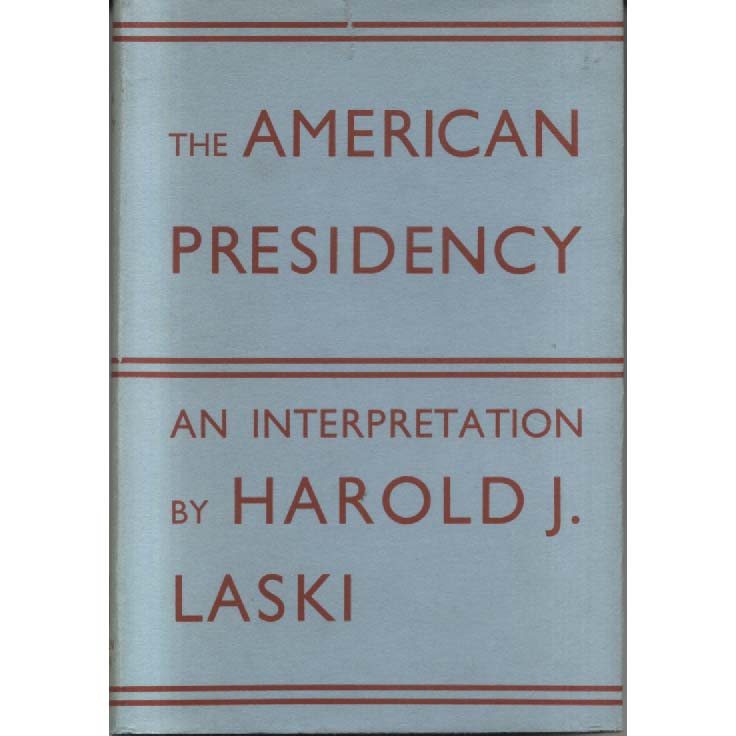
Harold J. Laski's The American Presidency - An Interpretation, published in 1962 by George Allen and Unwin, stands as a notable cultural artifact that encapsulates a specific moment in political thought and scholarship. The book is presented in a standard paperback format, reflecting the mid-20th century publishing trends that favoured accessible political literature. The cover design, utilising bold typography and a minimalistic aesthetic, suggests an earnest attempt to engage the reader with serious political discourse. At first glance, it appears to be an earnest exploration of the complexities surrounding the American presidency, yet upon further examination, it reveals itself to be a product of its time, laden with the intellectual currents and socio-political anxieties of the early 1960s.
Laski, a prominent British political theorist and author, is perhaps best known for his contributions to political thought, particularly in the context of democratic socialism. His work often grappled with the tensions between individual liberty and collective responsibility, a theme that resonates throughout The American Presidency. Laski's reputation rests on his ability to critique and interpret political institutions, making him a significant figure in the study of political science. However, while he is widely acknowledged in academic circles, his works do not always penetrate mainstream consciousness, leading to a somewhat obscure status outside of specific academic fields. This contrast between his scholarly impact and public recognition raises interesting questions about how political thought is received and disseminated.
The year 1962 was a pivotal time in American history, marked by social upheaval, civil rights movements, and the Cold War's ongoing tensions. Within this context, Laski's examination of the American presidency offers insights into the evolving nature of political power and governance. The book was published during a period when questions about presidential authority and responsibility were becoming increasingly salient, particularly in light of events such as the Cuban Missile Crisis. The mid-20th century was characterised by a growing disenchantment with traditional political structures, and Laski's interpretation reflects these anxieties, attempting to dissect the implications of presidential actions and decisions amidst a rapidly changing sociopolitical landscape.
The text itself offers a blend of historical analysis and theoretical inquiry, aiming to elucidate the role and function of the presidency within the larger framework of American democracy. Laski's writing style is indicative of the intellectual rigor of the era, utilising complex sentences and a formal tone reflective of scholarly discourse. However, the accessibility of the text may be limited for casual readers, as it often dives into intricate political theories that may not resonate with those unfamiliar with the academic jargon of political science. This tension between scholarly ambition and reader accessibility is a hallmark of many works from this period, as authors grappled with their desire to engage a wider audience while remaining true to their intellectual roots.
In terms of print culture, The American Presidency emerged in an era when political literature was experiencing a renaissance. The 1960s saw a surge of interest in political theory, with many authors seeking to make sense of the turbulent times. The paperback format allowed for wider distribution and accessibility, which was crucial for fostering public discourse around pressing political issues. However, the book's academic pedigree may have limited its reach to a broader audience, relegating it to university libraries and scholarly collections rather than popular reading lists.
Laski's critical perspective on the presidency also invites reflection on the role of the intellectual in public life. His ability to engage with contemporary issues while drawing on historical precedents speaks to a tradition of political scholarship that seeks to inform and influence public debate. Yet, the degree to which his insights have permeated popular understanding of the presidency remains uncertain, suggesting a disconnect between academic discourse and public engagement in political issues.
Overall, The American Presidency - An Interpretation serves as a valuable cultural object, encapsulating the intellectual climate of the early 1960s while also revealing the limitations of scholarly works in reaching a wider audience. Laski's exploration of presidential power offers a compelling lens through which to view the complexities of American governance, yet the book's dense prose and academic framing may deter the casual reader. It stands as a testament to the challenges of bridging the gap between political theory and public discourse.
In conclusion, The American Presidency is both a reflection of its time and a significant contribution to the understanding of political institutions. For those interested in the intersection of politics and scholarship, it remains a noteworthy addition to the canon of political literature, albeit one that may require some perseverance to navigate. Crappy Old Books invites readers to explore such hidden gems, recognising that even the most obscure texts can offer valuable insights into the cultural and political fabric of their era.