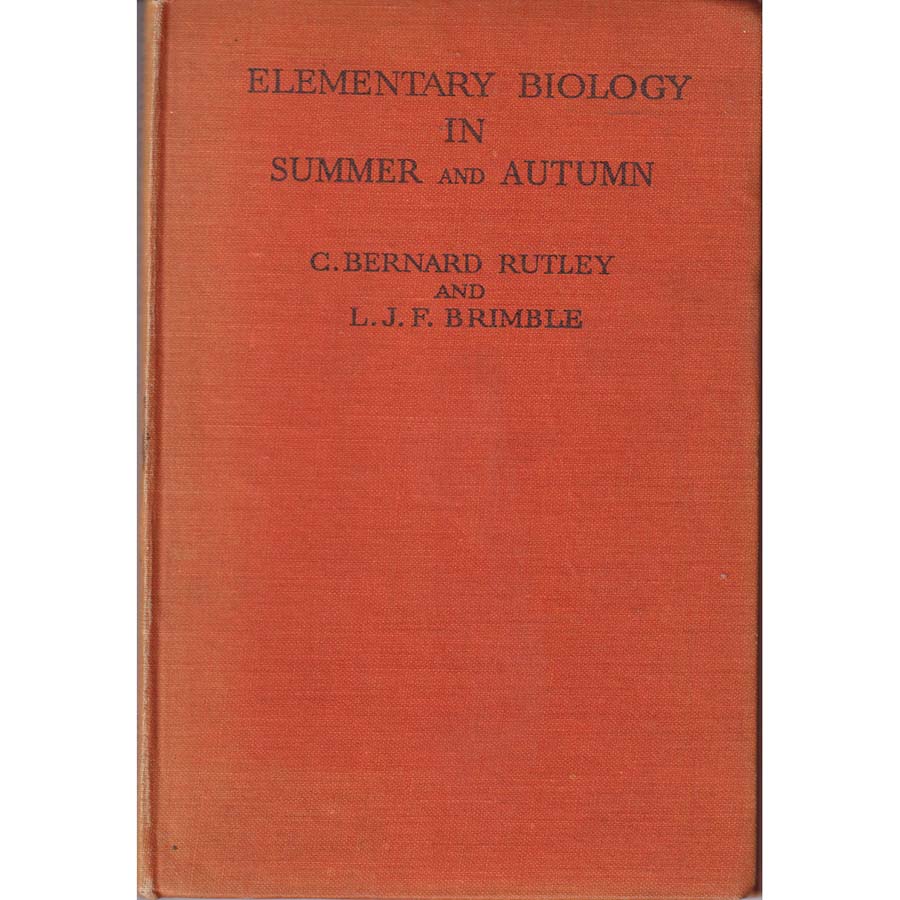
AI-assisted note, based on the text and a physical inspection of this copy.
Elementary Biology in Summer and Autumn is a rather unassuming title that captures the essence of its time, both in content and presentation. Published in 1945 by Macmillan and Co, this book epitomises the post-war era's educational ethos, striving to engage young minds with the natural world during the warmer months. The cover design, typical of mid-20th century educational texts, features a muted palette and simple illustrations that reflect a gentle, pedagogical intent. The paperback format, while utilitarian, also carries a certain nostalgic charm, suggesting an era when such texts were integral to classroom and home learning alike. It’s a tangible reminder of a time when exploration and observation were the cornerstones of biological education, particularly in the context of seasonal change.
The authors, C Bernard Rutley and LJF Brimble, are not particularly well-documented figures in the annals of literary or scientific history. While Rutley’s name may resonate within certain educational or scientific circles, there is limited information available about his broader contributions. Similarly, Brimble appears to be an obscure figure, with scant records detailing his career or works. This obscurity may reflect the collaborative nature of educational publishing during the mid-20th century, where multiple authors contributed to collective efforts rather than establishing individual reputations. As such, the book may serve as a historical artefact of educational collaboration, rather than a platform for individual literary or scientific fame.
Published in the immediate aftermath of the Second World War, Elementary Biology in Summer and Autumn is positioned within a cultural context that values education as a means of recovery and growth. The 1940s were marked by a renewed focus on rebuilding society, and education played a pivotal role in that endeavour. With children returning to schools and communities striving to reconnect with nature, this book reflects a growing interest in natural sciences as foundational to a child's development. The emphasis on seasonal changes in biology aligns with a natural curiosity that many children possess, making the subject matter both accessible and engaging.
The content of the book is straightforward, with a style that prioritises clarity and simplicity. Each chapter is likely structured to guide the reader through various aspects of biology relevant to the seasons of summer and autumn. This approach not only makes the subject matter digestible but also encourages outdoor exploration, tying in with the post-war sentiments of reconnecting with the environment. The language is likely to be tailored for younger audiences or beginners, which is reflective of the educational trends of the time that sought to demystify science and make it more approachable.
In terms of print culture, the book belongs to a period when educational texts were transitioning from purely textual formats to include diagrams, illustrations, and photographs. This evolution was significant, as it allowed for a more interactive experience for the reader, particularly for younger audiences. The illustrations within Elementary Biology in Summer and Autumn would have served not just as decorative elements, but as crucial visual aids to complement the text and enhance understanding. The tactile experience of a paperback book from this era, with its slightly yellowed pages and faint smell of old paper, evokes a sense of nostalgia and history that is often lost in today’s digital age.
The binding of the book, typical of its time, may not exhibit the durability of contemporary publications. This fragility adds an extra layer of charm, hinting at the numerous hands it has passed through since its publication. One can easily imagine it being a staple in classrooms or a well-loved text in family libraries, its pages turned by curious children eager to learn about the world around them. The physicality of the book enhances its cultural significance, as it represents a tangible connection to the educational practices of the time.
As we reflect on Elementary Biology in Summer and Autumn, it becomes apparent that the book serves not only as a scientific resource but also as a cultural artefact. It embodies the spirit of post-war education, the burgeoning interest in biology among young readers, and the collaborative effort of its authors to present the wonders of nature in an accessible format. While the authors may not be household names, their contributions to educational literature are nonetheless important, as they helped shape the learning experiences of children during a transformative period in history.
In conclusion, Elementary Biology in Summer and Autumn stands as a testament to a bygone era of educational publishing. Its simple yet effective design, coupled with a focus on seasonal biology, ensures that it remains a relevant piece of cultural history. For those who appreciate the charm and nostalgia of Crappy Old Books, this title offers a window into the past, inviting readers to explore the natural world through the lens of the educational practices of the 1940s.