AI-assisted note, based on the text and a physical inspection of this copy.
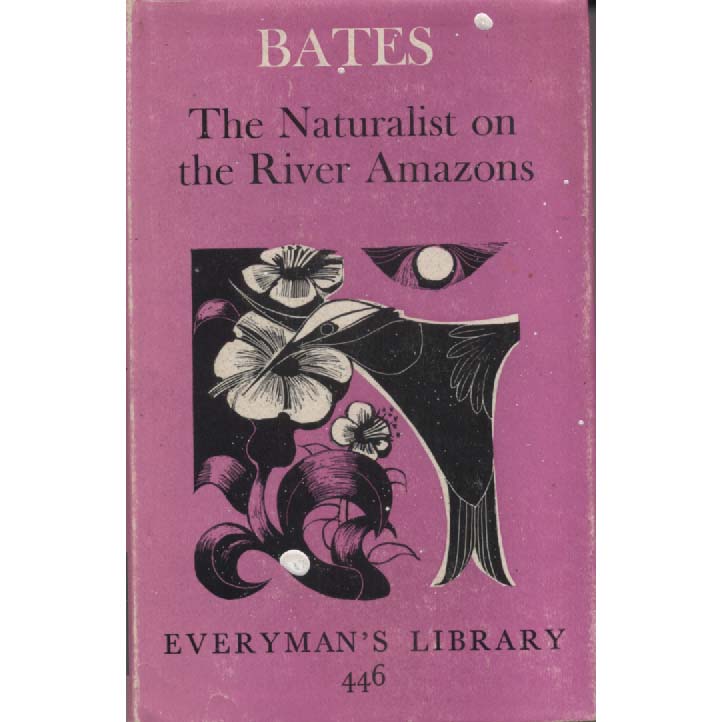
Henry Walter Bates’ "The Naturalist on the River Amazons," published in 1969 by Everyman’s Library, offers an intriguing glimpse into the adventurous spirit of the 19th century. This book, a reprint of the original 1863 narrative, has been beautifully bound in a classic hardcover format, with a cover design that reflects the era's fascination with exploration and natural history. The muted colours and intricate illustrations evoke a sense of nostalgia, making it a delightful addition to any bookshelf, especially for those with an appreciation for Victorian literature and natural science.
The book presents itself as a travelogue, detailing Bates’ experiences as he navigates the Amazon River and its surrounding environments. The prose is rich, and Bates' observations of the diverse flora and fauna are both meticulous and poetic. His vivid descriptions bring the Amazon rainforest to life, allowing readers to immerse themselves in the sights and sounds of this mysterious land. The text is accompanied by well-placed illustrations that enhance the reading experience, transporting one back to a time when nature study was deeply intertwined with adventure. The paperback vibe, despite being a reprint, retains an authentic feel reminiscent of earlier natural history texts, which often catered to a curious and educated audience eager to learn about uncharted territories.
Henry Walter Bates himself is a figure of some historical significance within the realm of natural history. Born in 1825, he was an English naturalist and explorer who became well-known for his extensive work in the Amazon basin. Bates is particularly credited with developing the theory of mimicry in butterflies, a concept that has had lasting implications in biology. While his name may not resonate with the general public as much as contemporaries like Charles Darwin, his contributions to natural science are nonetheless noteworthy. Unfortunately, detailed biographical information about Bates seems to be limited, leaving his life story somewhat obscured in the annals of history. His explorations and writings have, however, secured him a position of respect among those interested in the history of naturalism and exploration.
The year 1969 marked a significant time in cultural history, characterised by a burgeoning interest in environmentalism and an increasing awareness of ecological issues. This reprint of Bates’ work coincided with a period when literature reflecting on nature and exploration was gaining momentum once again, possibly as a reaction to the rapid industrialisation and urbanisation occurring globally. The publication reflects a nostalgia for exploration, as well as a desire to reconnect with the natural world at a time when many were beginning to recognise the importance of conservation. The Everyman’s Library edition, with its classic design and scholarly intent, aligns well with the cultural zeitgeist of the late 1960s, a time when literary works were often revisited and re-evaluated in light of contemporary issues.
Moreover, Bates' narrative serves as a reminder of the historical context in which these explorations took place. The Amazon was not only a physical frontier but also a cultural one, with indigenous peoples and ecosystems often overlooked or misrepresented in the narratives of Western explorers. Bates’ respectful observations of the natural world and its inhabitants stand in contrast to more exploitative accounts, highlighting a shift in the way nature and culture were perceived during his time and beyond.
While "The Naturalist on the River Amazons" may not be a household name today, it remains a key text for those interested in the intersection of exploration, natural history, and literature. Its reappearance in the 1960s not only serves to preserve Bates' legacy but also provides insight into the evolving relationship between humans and the natural world. The book's design and presentation by Everyman’s Library further enhance its appeal, ensuring that it occupies a special place within the canon of natural history literature.
In conclusion, "The Naturalist on the River Amazons" is more than just a reprint; it is a cultural artifact that reflects a bygone era of exploration and scientific curiosity. The combination of Bates’ eloquent prose, the book's attractive design, and its historical significance positions it as a valuable read for both scholars and casual readers alike. As one delves into its pages, the reader is invited not only to explore the Amazon through Bates' eyes but also to consider the broader implications of such narratives in our understanding of the environment today. For those who appreciate literature that captures the essence of exploration and natural history, this book is a commendable choice, and one that Crappy Old Books would certainly recommend for its rich cultural context and enduring relevance.