AI-assisted note, based on the text and a physical inspection of this copy.
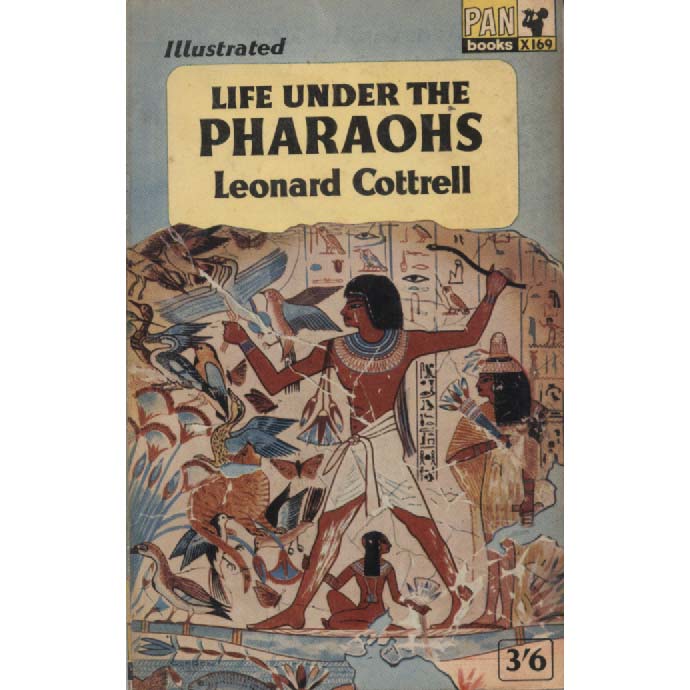
“Life Under The Pharaohs” by Leonard Cottrell, published in 1962 by Pan Books, is a curious artefact from a time when popular interest in ancient civilisations was on the rise, particularly following the mid-20th-century archaeological discoveries in Egypt. The book itself is wrapped in a cover design typical of the time, featuring bold, eye-catching illustrations that evoke a sense of adventure and intrigue. The paperback format also lends it a casual, accessible vibe, suggesting that this is a work intended for the everyday reader rather than an academic audience. The use of colourful images and a striking typeface on the cover hints at a romanticised view of ancient Egypt, which is both alluring and somewhat misleading—perfectly in line with the era's trend of sensationalising historical narratives.
As one opens the book, one is greeted with a layout that feels both nostalgic and somewhat dated, with a mix of text and illustrations that cater to a 1960s readership. The layout reflects a time when publishers aimed to entice readers with visually appealing designs, and Cottrell’s work is no exception. The pages are filled with photographs and drawings that aim to bring ancient Egypt to life, yet the reproduction quality varies, lending a somewhat amateurish feel to the visual presentation. This inconsistency might detract from the reader's experience, but it also adds a layer of charm, reminding us of a pre-digital age in publishing.
Leonard Cottrell appears to be a figure whose contributions to literature are somewhat overshadowed by his contemporaries, as there is limited biographical information readily available. He is known primarily for his writings on ancient history and archaeology, yet he does not have the same level of recognition as other authors of historical narratives. His works, including “Life Under The Pharaohs,” often reflect a blend of factual recounting and imaginative storytelling, which may suggest that he was more of a populariser of history rather than a strict academic. While his lack of prominent accolades or widespread acknowledgment might place him in the realm of obscurity, it is clear that he sought to engage a general audience with his explorations of the past.
The year 1962 was a significant period in terms of cultural and social shifts, particularly in the United Kingdom and the United States. The post-war era was marked by a burgeoning fascination with Egyptology, spurred in part by archaeological discoveries and an increasing appetite for knowledge about ancient civilisations. Cottrell’s book taps into this zeitgeist, offering readers a chance to explore the grandeur of the Pharaohs in a digestible format. The accessibility of Cottrell's narrative, paired with the rising popularity of historical documentaries and television series, reflects a cultural moment where ancient history was not just for scholars but for the masses as well. It is a testament to the era's enthusiasm for the exotic and the mysterious, and Cottrell’s work occupies a niche within that broader trend.
“Life Under The Pharaohs” aims to provide an overview of Egyptian life during the time of the Pharaohs, touching upon various aspects such as religion, governance, and daily activities. However, Cottrell’s approach can often feel superficial; while he covers a wide range of topics, the depth of analysis is lacking. It is evident that the book was written with the intent of captivating the reader's imagination rather than thoroughly educating them. This may appeal to casual readers, but those seeking a more scholarly examination of the subject may find themselves frustrated by the lack of depth and insight.
In summary, Cottrell’s work stands as a cultural object that encapsulates the spirit of its time—a blend of fascination, accessibility, and a somewhat romanticised view of ancient Egypt. It serves as a portal into an era when the past was increasingly within reach of the general public, yet it also exemplifies the pitfalls of popular history. The book's nostalgic charm, combined with its occasional lapses into oversimplification, makes it a curious read for those interested in both the content and the context of its creation.
For those looking to delve into a slice of 1960s publishing and the popularisation of ancient history, Crappy Old Books offers a fitting repository for such explorations. “Life Under The Pharaohs” remains a tangible reminder of the era's cultural landscape, albeit with the caveats of its time.