AI-assisted note, based on the text and a physical inspection of this copy.
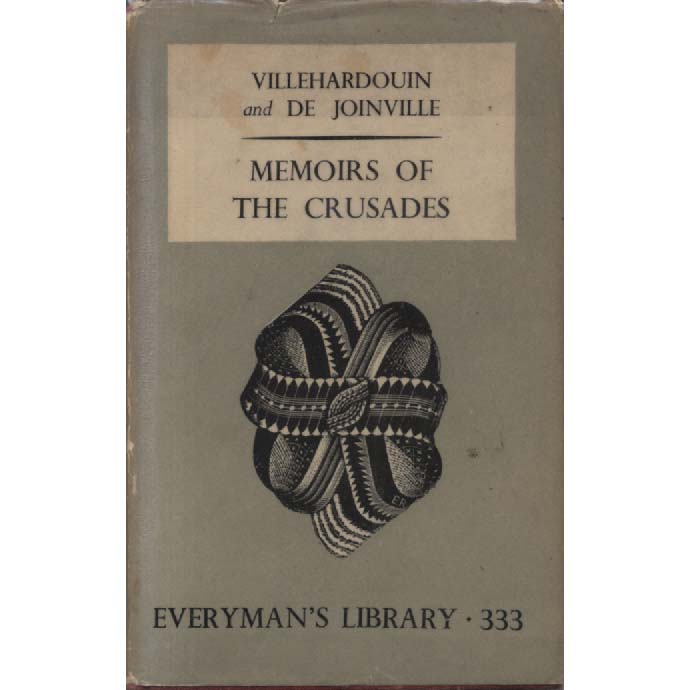
“Memoirs Of The Crusades,” published in 1933 by Everyman's Library, offers a curious blend of adventure and historical narrative, encapsulating the fervour of the medieval crusades through the eyes of two notable figures: Geoffrey de Villehardouin and Jean de Joinville. The book is presented in a paperback format typical of its era, with a cover that hints at the richness of its content—featuring an illustration reminiscent of medieval manuscripts. The cover design, while not particularly striking, possesses a certain charm that evokes the period it seeks to represent, appealing to both history enthusiasts and casual readers alike.
Villehardouin's and Joinville's accounts, both drawn from first-hand experiences, provide a unique window into the mindset of the 12th and 13th centuries. Their narratives are not just chronicles of battles and conquests; they reveal the cultural and spiritual motivations behind the Crusades, an endeavour that captivated Europe for centuries. The prose is imbued with a sense of urgency and passion, reflecting the fervent beliefs and the chaotic reality of the Crusading period. The juxtaposition of these two memoirs highlights differing perspectives—Villehardouin's military focus contrasts with Joinville's more personal and reflective storytelling, adding layers to the reader's understanding of the historical context.
The authors themselves occupy a notable place within the annals of medieval literature. Geoffrey de Villehardouin was a French knight and chronicler who participated in the Fourth Crusade, ultimately becoming its official historian. His work is one of the earliest examples of historical writing in the French language, and he is often credited with elevating the genre of historical memoirs. Jean de Joinville, on the other hand, was a chronicler of the Seventh Crusade and a contemporary of Saint Louis. His memoirs serve not only as a historical record but also as a personal account of his interactions with the king, offering insight into medieval kingship and the cultural landscape of the time. While both authors are relatively well-known within the niche of medieval studies, they may not be household names, making their joint publication in this 1933 edition an intriguing artefact of historical literature.
The year 1933 was a time of significant political and cultural upheaval in Europe. The interwar period was marked by a resurgence of interest in history and nationalism, often manifesting in literature that sought to explore and define national identities. In this context, the republication of such historical texts can be seen as part of a broader movement to reconnect with European heritage. Everyman's Library, known for its commitment to producing affordable editions of classic literature, played a crucial role in making these works accessible to a wider audience. The publication of “Memoirs Of The Crusades” fits neatly into this cultural milieu, as readers sought to engage with their past amid the uncertainties of the present.
The book's physical attributes speak to its time. The paper is of decent quality but bears the hallmarks of the era's conservation practices, such as a slightly yellowed hue that adds to its vintage feel. The typography is straightforward, prioritising readability over ornate design, which aligns with Everyman’s mission to present literature in a manner that is both accessible and respectable. However, the paperback nature of the book does not lend it the gravitas one might expect from such profound historical accounts. Instead, it feels more like a casual read, suitable for a leisurely afternoon rather than a rigorous academic study.
In reading “Memoirs Of The Crusades,” one cannot help but notice the complexities of its representation of the Crusades. The narratives are infused with the biases and perspectives of their time, which calls for a critical reading. As historical documents, they provide valuable insights, yet they also reflect the cultural myths and assumptions that underpinned medieval society’s understanding of warfare and faith. This duality makes the book a rich subject for discussion, raising questions about how we interpret history through the lens of personal experience and narrative style.
In conclusion, “Memoirs Of The Crusades” serves as a fascinating cultural object that encapsulates both the historical fervour of the medieval period and the 20th-century interest in heritage and identity. The combination of Villehardouin's and Joinville's accounts offers a multifaceted view of the Crusades, while the 1933 Everyman's Library edition presents these memoirs in a format that invites exploration without pretension. For those interested in the interplay between history and literature, this book is a worthy addition to one's collection, especially as a representative piece of Crappy Old Books that highlights the quirks of publishing history and cultural memory.