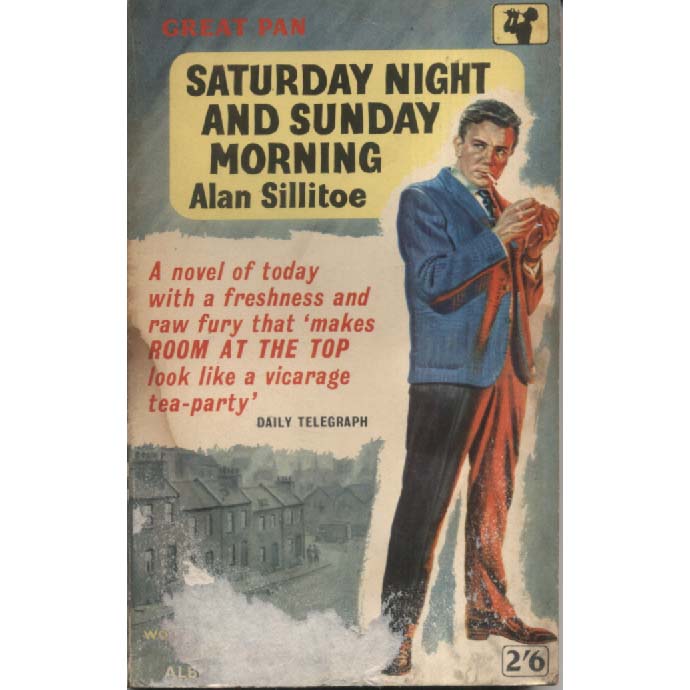
AI-assisted note, based on the text and a physical inspection of this copy.
“Saturday Night and Sunday Morning” by Alan Sillitoe, published in 1960 by Pan, stands as a gritty exploration of working-class life in post-war Britain. The cover design, often adorned with stark graphics and bold typography, captures the essence of its raw narrative. It reflects a period when paperback novels were becoming increasingly accessible, enabling a wider audience to engage with literature that spoke directly to their realities. The book’s physicality—its slightly worn edges, the smell of aging paper—evokes a sense of nostalgia, as though it has been passed around among friends in smoky pubs, enhancing its cultural resonance.
At the heart of Sillitoe's work is the character of Arthur Seaton, a factory worker who embodies the frustrations and desires of the working class. This novel is not just a story; it’s a reflection of the societal conditions of its time, showcasing the struggles against a backdrop of industrial monotony. The narrative dives into the escapism found in nightlife, portraying Saturday night as a fleeting respite from the dreariness of the workweek, followed by the inevitable return to reality on Sunday morning. The prose is laced with a sense of authenticity, drawing readers into the visceral experiences of its characters, making the mundane feel monumental.
Alan Sillitoe is a well-known figure in British literature, part of the 'Angry Young Men' movement, which critiqued the social injustices of the time. Born in 1928 in Nottingham, he experienced the struggles of the working class firsthand, which profoundly influenced his writing. Sillitoe's prominence in the literary landscape is marked by his ability to articulate the discontent and aspirations of a generation. His works often reflect a deep understanding of the human condition, making him a significant voice in the canon of post-war British literature. Despite his acclaim, Sillitoe's works can sometimes feel overshadowed by contemporaries, yet he remains a vital part of the conversation surrounding the socio-political landscape of his time.
Published in 1960, “Saturday Night and Sunday Morning” arrived during a transformative period in Britain. The country was grappling with the aftermath of World War II, and the economic landscape was fraught with challenges. The youth of the era were beginning to assert their identities, seeking freedom and autonomy in a rapidly changing world. This cultural backdrop is pivotal to understanding the novel, as it captures the essence of a generation caught between tradition and modernity, between the constraints of their upbringing and the desire for personal expression. The book resonates with a sense of rebellion, reflecting the disillusionment felt by many in the face of a rigid social structure.
The paperback edition from Pan is emblematic of its time, showcasing the shift towards more affordable literature that was accessible to the masses. The physicality of the book, with its slightly dog-eared pages and faded cover, adds an element of authenticity, as it feels like a relic from a bygone era. Readers today can appreciate the cultural significance of such editions, as they serve to remind us of the evolution of print culture and the ways in which literature has sought to connect with its audience.
In conclusion, “Saturday Night and Sunday Morning” remains a poignant exploration of the struggles and aspirations of working-class life in 1960s Britain. Alan Sillitoe’s keen observations and powerful prose create a narrative that is both specific to its time and universally relatable. The book serves as a cultural object, not merely a product of its era, but as a testament to the resilience of the human spirit. It encapsulates a moment in history where literature became a voice for the voiceless, a theme still relevant today. For those interested in the intersections of culture, literature, and history, this novel is a must-read, and you can find such treasures at Crappy Old Books.