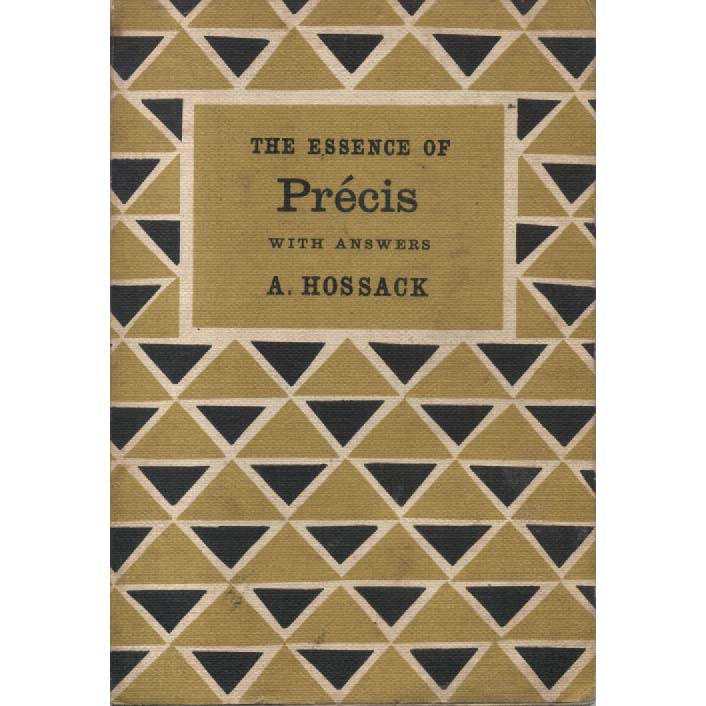
AI-assisted note, based on the text and a physical inspection of this copy.
In the realm of educational literature, few titles encapsulate the mid-20th century's pedagogical fervour as aptly as The Essence Of Precis With Answers by A Hossack. Published in 1962 by the well-regarded Methuen, this book emerges as a curious artifact from an era when the precise art of summarisation was held in high esteem, especially in academic circles. The cover design reflects the utilitarian aesthetic typical of educational texts of the time—simple yet functional, emblazoned with bold letters that suggest a no-nonsense approach to learning. The paperback format, with its slightly yellowed pages and a texture that speaks to its age, invites a nostalgia for a time when information was disseminated in a more tactile manner than today’s digital age allows.
A Hossack, the author, appears to occupy a somewhat obscure position in the literary landscape. There is scant information available regarding his biographical details or contributions to the field of education or literature. His name does not surface prominently in discussions of notable authors from the 20th century, leading one to speculate whether he was perhaps a dedicated educator or a private scholar whose work did not gain widespread recognition. The absence of notable awards, accolades, or a substantial bibliography makes it difficult to ascertain his influence or standing within the broader educational discourse. This obscurity does, however, prompt a sense of intrigue about the motivations behind his writing and the intended audience for his work.
The year 1962 was a pivotal moment in history, marked by significant cultural and educational shifts. The post-war era had ushered in a wave of new ideas about teaching methodologies, reflecting a growing emphasis on clarity and precision in communication. This was a time when educational policies were evolving, and the importance of effective writing was being increasingly recognised in academic settings. Hossack’s work aligns with this ethos, offering guidance on the art of précis writing—a skill that was deemed essential for students and professionals alike during that period. The book serves as a window into the values of its time, where mastering the ability to condense information was not merely an academic exercise but a critical life skill.
As one delves into the content of The Essence Of Precis With Answers, it becomes evident that Hossack’s approach is methodical and instructional. The text is laden with exercises and sample responses, designed to provide readers with practical experience in summarising complex ideas succinctly. This hands-on approach reflects the educational philosophies of the time, which valued active learning and student engagement. However, the language employed is often dry and pedantic, characteristic of instructional texts from this period. While it may serve its purpose as a teaching tool, the lack of engaging prose can render the reading experience somewhat laborious for those seeking literary enjoyment.
The cultural significance of this book transcends its immediate educational utility. It embodies the ideals of an era that prioritised structured learning and the mastery of communication as a means of empowerment. The pedagogical style mirrors the educational frameworks of the time, which often emphasised rote learning and formulaic responses, rather than fostering creativity or critical thinking. Hossack’s work can thus be viewed as both a reflection and a product of its time—a representation of the educational values that shaped a generation.
Moreover, it is interesting to consider how such a text might be received in today’s educational landscape, where the emphasis has shifted towards more dynamic and interactive forms of learning. The principles of précis writing remain relevant, yet the methods of instruction have evolved significantly. Modern readers might find Hossack’s style to be somewhat antiquated, perhaps even stifling, when compared to contemporary approaches that encourage exploration and individual expression. Nonetheless, for those with an interest in historical educational practices or the evolution of writing skills, Hossack’s work offers a valuable glimpse into the past.
In summary, The Essence Of Precis With Answers stands as a testament to the educational priorities of the 1960s. While it may not be a literary masterpiece by any stretch, its cultural significance cannot be overlooked. The book serves as a reminder of the era's commitment to clarity in communication and the importance placed on summarisation as a vital skill. For collectors of educational texts or enthusiasts of mid-20th century pedagogical practices, this title from Crappy Old Books is a noteworthy addition that encapsulates a bygone era of learning.