AI-assisted note, based on the text and a physical inspection of this copy.
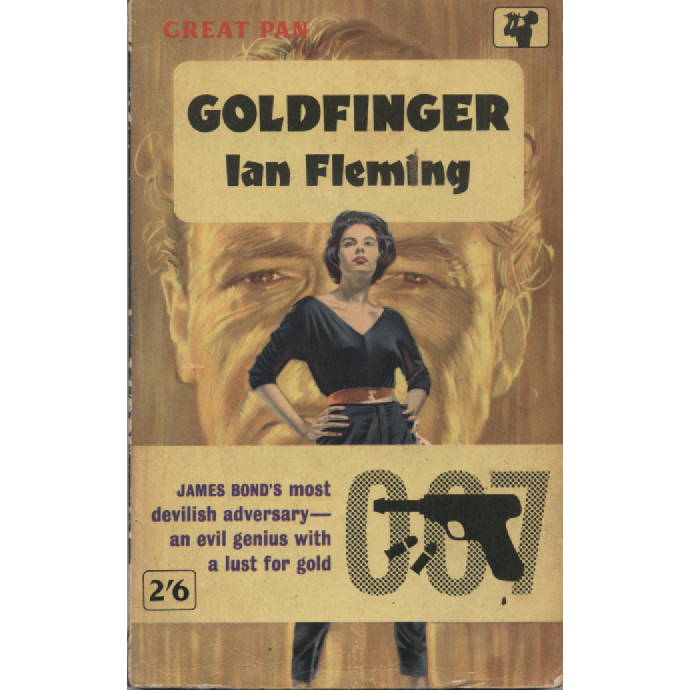
Ian Fleming's Goldfinger, published in 1962 by Pan Books, stands as a quintessential piece of mid-20th century popular literature. The cover design, typical of the era, features a bold and striking graphic aesthetic that captivates the eye, employing a stark contrast of gold and black that hints at the themes of wealth and danger intertwined throughout the narrative. The paperback format, with its soft cover and slightly worn edges, exudes a sense of nostalgia, reminiscent of the days when pocket-sized adventures were the go-to for transportable escapism. This particular edition, with its glossy finish and eye-catching typography, serves not only as a means to read but as a collectible object, embodying a specific moment in print culture when thrillers were taking off as a dominant genre.
Fleming, a former naval intelligence officer, carved out a niche in literary history with his creation of the iconic character James Bond. This character, who epitomises suave sophistication and indomitable courage, has transcended the pages of Fleming's novels to become a cultural touchstone in film, advertising, and beyond. While much is known about Fleming's life—his experiences in World War II, his privileged upbringing, and his eventual success as a writer—it is important to note that he remains a figure primarily associated with the spy genre, often overshadowed by the cinematic adaptations of his works. His influence on both literature and film is undeniable, yet the subtleties of his prose and character development often get lost amidst the glitz of Bond's on-screen persona.
Published during a time of significant cultural upheaval, Goldfinger reflects the anxieties and aspirations of the early 1960s. The Cold War was at its height, and the world was steeped in a cocktail of glamour and peril—factors that Fleming articulated through his writing. The novel taps into the zeitgeist of an era defined by a fascination with espionage, technology, and the moral ambiguities that accompany a rapidly changing world. The consumerism of post-war Britain, coupled with an emerging sense of individualism, finds its way into the narrative, as characters navigate a landscape where wealth and power are both coveted and dangerous. This was also the age of the quintessential gentleman spy, a figure who, much like the decade itself, embodied both charm and treachery.
The plot of Goldfinger revolves around Bond's mission to uncover the nefarious schemes of Auric Goldfinger, a gold-obsessed villain whose machinations threaten the global financial system. While the storyline may appear formulaic by today's standards, it is essential to consider the context in which it was written. At the time, the idea of a lone agent taking on a powerful adversary resonated with readers, reflecting a blend of escapist fantasy and the real-world tensions of the day. The pacing is brisk, with Fleming's characteristic attention to detail painting vivid images of high-stakes gambling, elaborate plots, and exotic locales, all hallmarks of his writing style.
However, the representation of gender and race within the narrative can be jarring to contemporary readers. The portrayal of female characters often veers into objectification, and the racial stereotypes present throughout the text are reflective of a bygone era that lacks the sensitivity and awareness of today's social climate. These elements serve as a reminder of the cultural context in which the book was produced, providing an opportunity for critical reflection on how literature can both entertain and perpetuate problematic norms.
Fleming's writing style is marked by a blend of crisp dialogue and rich descriptions, creating a sense of immediacy that pulls the reader into the action. His ability to craft suspenseful scenes, particularly during high-octane moments, underscores his prowess as a storyteller. Yet, it is the interplay of Bond's character—his charm, wit, and moral ambiguity—that keeps readers engaged. Bond is not merely a hero; he is a complex figure who grapples with the consequences of his actions, making him both relatable and enigmatic.
The cultural impact of Goldfinger, and indeed the entire Bond series, has been profound. It has spawned numerous adaptations, merchandising opportunities, and a legacy that endures to this day. The film adaptation of Goldfinger, released in 1964, solidified Sean Connery's status as the definitive Bond and helped to catapult the franchise into a global phenomenon. This crossover from page to screen illustrates the enduring appeal of Fleming's creation and the universal themes of power, greed, and danger that resonate across generations.
In conclusion, Ian Fleming's Goldfinger is more than just a spy novel; it is a cultural artifact that reflects the complexities of its time, from the glamour of the 1960s to the moral dilemmas faced by its characters. While it is essential to approach the text with a critical eye, recognising its shortcomings in representation, it also offers a glimpse into the allure of a world filled with intrigue and adventure. The book stands as a testament to the power of storytelling, encapsulating the spirit of an era while continuing to captivate readers and audiences alike. For those interested in the evolution of popular literature and the cultural landscape of the 20th century, Goldfinger remains a noteworthy entry in the canon of Crappy Old Books.