AI-assisted note, based on the text and a physical inspection of this copy.
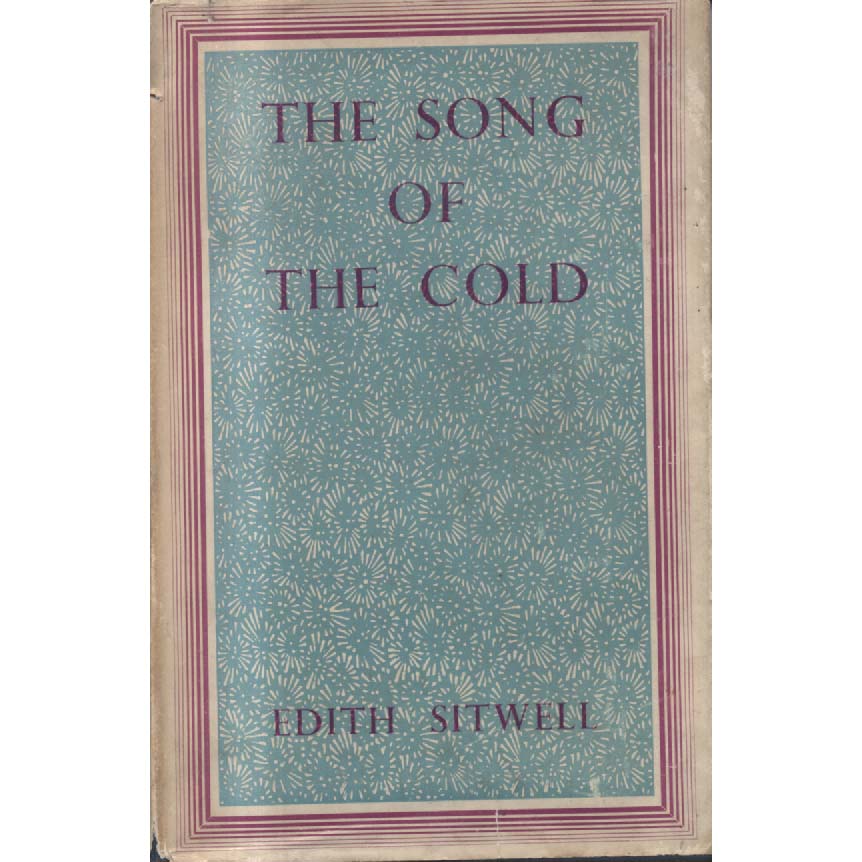
Edith Sitwell's The Song of the Cold, first published in 1946 by MacMillan, presents itself as a curious artefact from a post-war literary landscape. Bound in a striking cover that juxtaposes muted tones with an abstract design, it captures the eye while simultaneously hinting at the complex emotional undercurrents within. The paperback edition possesses that particular feel of mid-20th century literature—slightly worn along the edges, with a texture that suggests both durability and a history of passive readership. The cover art, while not immediately evocative of the text, reflects an era where abstract expressionism began to seep into mainstream literature, inviting readers to interpret both visually and literarily. In this sense, the book embodies the duality of the time: a world grappling with the remnants of conflict while still yearning for beauty and depth in art.
Edith Sitwell, a notable figure in the literary world, is often recognised for her contributions to poetry and criticism, particularly during the early to mid-20th century. Born into an aristocratic family in 1887, she was part of the avant-garde movement and a contemporary of other literary giants such as T.S. Eliot and Ezra Pound. Her works often reflect a unique blend of modernist sensibilities and a deep appreciation for musicality in poetry. She is perhaps best known for her distinct voice and her role in the literary scene, serving as a bridge between the traditional and the modern. However, despite her prominence in literary circles, she remains somewhat obscure to the general public, with her works often overshadowed by her more widely read contemporaries. It is evident that Sitwell's literary legacy is marked by a complex interplay of acclaim and relative neglect.
The year 1946 marked a significant turning point in global history, as the world began to rebuild and reimagine itself after the devastation of World War II. Literature from this period often reflects the profound sense of loss, disillusionment, and yet, a flickering hope for renewal. The Song of the Cold emerges within this cultural milieu, providing a voice that speaks to both the desolation of war and the enduring human spirit. Sitwell's exploration of themes such as isolation, resilience, and the beauty found in melancholy resonates strongly with the post-war zeitgeist. Readers in 1946, grappling with their own experiences, may have found solace or stark reflection in her verses, while contemporary readers may appreciate the historical context and the emotional depth that resonates even today.
As for the text itself, Sitwell's poetic language is striking, often employing vivid imagery and a musicality that can be both haunting and beautiful. The structure of her work invites readers to pause and reflect, allowing the words to linger in the mind long after the page is turned. However, some may argue that her style, steeped in modernist abstraction, can be challenging for readers accustomed to more straightforward narratives. While Sitwell’s intention may have been to evoke a particular emotional response, the result can be polarising; some may find it enriching, while others could perceive it as overly cryptic or pretentious. This tension between accessibility and artistic integrity is a common struggle within literary circles, particularly in the wake of the war, where clarity of expression often felt at odds with the chaos of lived experience.
In examining The Song of the Cold as a cultural object, its significance transcends mere literary value. It serves as a historical marker, a tangible representation of a specific moment in time when the world was simultaneously mourning and searching for meaning. The book's physical presence—its weight, the quality of the paper, and the fading ink—adds layers to the experience, inviting readers to engage not just with the content but with the very act of reading. This tactile interaction is increasingly rare in a digital age, where books often exist as ephemeral bytes in the vast expanse of the internet. Sitwell’s work, then, becomes a relic of a time when literature was a physical experience, tied to the sensory engagement of turning pages and feeling the texture of words.
Moreover, the role of publishers like MacMillan in bringing such works to the public cannot be understated. In an era where literature was not only a means of escape but also a method of grappling with cultural trauma, publishers acted as gatekeepers, curating voices that would shape cultural discourse. MacMillan's decision to publish Sitwell's work indicates an understanding of her importance within the literary canon, even if her broader public recognition has waned. This interplay between author and publisher highlights the often precarious nature of literary fame and the challenges of sustaining a legacy in an ever-changing cultural landscape.
In conclusion, The Song of the Cold by Edith Sitwell serves as a fascinating case study in post-war literature, reflecting the complexities of human emotion, artistic expression, and cultural history. Its physical attributes, combined with Sitwell's unique voice, create a compelling reading experience that transcends mere words on a page. For those interested in the intersections of literature, history, and culture, this book is a worthy addition to any collection. In the spirit of celebrating such intriguing works, Crappy Old Books continues to shine a light on literary artefacts that deserve attention, even if they exist on the fringes of popular literary discourse.