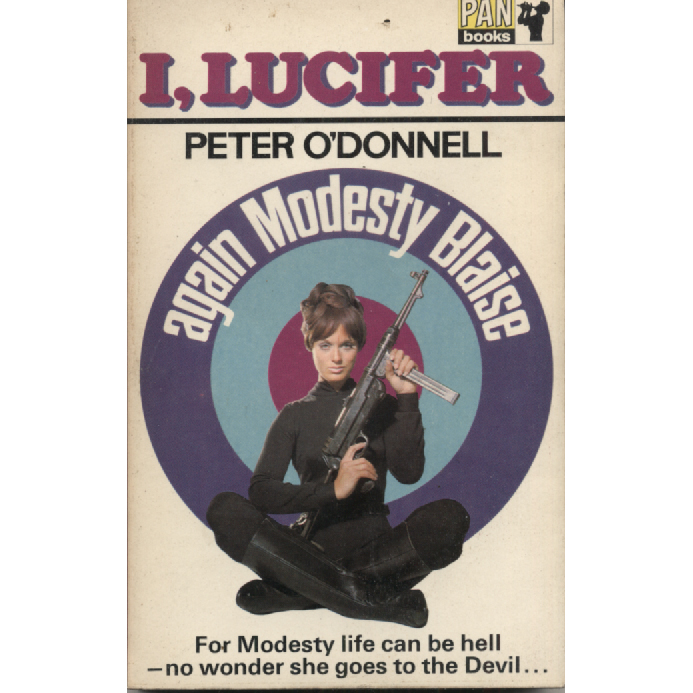
AI-assisted note, based on the text and a physical inspection of this copy.
Modesty Blaise is a product of her time, as are these books.
I, Lucifer sits right in the sweet spot of what made Modesty Blaise such a cultural oddity and such a pleasure: it is both a brisk, high-colour thriller and a small time capsule of how the 1960s wanted espionage to feel. If you come to it via the newspaper strip, you can immediately sense the same DNA. Peter O’Donnell writes action with a visual snap, as if he is still thinking in panels and cuts. Scenes are built to land cleanly: a face, a gesture, an object on a table, then the trap springs. There is a particular confidence to the way the book moves, rarely apologising, rarely lingering too long, always trying to keep you in forward motion. That pace is part of the “pedigree” of Modesty. These novels are not secondary spin-offs. They are an extension of the same sensibility, simply given a different engine.
Story-wise, I, Lucifer is classic Modesty territory: an escalated criminal scheme with a slightly theatrical edge, the kind that feels only half a step from plausible and therefore more fun for it. The title hints at the tone. There is a faint sulphuric glamour to the opposition, a villainy that wants to be remembered, not merely to succeed. Modesty and Willie Garvin are pulled into the business with that familiar mix of capability and irritation, because the world keeps insisting on being messy and somebody competent has to deal with it. What’s especially enjoyable is the way the book balances competence with personality. Modesty is not written as a blank “tough woman” template, and Willie is not just comic relief or muscle. Their loyalty is the emotional spine, and it stops the whole thing turning into a mere parade of set pieces.
Peter O’Donnell himself is an important part of why the Modesty Blaise books endure. A journalist and comic-strip writer by background, he brought a reporter’s economy and a cartoonist’s eye to prose fiction. His sentences are efficient, visual, and rhythmically paced, shaped by years of thinking in frames rather than chapters. O’Donnell was also unusual in how seriously he took his heroine. Modesty Blaise was not written as novelty or provocation, but as a competent professional whose authority was never treated as a joke. That seriousness of intent — combined with a lightness of touch — gives the books their distinctive tone. They are confident without being heavy, stylish without being hollow, and they trust the reader to keep up. In an era crowded with spy heroes, O’Donnell’s restraint and clarity are part of what made Modesty Blaise feel modern, and what still makes these novels read with surprising ease today.
Where it really earns its keep, though, is as a sign of its time. A 1967 Pan Books paperback is not simply a container for a story. It belongs to a moment when cheap, widely available paperbacks were shaping taste and identity. This was the era when adult reading became casual in public. Thrillers and spy stories travelled in coat pockets, appeared on trains, turned up on kitchen tables, and were traded like gossip. The physical form matters. Pan’s look and feel, the typography, the bright cover promise, the very idea that something this stylish and slightly wicked could be bought and consumed as everyday entertainment, is central to what the book is in culture.
Read now, there is also a faint, fascinating tension in the values. The book carries the 1960s belief in glamour as a kind of technology: the right clothes, the right confidence, the right poise, and you can walk into almost any room. It also reflects the period’s appetite for danger presented as performance. That does not make it dated in a bad way. It makes it specific. It tells you what readers wanted then: speed, style, competence, and a world in which wit could be as sharp as a blade.
As an object, it is also the sort of paperback that rewards attention beyond the plot. The cover is part of the sales pitch, yes, but also part of the mythology. These books were designed to be seen. They were small posters for a private fantasy of sophistication and risk. If you’re building “Crappy Culture” with an antiques-eye for patina, this is exactly the kind of item that makes sense: not a sacred first edition to be worshipped, but a real survivor of mass culture, handled, read, carried, and kept.
Physically, it is a worn old paperback, the sort that probably shouldn’t, but probably wants to be collected in a plastic bag and put on display. It is an artefact of 1967: the year the Beatles released Sgt. Pepper, the first television programmes were broadcast in colour, and Concorde was unveiled. Most of us have heard of the 1960s, and of 1967 in particular, but far fewer actually remember it. This book is 1967. It began life as a brand-new paperback in some outlet somewhere, and someone bought it. Who? Comic-strip readers? Fans of spy fiction? Was it advertised on buses or in magazines? How exactly did 1967 revolve around this book? Who could know. Now it is simply an artefact, nearly sixty years old, its pages tanned and fatigued, each one carrying the promise of a sliver of that time and that world.
Moreover, in short: I, Lucifer is a confident Modesty Blaise adventure that delivers what it promises, while quietly acting as a neat artefact of 1960s paperback Britain. It is enjoyable as a thriller and interesting as a cultural object, and it manages to be both without straining.