Rudiments And Theory Of Music
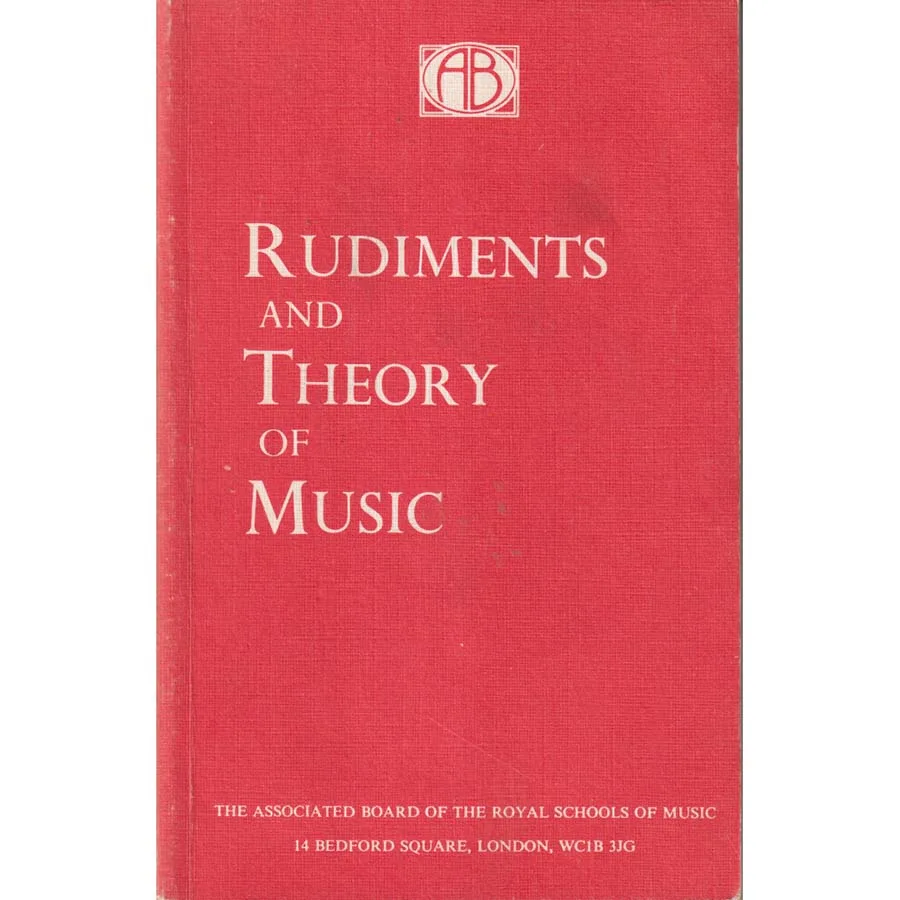
Publisher: The Associated Board of the Royal Schools of Music
Format: Paperback
ISBN: none
Rudiments and Theory of Music (1958), published by The Associated Board of the Royal Schools of Music, is a distinguished little volume dedicated to explaining why music, something supposedly created to express the deepest emotions of the human soul, requires such an extraordinary quantity of rules, mathematical calculations and opportunities for examination failure.
This venerable guide introduces readers to the fundamental principles of musical theory, including notation, scales, intervals, key signatures, time signatures, rhythm and the various mysterious symbols that transform an otherwise innocent sheet of paper into something capable of causing considerable anxiety. For generations of aspiring musicians, mastering these rudiments was an essential part of their musical education, alongside practising scales, enduring piano lessons and developing an increasingly complicated relationship with the metronome.
The Associated Board has long been a formidable institution in British musical education, producing generations of accomplished musicians and an equally impressive number of people who abandoned the clarinet shortly after Grade Three. Its publications are characterised by precision, authority and a reassuring absence of unnecessary frivolity. Music may be an art, but there is evidently no reason why learning about it should be excessively enjoyable.
Published in 1958, this edition comes from an age when musical education relied upon printed textbooks, patient teachers and considerable repetition. There were no smartphone applications to identify chords, no online tutorials explaining diminished sevenths and certainly no artificial intelligence capable of completing your theory homework. If you wanted to understand the difference between a perfect fourth and an augmented fourth, you simply had to sit down and learn it.
Despite its vintage, the fundamental principles contained within remain remarkably relevant. Musical notation has proved considerably more resistant to technological obsolescence than most subjects, and middle C has stubbornly refused to require a software update.
An appealing acquisition for music students, teachers, collectors of vintage educational publications, amateur composers and former piano pupils wishing to confront the intellectual challenges that once stood between them and their Saturday afternoons. It would also make an excellent gift for anyone who insists that they play entirely by ear but secretly wonders what all those little black dots actually mean.
Offered by Crappy Old Books in Good condition, this 1958 edition is a charming piece of musical educational history, dating from a period when the rules of harmony were taken extremely seriously, even as rock and roll was enthusiastically demonstrating what could be achieved by ignoring respectable musical conventions.
No ISBN, having been published before such things became standard. Fortunately, the notes themselves are numbered, measured and categorised with sufficient enthusiasm to compensate.
A wonderfully authoritative reminder that behind every beautiful melody lies a complex theoretical apparatus capable of making even the simplest tune sound like an administrative procedure.
Keep browsing: See more Music books Other books by The Associated Board of the Royal Schools of Music