Galaxy Formation
Publisher: Macmillan
Format: Hardback
ISBN: 9780333193679
The universe is an extraordinary place. It contains billions of galaxies, each populated by billions of stars, all scattered across distances so enormous that even the most enthusiastic railway enthusiast would struggle to produce a satisfactory timetable. Yet at some point, all these magnificent collections of stars had to come from somewhere. John Gribbin, never a man to shy away from a difficult scientific question, decided to investigate how the whole extravagant arrangement got started.
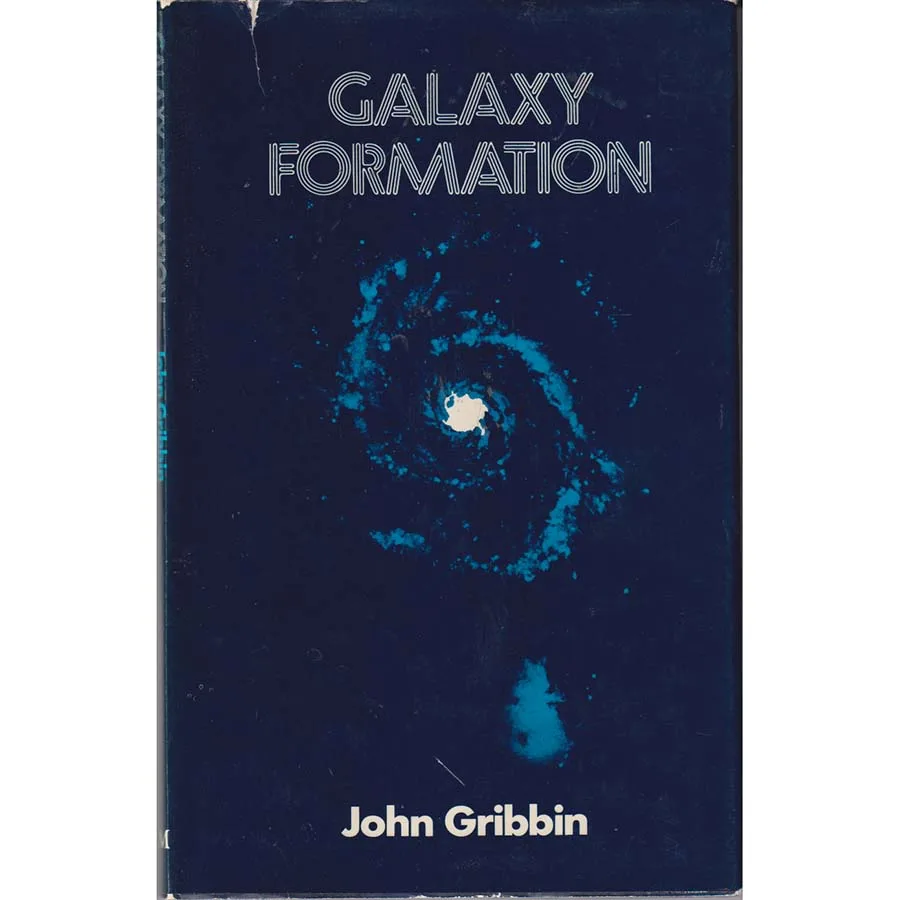
Slight tear to front dust jacket top left, see image.
Galaxy Formation (1976), by John Gribbin and published by Macmillan, is a fascinating exploration of one of astronomy’s greatest mysteries: how the enormous structures of the universe developed from the comparatively simple conditions of its earliest existence.
Galaxies are not modest objects. They contain immense populations of stars, vast clouds of gas and dust, and structures of such astonishing complexity that the ordinary human mind begins to struggle somewhere around the first few million light-years.
Yet these cosmic giants must have emerged through physical processes governed by the laws of nature, rather than appearing fully assembled like particularly ambitious pieces of celestial furniture.
Gribbin examines the scientific ideas surrounding the origins and development of galaxies, exploring the roles of gravity, matter, cosmic expansion and the extraordinary circumstances of the early universe.
There is something wonderfully ironic about humanity’s determination to explain the origins of galaxies. We inhabit a tiny planet orbiting an unremarkable star in one spiral arm of the Milky Way, yet have developed sufficient intellectual confidence to investigate how the entire cosmic neighbourhood came into existence.
The book belongs to a particularly exciting period in modern cosmology. By the mid-1970s, the Big Bang model had gained substantial scientific support, the discovery of cosmic microwave background radiation had transformed understanding of the early universe, and astronomers were developing increasingly sophisticated theories to explain how matter became organised into stars and galaxies.
Unfortunately, the universe proved less cooperative than scientists might have hoped. Observations raised difficult questions, competing theories flourished, and the relationship between elegant mathematical explanations and the actual behaviour of distant galaxies remained a source of considerable professional excitement.
Gribbin, one of Britain’s best-known popular science writers, brings his characteristic enthusiasm for complex scientific ideas to a subject that combines observational astronomy, theoretical physics and the enormous intellectual ambition required to explain cosmic history.
Published in 1976, this volume also offers a fascinating historical perspective on cosmology before later discoveries transformed the field. Modern understanding of dark matter, dark energy and the large-scale structure of the universe has developed enormously, making this book particularly interesting as a record of scientific thinking during an earlier stage of investigation.
Condition: Good. This 1976 Macmillan edition is a previously owned copy showing ordinary signs of age, reading and handling, but remains an appealing vintage scientific volume.
Offered by Crappy Old Books, where we admire the extraordinary achievements of modern astronomy, although organising a few thousand second-hand books presents enough structural difficulties without attempting to assemble an entire galaxy.
An absorbing historical exploration for astronomy enthusiasts, physics readers and collectors of vintage scientific literature.
After all, understanding how galaxies formed is a magnificent intellectual ambition. Understanding why the universe needed quite so many of them is another matter entirely.
Keep browsing: See more Space books Other books by John Gribbin