Information Analysis
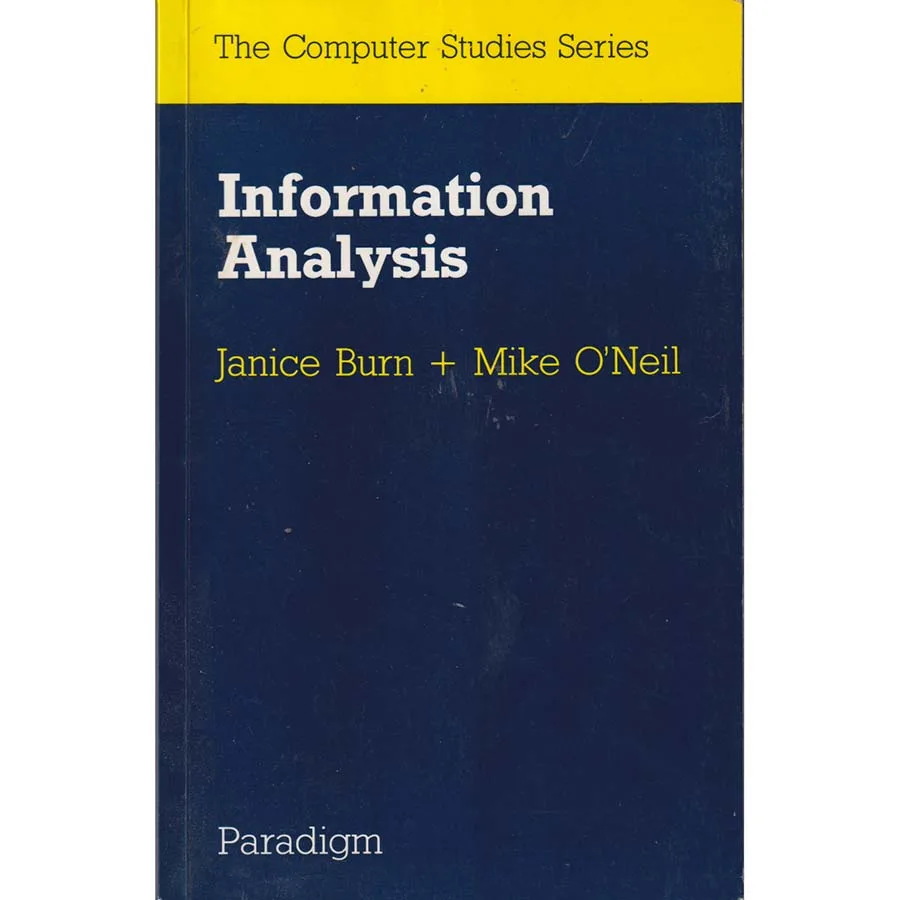
Publisher: Paradigm
Format: Paperback
ISBN: 9780948825507
Information is a wonderful thing. Organisations collect it, store it, process it, print it, file it and occasionally lose it altogether, generally just before somebody important asks to see it. Unfortunately, possessing vast quantities of information does not necessarily mean that anyone understands what it says or has the faintest idea what to do with it. Janice Burn and Mike O’Neil decided that this was a problem worth investigating, preferably before another office disappeared beneath a mountain of computer printouts.
Information Analysis (1987), by Janice Burn and Mike O’Neil and published by Paradigm, is a fascinating technical study from the early years of modern business computing, when organisations were beginning to realise that computers could do rather more than calculate wages, produce invoices and generate impressive quantities of paper.
Part of the Computer Studies Series, the book examines the principles of analysing information, understanding organisational requirements and making better use of the data upon which businesses increasingly depended.
The fundamental problem is deceptively straightforward. Before a computer system can provide useful answers, somebody must establish what questions need asking, what information is required and how that information should be organised. Unfortunately, this frequently involves talking to managers, users and other individuals who may have entirely different ideas about what the system is supposed to accomplish.
Information analysis seeks to impose a little order upon this magnificent confusion, exploring the relationship between business operations, information requirements and the processes through which data becomes useful knowledge.
There is something wonderfully ironic about the computer revolution of the 1980s. Businesses invested enormous sums in increasingly sophisticated machines, confidently expecting them to eliminate administrative inefficiency, only to discover that computers were perfectly capable of reproducing existing inefficiencies at considerably greater speed.
Burn and O’Neil’s subject therefore remains remarkably relevant. Technology may have advanced beyond anything imaginable in 1987, but organisations still struggle with incomplete information, contradictory records, poorly understood requirements and computer systems that do precisely what they were programmed to do rather than what anybody actually wanted.
Published in an era of IBM-compatible PCs, floppy disks, green-screen terminals and computer departments possessing almost mystical authority, this volume also provides an intriguing historical snapshot of information technology before the internet transformed the entire business.
For modern readers, it offers an opportunity to explore the intellectual foundations of information management, systems analysis and business decision-making at a formative moment in the development of corporate computing.
Condition: Good. This 1987 Paradigm edition is a previously owned copy showing ordinary signs of age, reading and handling, but remains an appealing vintage technical publication.
Offered by Crappy Old Books, where we fully appreciate the importance of information analysis, particularly when attempting to establish why a database insists that a book is located on a shelf where it has clearly never been.
A fascinating volume for computing historians, information systems specialists and collectors of vintage technical literature.
Proof that computers may have changed beyond recognition, but the difficulty of getting useful information out of them remains an enduring human achievement.
Keep browsing: See more IT books Other books by Janice Burn and Mike ONeil