Guilty But Insane
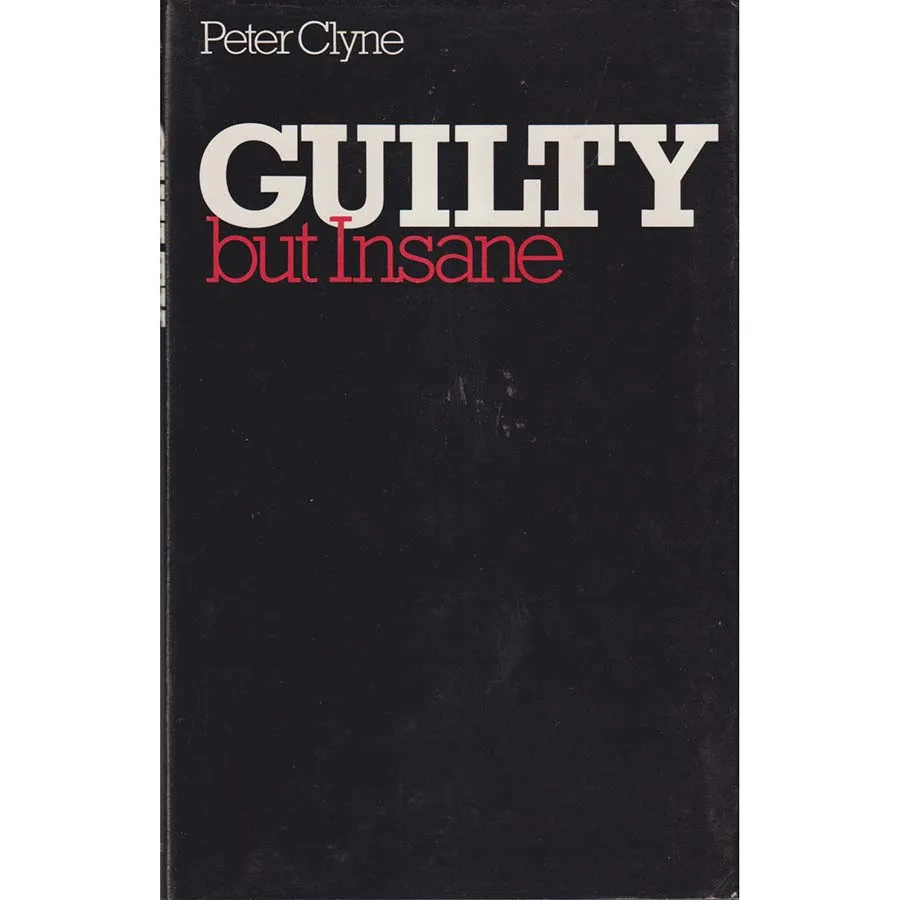
Publisher: Nelson
Format: Hardback
ISBN: 0171380282
The law is a remarkable institution. It has spent centuries developing elaborate rules to determine whether people are guilty of crimes, only to discover that the human mind has an unfortunate tendency to complicate matters. After all, what happens when someone commits a dreadful act but cannot properly understand what they are doing? Should they be punished, treated or handed over to a committee of experts who will spend the next seventeen years disagreeing about the answer?
Guilty But Insane: Anglo-American Attitudes to Insanity and Criminal Guilt (1973), by Peter Clyne and published by Nelson, is a fascinating examination of one of the most difficult and controversial questions in criminal law: where does moral and legal responsibility end and mental illness begin?
Clyne explores the complicated relationship between psychiatry and the criminal justice system, investigating how different countries have attempted to determine whether an accused person should be held criminally responsible for their actions.
The problem is deceptively straightforward. Criminal law generally assumes that individuals possess sufficient understanding and control to be held accountable for their behaviour. Unfortunately, human psychology has never shown much enthusiasm for fitting neatly into legal definitions.
Central to the discussion are the famous M’Naghten Rules, established in nineteenth-century Britain following a notorious murder case. These rules attempted to define when mental disorder could provide a defence against criminal responsibility, creating a legal framework that would influence courts for generations.
Naturally, the legal profession’s confidence in establishing a precise definition of insanity was not universally shared by psychiatrists, who had developed the inconvenient habit of discovering that mental illness was considerably more complicated than the law appeared to recognise.
Clyne compares approaches adopted in Britain, the United States and other jurisdictions, including Commonwealth countries and Scandinavia, examining the differing assumptions underlying their legal systems.
The book also considers developments in psychiatric thinking, the relationship between mental illness and criminal behaviour, and the difficult question of whether legal definitions can adequately reflect scientific understanding.
There is something wonderfully ironic about a system in which psychiatrists may disagree about a person’s mental condition while lawyers argue over whether that disagreement satisfies a rule devised more than a century earlier.
Clyne approaches these questions with a lawyer’s analytical curiosity, challenging established assumptions and exploring whether the concept of mental illness itself possesses the clarity that legal proceedings require.
Published in 1973, the book also provides an intriguing historical snapshot of criminal law and psychiatry during a period when traditional approaches to mental disorder were facing increasing scrutiny.
Condition: Fine. This original 1973 Nelson edition is a particularly well-preserved copy, showing minimal signs of age or handling. An attractive survivor from an era when legal and psychiatric professionals were already engaged in arguments that remain remarkably difficult to resolve.
Offered by Crappy Old Books, where we appreciate criminal history, legal controversy and the extraordinary human talent for transforming apparently simple questions into magnificent intellectual disputes.
An absorbing specialist volume for readers interested in forensic psychiatry, criminal responsibility, legal history and the uncomfortable territory where law and psychology collide.
After all, determining whether someone is guilty is difficult enough. Determining whether they were legally responsible for what they did can become an entirely different trial.
Keep browsing: See more Crime books Other books by Peter Clyne