The Divided Self
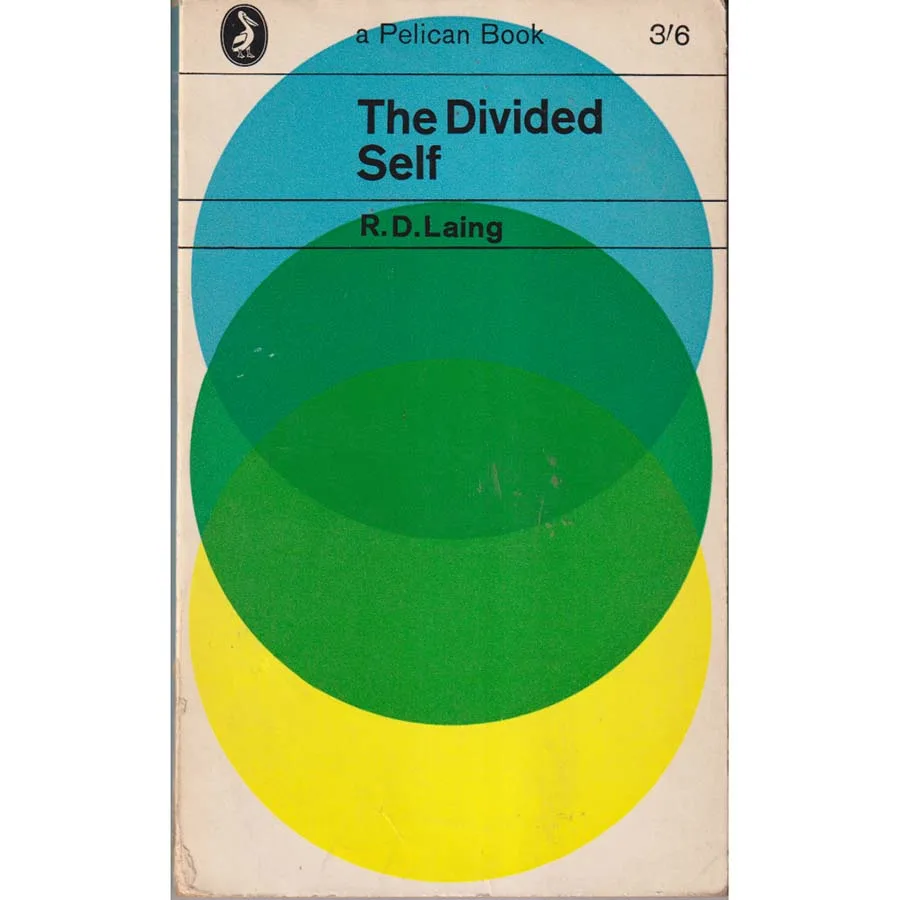
Publisher: Pelican
Format: Paperback
ISBN: none
Human beings are complicated creatures. We possess thoughts, emotions, personalities and an extraordinary capacity for misunderstanding ourselves, frequently while remaining absolutely convinced that we understand everybody else. R. D. Laing, the Scottish psychiatrist and philosophical troublemaker, suspected that conventional psychiatry might occasionally be making matters worse by treating deeply troubled individuals as collections of symptoms rather than people attempting to make sense of an incomprehensible world.
The Divided Self: An Existential Study in Sanity and Madness (1965), published by Pelican, is one of the most influential and controversial works of twentieth-century psychiatry, challenging established assumptions about schizophrenia, mental illness and the nature of personal identity.
Originally published in 1960, the book explores the experience of individuals whose sense of themselves and their relationship with reality has become profoundly disturbed. Rather than approaching such people exclusively through diagnostic categories, Laing attempts to understand their experiences from within, asking what their seemingly irrational behaviour might mean to the people actually experiencing it.
It was a rather revolutionary suggestion. Psychiatry had developed an impressive collection of classifications, theories and treatments, but Laing wondered whether understanding the patient’s own perspective might occasionally be more useful than explaining why the patient was wrong about everything.
Central to his argument is the concept of ontological insecurity, a condition in which individuals experience their own existence as fragile, threatened or fundamentally uncertain. For such people, everyday relationships can become terrifying encounters, and ordinary social expectations may feel like threats to their very identity.
Laing examines the division between the inner self and the outward personality, exploring how individuals may construct elaborate defences against a world they experience as overwhelming or hostile.
His writing combines psychiatric case studies, existential philosophy and psychological interpretation, drawing upon thinkers such as Sartre and Heidegger while developing his own distinctive understanding of human experience.
There is something deliciously ironic about a book questioning conventional definitions of sanity becoming one of the most celebrated works in a profession largely devoted to establishing precisely those definitions.
Laing’s ideas later became associated with the controversial anti-psychiatry movement, although his own relationship with that label was complicated. His interpretations have attracted considerable criticism, and the book is best read as an influential historical and philosophical contribution rather than a definitive account of contemporary psychiatric science.
Nevertheless, its central challenge remains thought-provoking: understanding another person’s behaviour may require something more substantial than attaching a convenient label to it.
Condition: Good. This 1965 Pelican edition is a previously owned copy showing ordinary signs of age, reading and handling. A pleasing vintage survivor from an era when psychiatry, philosophy and social criticism were engaged in some exceptionally lively disagreements.
Offered by Crappy Old Books, where we appreciate independent thinkers, unconventional theories and the reassuring possibility that human behaviour may occasionally make sense once somebody bothers to ask the right questions.
No ISBN, naturally. In 1965, books could still exist without numerical identification, even when their contents questioned the wisdom of classifying everything.
A fascinating, provocative and intellectually challenging classic for readers interested in psychology, psychiatry, philosophy and the uneasy boundary between sanity and madness.
After all, in a world where everybody occasionally behaves irrationally, deciding precisely who is normal may be a considerably more complicated occupation than it first appears.
Keep browsing: See more Academic books Other books by RD Laing