The Successful Error
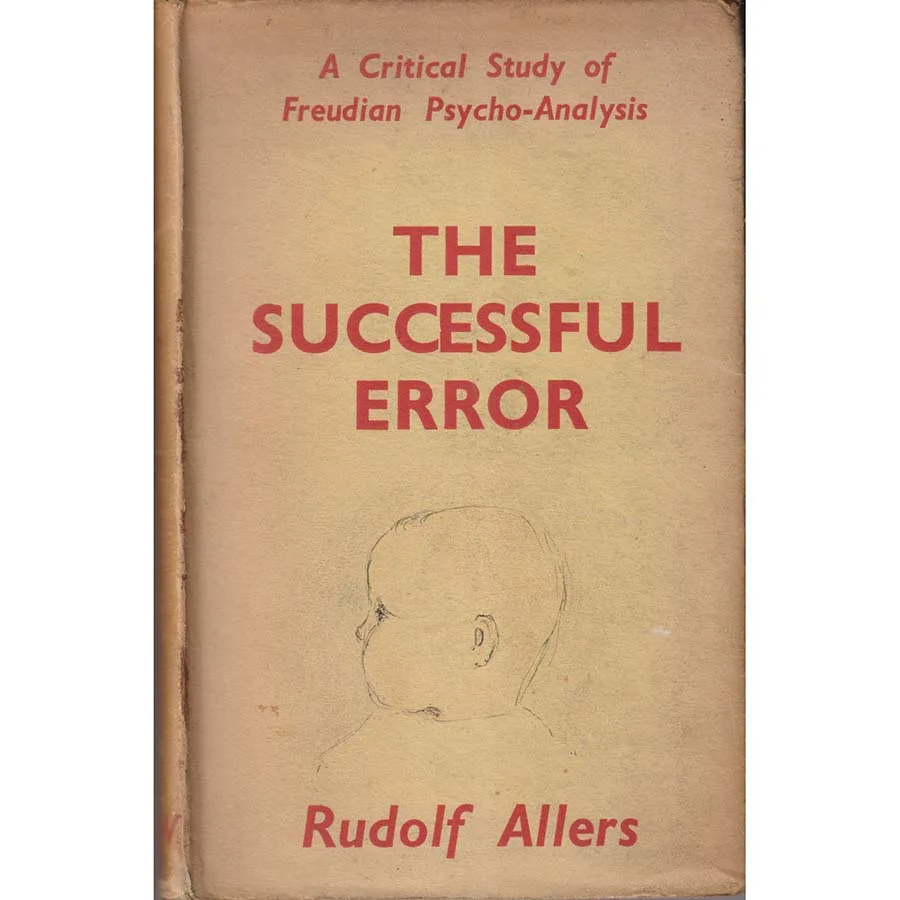
Publisher: Sheed and Ward
Format: Hardback
ISBN: none
Sigmund Freud was a remarkable man. He discovered that human beings possessed an unconscious mind, announced that practically everything could be explained through sex, childhood and repressed desires, and established a psychological movement whose followers became almost as enthusiastic about defending their master’s theories as Freud himself was about developing them. Unfortunately, Rudolf Allers had been examining the evidence and decided that the entire enterprise might require a little scrutiny.
The Successful Error: A Critical Study of Freudian Psychoanalysis (1941), by Rudolf Allers and published by Sheed and Ward, is a fascinating, intellectually combative examination of one of the most influential psychological theories of the twentieth century.
Allers was an Austrian psychiatrist who had himself been associated with the early psychoanalytic movement. Unlike critics who dismissed Freud from a position of complete unfamiliarity, Allers understood the theories, terminology and intellectual assumptions of psychoanalysis from the inside. This made his subsequent disagreement considerably more inconvenient for the faithful.
His central argument is wonderfully provocative: Freud may have been a brilliant and influential thinker, but that does not necessarily mean his explanations of human behaviour were scientifically correct.
Allers investigates the logical foundations of psychoanalysis, questioning its assumptions about unconscious motivation, repression, sexuality and the interpretation of psychological symptoms. He examines whether Freud’s theories can genuinely be tested through scientific methods or whether they constitute an elaborate philosophical system disguised in the respectable clothing of empirical investigation.
There is something deliciously ironic about this predicament. Psychoanalysis became famous for explaining why people believed things that were not necessarily true, only to encounter a critic suggesting that psychoanalysts themselves might be demonstrating precisely the same difficulty.
Allers also explores the relationship between psychology, philosophy, medicine, education and religion, bringing his own intellectual and Christian philosophical perspective to bear upon Freudian assumptions about human nature.
His criticism is not simply an exercise in declaring Freud wrong about absolutely everything. He recognises the importance of Freud’s influence and achievements while challenging the foundations upon which his grander theoretical claims were constructed.
Published in 1941, this volume captures a fascinating moment in the development of modern psychology, when psychoanalysis possessed enormous intellectual prestige but was increasingly encountering serious challenges from alternative schools of thought.
For contemporary readers, it offers both a substantial historical critique and an intriguing reminder that scientific reputations, however magnificent, should ideally remain open to examination.
Condition: Good. This 1941 Sheed and Ward edition is a previously owned copy showing ordinary signs of age, reading and handling, but remains an appealing vintage philosophical and psychological volume. Having survived more than eight decades, it has demonstrated considerably greater staying power than many once-fashionable psychological certainties.
Offered by Crappy Old Books, where we admire independent thinking, enjoy intellectual disagreements and have absolutely no intention of explaining your decision to purchase this book through unresolved childhood conflicts.
No ISBN, naturally. In 1941, books were still permitted to exist without numerical identification.
An absorbing historical work for students of psychology, philosophy and psychoanalysis, particularly those who appreciate the spectacle of an exceptionally intelligent man questioning the theories of another exceptionally intelligent man.
Freud might have had something interesting to say about Allers’s motivations. Allers, one suspects, would have demanded evidence.
Keep browsing: See more Academic books Other books by Rudolf Allers