Plain Words - A Guide To The Use Of English
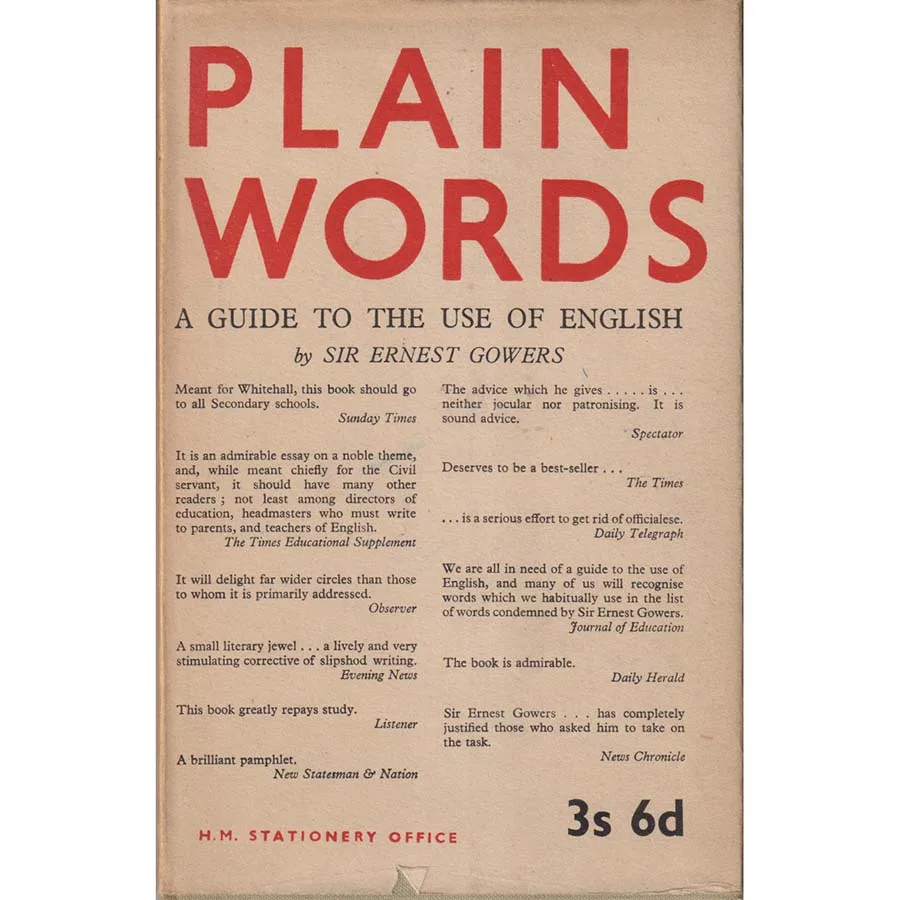
Publisher: HMSO
Format: Hardback
ISBN: none
The English language is a magnificent invention, capable of expressing profound philosophical ideas, delivering stirring political speeches and explaining that the train has been delayed because of leaves on the line. Unfortunately, it is also capable of producing sentences so spectacularly complicated that nobody, including the person who wrote them, has the faintest idea what they mean. Sir Ernest Gowers, a distinguished civil servant, decided that this nonsense had gone quite far enough.
Plain Words: A Guide to the Use of English (1948), by Sir Ernest Gowers and published by His Majesty’s Stationery Office, is a wonderfully sensible, witty and refreshingly straightforward attack upon the unnecessary complications of official English.
Originally written for members of the Civil Service, the book attempts to persuade government officials that communicating with the public need not involve constructing sentences of extraordinary length, employing unnecessarily elaborate vocabulary or disguising a simple statement beneath several layers of bureaucratic fog.
Gowers recognised that official writing had developed some remarkable peculiarities. A civil servant could transform "We have received your letter" into a paragraph of impressive administrative complexity, while an ordinary request might emerge from a government department sounding like a diplomatic treaty negotiated by several exceptionally nervous lawyers.
His solution was revolutionary in its simplicity: use familiar words, avoid unnecessary expressions, construct readable sentences and remember that the object of writing is to communicate something.
The advice extends beyond government offices to anyone who writes letters, reports, articles or other material intended to be understood by fellow human beings. Gowers examines the misuse of words, cumbersome expressions, grammatical difficulties and the unfortunate tendency to employ impressive language when ordinary language would work considerably better.
There is something deliciously ironic about a government department publishing a book explaining how government departments ought to stop writing like government departments. It suggests that somewhere within the machinery of Whitehall, somebody had finally realised that the problem might not be the public’s inability to understand official documents.
Published in 1948, the book appeared when Britain was rebuilding after the Second World War and its expanding administrative institutions were communicating with an increasingly broad public. Clear English was not merely an aesthetic preference but a practical necessity.
The original dust jacket adds considerable period charm, with its bold red lettering, enthusiastic newspaper endorsements and wonderfully confident original price of 3s 6d. Evidently, improving the nation’s command of English was once considered an affordable undertaking.
Condition: Good. This 1948 HMSO edition is a previously owned vintage copy showing ordinary signs of age and handling. The illustrated dust jacket has the attractive, slightly timeworn appearance expected of a publication approaching its eightieth birthday, and retains its distinctive period character.
Offered by Crappy Old Books, where we wholeheartedly approve of plain English, although our own decision to write several hundred words describing a book that recommends using fewer words might reasonably be regarded as a failure to follow its advice.
No ISBN, naturally. In 1948, books could still be identified without numerical assistance.
A delightful vintage reference for writers, editors, historians, civil servants and anyone who has ever received an official letter and wondered whether it was deliberately designed to prevent understanding.
In short, a good book about writing clearly. Sir Ernest would almost certainly have preferred that we left it at that.
Keep browsing: See more Academic books Other books by Ernest Gowers